
Volcan Irazu and its layered volcanic summit
Published on 09/22/2026 at 11:30 | Editorial responsibility: Rafael Müller, Editor-in-Chief AD HOC NEWS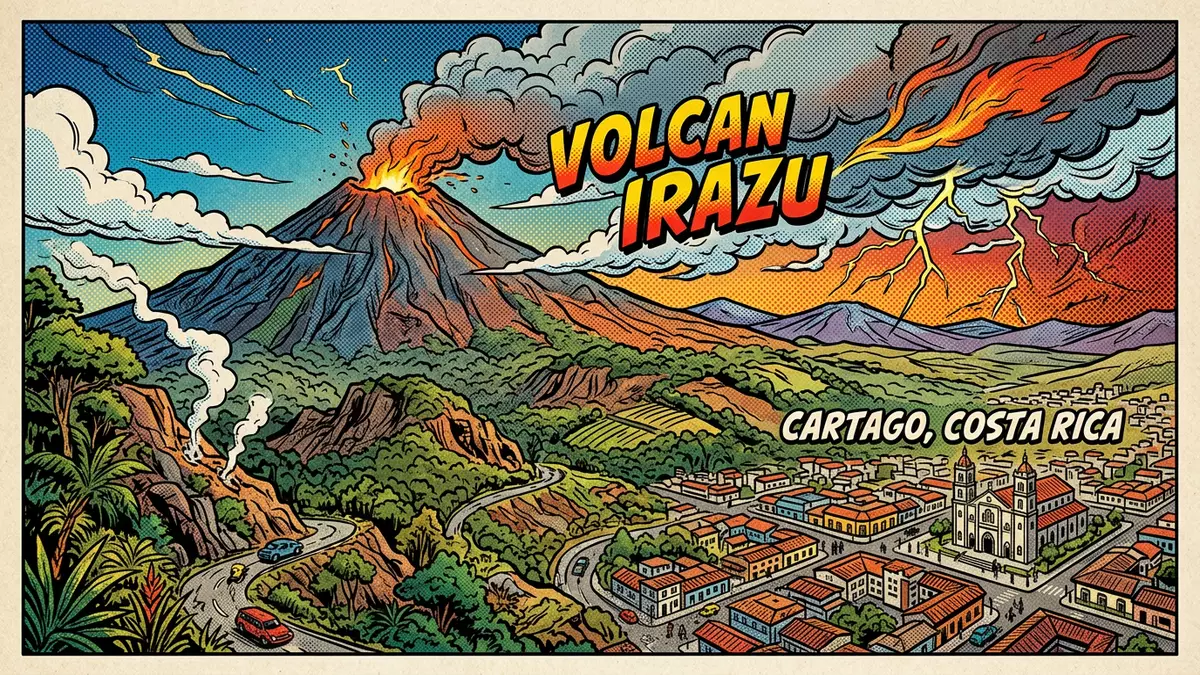
Volcan Irazu rises above Cartago as a broad volcanic summit shaped by lava, ash and overlapping crater structures. At 3,432 m (11,260 ft), it is Costa Rica’s highest volcano, with the Central Cordillera extending around its slopes.
Volcan Irazu: a summit built from lava and ash
Volcan Irazu is a complex volcanic shield with a summit formed from successive volcanic structures. Its deposits include andesite, basaltic andesite, basalt and pyroclastic rock, arranged in layers of lava flows and fragmented volcanic material.
The summit landscape contains the Principal Crater and the Diego de la Haya crater. The Principal Crater contains a shallow crater lake, while Diego de la Haya is an inactive crater to its east. Volcanic terraces and the Hermosa area separate parts of the crater complex. the crater complex includes lava flows, pyroclastic cones and older eroded volcanic forms.
From the 1723 eruption to the Cartago landscape
The first documented eruption dates from 1723, when Diego de la Haya Fernandez recorded strong volcanic activity. Eruptive phases followed during the nineteenth and twentieth centuries, leaving ash deposits and lahar channels across the western slopes.
The eruption sequence of 1963 to 1965 remains central to Volcan Irazu’s history. Ash reached Cartago and the Central Valley, while material in the Reventado River contributed to an avalanche that destroyed houses in Taras. the park’s recorded history also includes a 1994 explosion on the northern wall of the Principal Crater.
A protected volcano with several volcanic habitats
Irazú Volcano National Park was created by law in 1955 and expanded in 1988. The protected area covers volcanic terrain between the summit and lower mountain environments, including cloud forest and upland rainforest habitats.
The volcano’s Caribbean flank has deep ravines, landslide scars and rugged terrain. Its Pacific flank above Cartago has gentler slopes, while lava terraces remain visible around the upper mountain. A field of Cervantes lava lies on the southern flank. the protected volcanic landscape extends across changing elevations and vegetation zones.
Visiting Volcan Irazu: what travellers from Western Europe should know
- Volcan Irazu lies in the Central Cordillera, north-east of Cartago. The mountain road from Cartago reaches the national park and the summit area.
- The summit stands at 3,432 m (11,260 ft), so altitude forms part of the terrain. Crater viewpoints and volcanic ground occupy the upper park.
- The landscape includes ash, lava, pyroclastic rock, crater edges and a shallow lake. The Caribbean side contains ravines and landslide terrain.
- The official language is Spanish and the currency is the Costa Rican colón.
- Entry requirements depend on your nationality; UK travellers can check the FCDO travel advice at gov.uk/foreign-travel-advice, Irish travellers the Department of Foreign Affairs at ireland.ie.
Searching for Volcan Irazu on social platforms
These links open searches for Volcan Irazu on each platform.
Frequently asked questions about Volcan Irazu
Where is Volcan Irazu?
Volcan Irazu is in Costa Rica’s Central Cordillera, in Cartago Province. The summit lies north-east of the city of Cartago.
What can visitors see at Volcan Irazu?
The upper area contains a crater lake, volcanic terraces, ash deposits and several crater structures. The surrounding national park includes forest habitats and rugged volcanic slopes.
What makes Volcan Irazu distinctive?
Its summit reaches 3,432 m (11,260 ft), and its landscape combines lava, pyroclastic deposits, crater lakes and a documented eruption history beginning in 1723.


