
Volcan de Santa Ana and the ring of lava above Santa Ana
Published on 09/17/2026 at 09:53 | Editorial responsibility: Rafael Müller, Editor-in-Chief AD HOC NEWS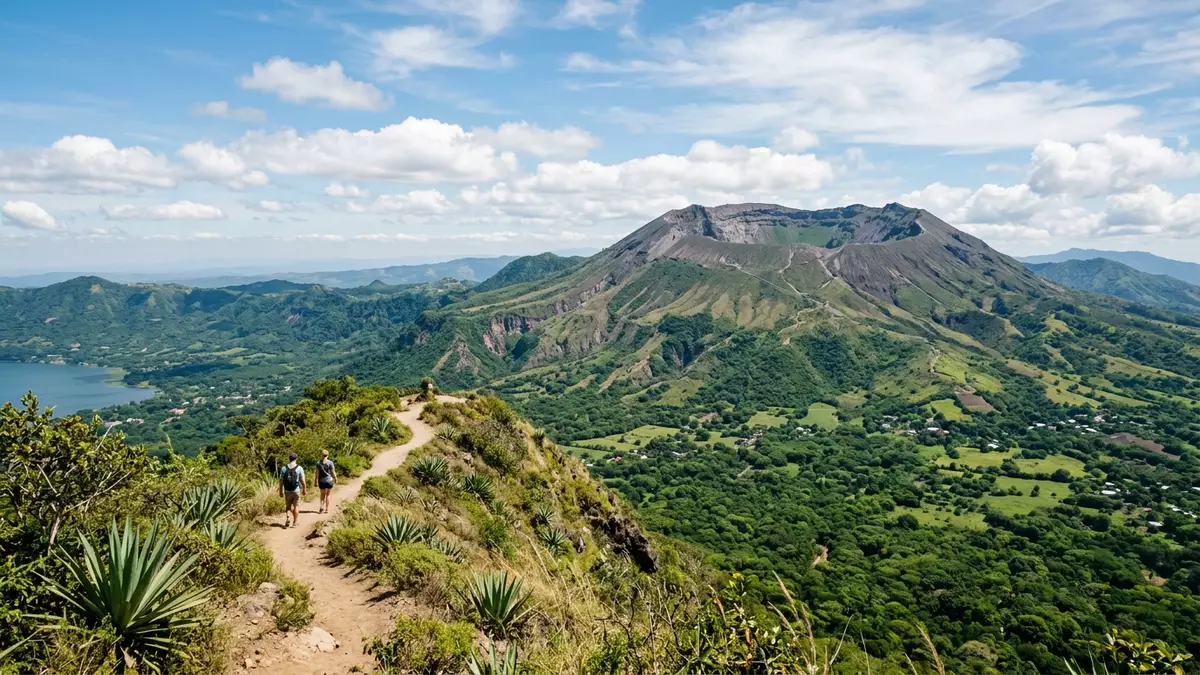
Volcan de Santa Ana, also called Ilamatepec, rises above western El Salvador as a broad stratovolcano with a summit of 2,381 m (7,812 ft). It is the highest volcano in the country and forms part of the Apaneca-Ilamatepec volcanic chain.
Volcan de Santa Ana and the volcanic highlands
The mountain stands immediately west of Coatepeque Caldera, where the slopes break into steep volcanic flanks and high ridges. Its andesitic-to-basaltic layers give the volcano its massive form and tie it to the wider geology of the region.
Santa Ana, the city and department, lie to the east and south-east, while the volcano belongs to the same highland belt as Cerro Verde and Izalco. This setting places Volcan de Santa Ana within a compact volcanic landscape rather than an isolated peak.
The crater and the summit ridge
At the top, the volcano opens into a large crater with a lake in its floor. The summit area is part of the mountain’s main visual character, because the crater sits inside the broader cone rather than at its edge.
The upper slopes are bare volcanic terrain, with dark rock, ash-coloured surfaces and a clear break between the summit bowl and the steeper outer mountain. Coatepeque Caldera lies close beside it, adding a second major landform to the same view.
Volcan de Santa Ana in the Los Volcanes landscape
Volcan de Santa Ana belongs to Los Volcanes National Park, a protected area that brings together Santa Ana, Izalco and Cerro Verde. The park sits within the Apaneca-Ilamatepec mountain range in western El Salvador.
The mountain’s shape, height and crater make it the dominant peak in that volcanic group. Its summit line, broad upper cone and deep crater distinguish it from the lower, greener hills around the park.
Visiting Volcan de Santa Ana: what travellers from Western Europe should know
- The volcano lies in western El Salvador, near Santa Ana city and the Coatepeque Caldera. The approach is through the Cerro Verde area inside Los Volcanes National Park.
- The summit area lies at 2,381 m (7,812 ft), so the upper slopes are high volcanic ground with exposed rock and a crater rim.
- The mountain belongs to a protected park landscape with Santa Ana, Izalco and Cerro Verde as the main volcanic landmarks. That gives the area a concentrated volcanic character rather than a single isolated viewpoint.
- Entry requirements depend on your nationality; UK travellers can check the FCDO travel advice at gov.uk/foreign-travel-advice, Irish travellers the Department of Foreign Affairs at ireland.ie.
Searching for Volcan de Santa Ana on social platforms
These links open searches for Volcan de Santa Ana on each platform.
Frequently asked questions about Volcan de Santa Ana
Where is Volcan de Santa Ana?
It stands in western El Salvador, in the Santa Ana department, immediately west of Coatepeque Caldera. The volcano is part of the Apaneca-Ilamatepec chain.
What does a visit involve?
The mountain is reached through the Cerro Verde side of Los Volcanes National Park. The terrain is high, rocky volcanic ground, with a summit crater and a clear elevation gain from the park area.
What makes it distinctive?
Its height, broad stratovolcano form and crater lake define it. It is also the highest volcano in El Salvador, which gives it a clear place in the country’s volcanic landscape.


