
Volcan de Santa Ana and its turquoise crater lake
Published on 09/07/2026 at 09:14 | Editorial responsibility: Rafael Müller, Editor-in-Chief AD HOC NEWS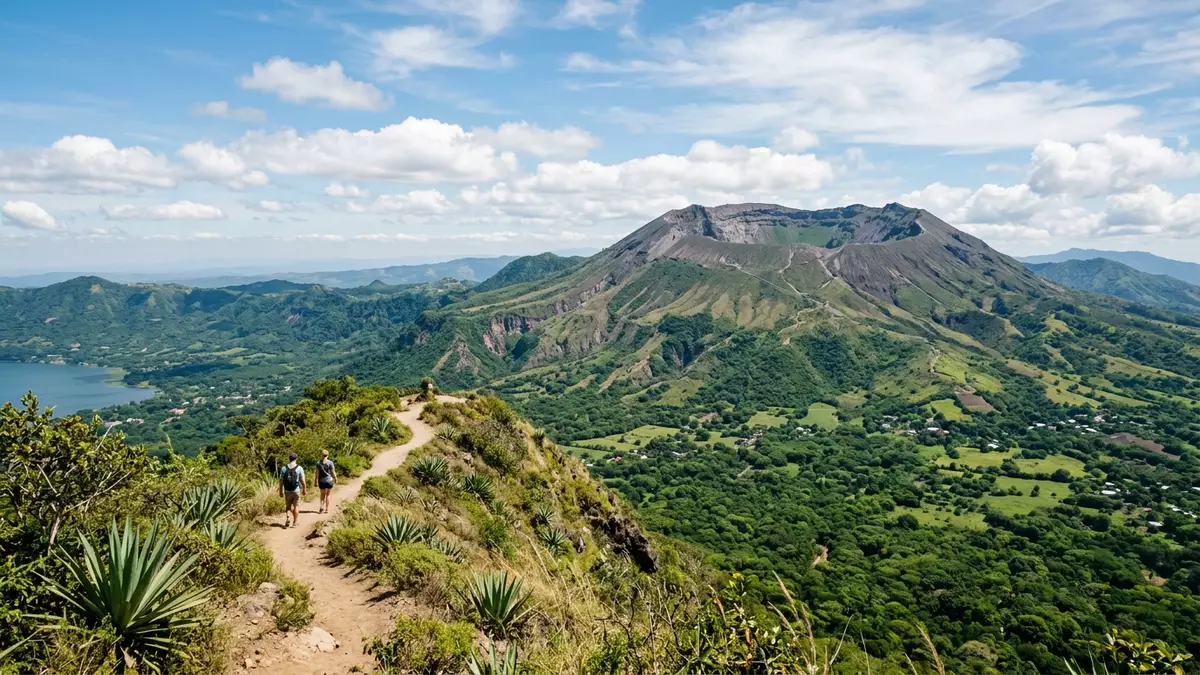
Volcan de Santa Ana, also known as Ilamatepec, is a high stratovolcano overlooking the city of Santa Ana in western El Salvador, with a summit rising to about 2,381 m (7,812 ft) above sea level.Santa Ana Volcano It is recognised as the highest volcano in El Salvador and is part of a volcanic chain that shapes the mountainous landscape of this region.El Salvador's highest volcano
A high stratovolcano above Santa Ana
Volcan de Santa Ana stands in the department of Santa Ana in western El Salvador, rising immediately west of the broad Coatepeque caldera and the lake that fills it.sits roughly 65 kilometres west The volcano forms part of the Apaneca mountain range and belongs to the Los Volcanes complex together with Izalco volcano and Cerro Verde, in a landscape of forested slopes and coffee-growing areas.parte del complejo de Los Volcanes
Geologically, Volcan de Santa Ana is an andesitic-to-basaltic stratovolcano, built from alternating layers of ash, lava and fragmented rock that give its flanks their steep, rugged form.andesitic-to-basaltic stratovolcano Its summit elevation of about 2,381 m (7,812 ft) makes it not only the country’s highest volcano but also one of its most conspicuous mountain peaks, with the upper slopes rising clearly above the surrounding ridges.highest point in El Salvador
The turquoise crater lake and summit craters
The summit area of Volcan de Santa Ana is marked by several nested craters, cut into the upper cone and giving the mountain a distinctive stepped profile near the top.four identifiable craters Within the innermost crater lies a vivid turquoise-coloured acid lake, a relatively small body of water surrounded by bare volcanic rock, whose colour contrasts with the darker material of the crater walls.turquoise-coloured acid crater lake
The present crater at the summit has a diameter of about 1.5 km and reaches a depth of several hundred metres, with fumaroles and gaseous vents marking areas of continuing activity within the floor.present crater about 1.5 km in diameter The combination of this large crater, its nested form and the strongly coloured lake has made the summit of Volcan de Santa Ana a distinctive feature within the Los Volcanes area and a clear expression of the volcano’s recent geological history.cráter con laguna turquesa
Eruptive history in western El Salvador
Volcan de Santa Ana has documented eruptions dating back to the sixteenth century, with the first historical record noted in 1520 and further events in 1904, 1920 and 2005.first historic eruption of Santa Ana was in 1520últimas erupciones ocurrieron en 1904, en 1920 y en 2005 The 2005 eruption was a notable explosive event that drew international scientific attention, with ash emissions and changes in the summit crater lake being documented in detail by monitoring programmes.erupted on 1 October 2005
In terms of volcanological classification, Volcan de Santa Ana is assessed at level 3 on the Volcanic Explosivity Index, indicating eruptions that are moderate in scale but capable of producing significant ash plumes and crater changes.Índice de explosividad volcánica nivel 3 The volcano’s activity is characterised by small to moderate explosive eruptions rather than large caldera-forming events, and monitoring efforts focus on the evolution of the crater lake and gas emissions as indicators of unrest.crater lake evolution during volcanic unrest
Visiting Volcan de Santa Ana: what travellers from Western Europe should know
- Volcan de Santa Ana rises south-west of the city of Santa Ana in western El Salvador, with access routes starting from the Los Volcanes area in the Apaneca range.
- The ascent towards the summit area involves mountain paths across volcanic rock and soil, with sustained gradients and sections of uneven, sometimes loose ground.
- Coatepeque caldera and its lake lie to the east of Volcan de Santa Ana, forming a broad water-filled depression that is visible from various points on the volcano’s slopes.
- The official language is Spanish and the currency is the United States dollar.
- Entry requirements depend on your nationality; UK travellers can check the FCDO travel advice at gov.uk/foreign-travel-advice, Irish travellers the Department of Foreign Affairs at ireland.ie.
Searching for Volcan de Santa Ana on social platforms
These links open searches for Volcan de Santa Ana on each platform.
Frequently asked questions about Volcan de Santa Ana
Where is Volcan de Santa Ana located?
Volcan de Santa Ana is situated in the department of Santa Ana in western El Salvador, immediately west of Coatepeque caldera and its lake.
What can visitors expect when reaching the summit area?
Visitors reaching the summit area encounter a large crater cut into the cone, with nested summit craters and a turquoise crater lake surrounded by bare volcanic rock.
What makes Volcan de Santa Ana distinctive among El Salvador’s volcanoes?
Volcan de Santa Ana is distinctive as the country’s highest volcano and for its summit crater with a vividly coloured acid lake set within several nested craters.


