
Volcan de Santa Ana and its turquoise crater lake
Published on 08/29/2026 at 16:42 | Editorial responsibility: Rafael Müller, Editor-in-Chief AD HOC NEWS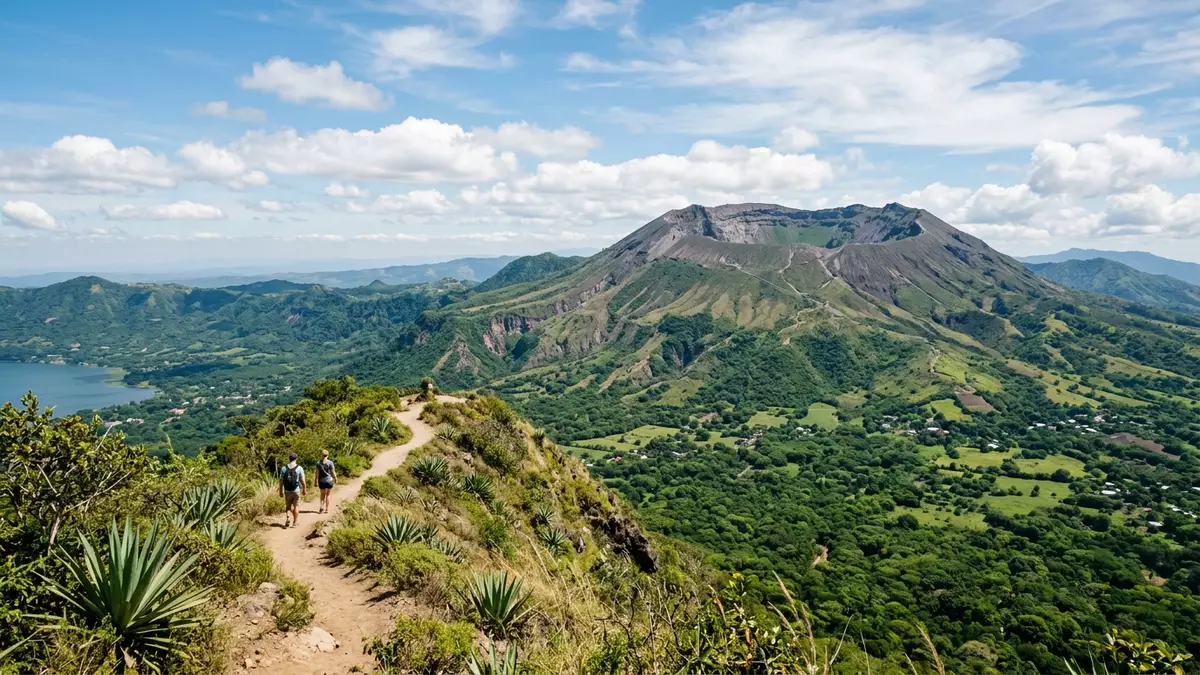
Volcan de Santa Ana, also known as Ilamatepec, is a stratovolcano in the department of Santa Ana in western El Salvador, rising as the country’s highest volcanic peak.
The highest volcano above Santa Ana
Volcan de Santa Ana stands in the Santa Ana department of El Salvador, forming a dominant volcanic mass west of the broad depression of Coatepeque Caldera.Santa Ana, El Salvador's highest volcano The mountain is widely recognised as a stratovolcano, built from successive layers of ash and solidified lava that give its flanks a sturdy, stepped profile.Santa Ana Volcano or Ilamatepec is a large stratovolcano
The peak reaches 2,381 m (7,812 ft) above sea level, making Volcan de Santa Ana the highest volcano in El Salvador and one of the country’s most prominent summits.the volcano is 2,381 metres above sea level Its upper slopes form part of the Los Volcanes complex, alongside neighbouring peaks such as Izalco and Cerro Verde, in a region known for coffee-growing estates and montane forest.
A summit crater with an acid lake
The summit of Volcan de Santa Ana is marked by a broad crater structure, with nested depressions that show the volcano’s long eruptive history.a flat and almost circular crater of 1.5 km in diameter Within the innermost basin lies a compact crater lake, whose waters take on vivid turquoise and greenish hues linked to volcanic gases and dissolved minerals.the volcano's summit crater contains a vivid turquoise acid lake
Scientific surveys around the turn of the century recorded the lake as strongly acidic, with very low pH values and temperatures well above the surrounding air, fed by underwater springs and high-temperature fumaroles along the crater walls.bathymetric survey carried out in 2000-2002 confirmed a bowl-shaped lake From the crater rim, the view extends from the lake and inner walls down the outer flanks towards Coatepeque Caldera and the agricultural landscapes below.
Activity, eruptions and monitoring
Volcan de Santa Ana has a documented record of eruptions stretching back centuries, with notable events in 1904, 1920 and 2005 that underline its status as an active volcano.sus últimas erupciones ocurrieron en 1904, en 1920 y en 2005 The 2005 eruption was a phreatomagmatic event in which interaction between magma and the summit lake generated an explosion that expelled water and volcanic material from the crater.on October 1, 2005, El Salvador's Santa Ana Volcano erupted
Research carried out before and after that eruption has focused on the evolution of the crater lake, tracking changes in its depth, chemistry and temperature as indicators of volcanic unrest.crater lake evolution at Santa Ana Volcano Volcan de Santa Ana is monitored by national and international institutions, which keep watch on its fumarolic activity and lake conditions to understand ongoing processes within this large stratovolcano.
Visiting Volcan de Santa Ana: what travellers from Western Europe should know
- Volcan de Santa Ana rises west of Lake Coatepeque in the Santa Ana department of El Salvador, with approaches that commonly pass through the Los Volcanes area and nearby settlements.
- The ascent to the summit crater involves walking on volcanic terrain, with sustained gradients and sections of loose ash and rock that demand steady footing and appropriate footwear.
- The crater rim and approach paths stand at considerable altitude above sea level, and the exposed upper slopes can bring strong sun and changing cloud cover even during a single visit.
- The official language is Spanish and the currency is the United States dollar.
- Entry requirements depend on your nationality; UK travellers can check the FCDO travel advice at gov.uk/foreign-travel-advice, Irish travellers the Department of Foreign Affairs at ireland.ie.
Searching for Volcan de Santa Ana on social platforms
These links open searches for Volcan de Santa Ana on each platform.
Frequently asked questions about Volcan de Santa Ana
Where is Volcan de Santa Ana located?
Volcan de Santa Ana stands in the Santa Ana department of western El Salvador, immediately west of Coatepeque Caldera and within the Los Volcanes region.
What can visitors expect at the summit?
At the summit, visitors encounter a broad crater with nested depressions and a brightly coloured acid lake, alongside steep inner walls and views over surrounding volcanic and agricultural landscapes.
What makes Volcan de Santa Ana distinctive among Central American volcanoes?
Volcan de Santa Ana is distinctive for combining the highest volcanic summit in El Salvador with an accessible crater holding a vivid acid lake that has been closely studied and monitored.


