
Volcan de Santa Ana and its turquoise crater lake
Published on 08/27/2026 at 06:23 | Editorial responsibility: Rafael Müller, Editor-in-Chief AD HOC NEWS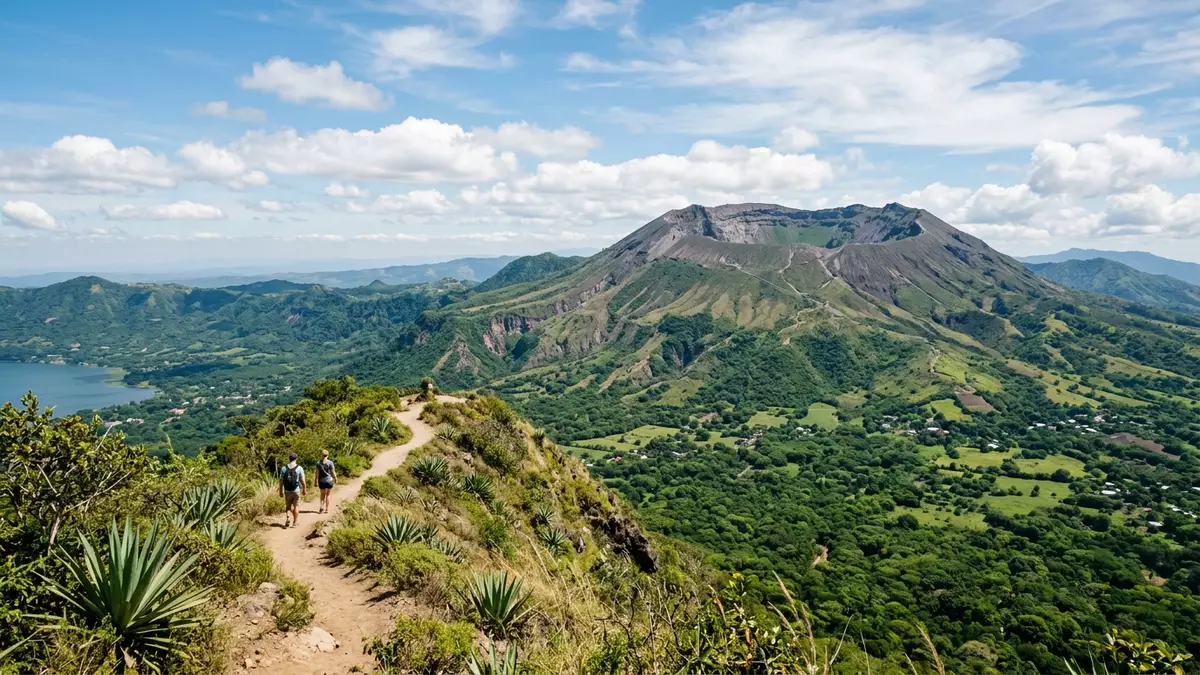
Volcan de Santa Ana, also known as Ilamatepec, is a high stratovolcano overlooking the city of Santa Ana in western El Salvador, rising to about 2,381 m (7,812 ft) above sea level in the Apaneca mountain range. Its summit crater holds a small turquoise lake, and the volcano forms part of a wider Los Volcanes complex that shapes a landscape of cloud forest and coffee plantations.
A layered volcano above Santa Ana
Volcan de Santa Ana stands in the department of Santa Ana in western El Salvador, immediately west of the large Coatepeque caldera and its lake, in a chain of volcanic peaks that mark this part of Central America.The volcano stands about 2,381 m (7,812 ft) above sea level, a height that makes it a dominant feature in the region and a reference point on clear days from the surrounding lowlands.
The volcano is a classic stratovolcano, built of layers of andesitic and basaltic rock, with flanks that fall away towards a belt of rural communities and coffee farms between Santa Ana and the shores of Lake Coatepeque.Geological surveys describe it as a massive andesitic-to-basaltic cone, and its profile sits alongside the neighbouring peaks of Izalco and Cerro Verde, which together form the Los Volcanes complex within the Apaneca range.
Crater rims and a turquoise lake
One of the most striking features of Volcan de Santa Ana is the arrangement of nested craters near its summit, where several rims sit inside one another like a stack of bowls eroded and reshaped by centuries of eruptions.Descriptions of the volcano note a small sulphurous lake in the main crater, a pool of mineral-rich water that takes on a vivid turquoise colour against pale rock.
The lake sits below a ring of bare volcanic rock, stained in places by minerals and framed by vents where gases emerge from the ground.Monitoring reports describe the crater lake as strongly acidic, and the broader summit area carries traces of recent activity in the form of altered rock and small fumaroles that dot the inner slopes of the crater.
Activity, history and landscape
Volcan de Santa Ana has a recorded history of eruptions extending back to the sixteenth century, with documented events in 1904, 1920 and 2005 that remind visitors and residents that this is an active volcanic system.The 2005 eruption produced explosions at the summit, and subsequent observation has placed the volcano in a monitored, dormant state within El Salvador’s national network of volcanic surveillance.
The surrounding landscape forms part of a protected area commonly known as the Los Volcanes complex, where Volcan de Santa Ana, Izalco and Cerro Verde rise above a patchwork of forest and cultivated land.Visitor information from the country’s tourism authorities places the volcano within a tropical cloud forest and coffee-growing region west of San Salvador, and the approach to the mountain passes viewpoints over Lake Coatepeque and the surrounding ridges.
Visiting Volcan de Santa Ana: what travellers from Western Europe should know
- Volcan de Santa Ana rises west of the city of Santa Ana in western El Salvador, with access routes leading through Cerro Verde National Park and rural roads that climb towards the Los Volcanes area.
- The ascent from the park involves a marked trail across uneven volcanic rock and compacted ash, and the final approach to the crater follows exposed slopes at altitude where weather conditions can change quickly.
- The surrounding area includes other named peaks such as Izalco and Cerro Verde, along with viewpoints over Lake Coatepeque, so a visit to Volcan de Santa Ana often combines several volcanic landscapes in one journey.
- The official language is Spanish and the currency is the United States dollar, and entry requirements depend on your nationality; UK travellers can check the FCDO travel advice at gov.uk/foreign-travel-advice, Irish travellers the Department of Foreign Affairs at ireland.ie.
Searching for Volcan de Santa Ana on social platforms
These links open searches for Volcan de Santa Ana on each platform.
Frequently asked questions about Volcan de Santa Ana
Where is Volcan de Santa Ana located?
Volcan de Santa Ana is in the department of Santa Ana in western El Salvador, immediately west of Coatepeque caldera and its lake, in the Apaneca mountain range.
What can visitors expect when reaching the summit?
The summit area includes nested crater rims and a small turquoise crater lake, with bare volcanic rock, mineral staining and visible vents where gases escape from the ground.
What makes Volcan de Santa Ana distinctive among Central American volcanoes?
Volcan de Santa Ana combines its status as El Salvador’s highest volcano with a strongly acidic turquoise crater lake and a setting within the multi-peaked Los Volcanes complex.


