
Volcan Arenal, the volcanic cone above La Fortuna
Published on 08/29/2026 at 22:03 | Editorial responsibility: Rafael Müller, Editor-in-Chief AD HOC NEWS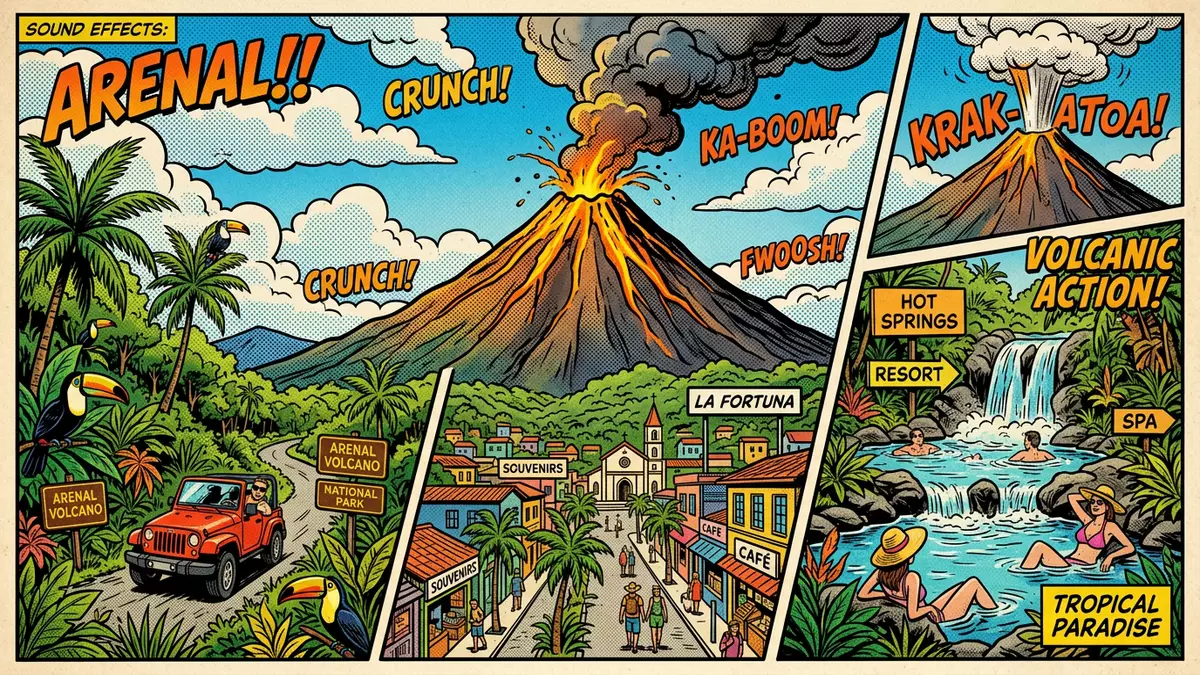
Volcan Arenal rises above La Fortuna in northern Costa Rica as a steep volcanic cone, framed by rainforest slopes and the protected landscape of Arenal Volcano National Park. Standing 1,670 m (5,479 ft) high, this andesitic stratovolcano dominates the northern lowlands and has shaped a region where forest, lava fields and lake views gather around one mountain.
A rainforest stratovolcano in northern Costa Rica
Volcan Arenal is an andesitic stratovolcano in the Alajuela Province of Costa Rica, in the canton of San Carlos and the district of La Fortuna.andesitic stratovolcano The cone rises to 1,670 m (5,479 ft) above sea level, making it one of the higher peaks of the country’s northern volcanic chain.1,670 m elevation The mountain stands between the foothills of the Cordillera de Tilarán and the San Carlos plains, close to the eastern shores of Lake Arenal, the largest inland lake in Costa Rica.between the Cordillera de Tilaran and the San Carlos plains
The volcano forms the centre of Arenal Volcano National Park, a protected area that covers forested slopes, older lava flows and views across Lake Arenal.Arenal Volcano National Park La Fortuna lies to the east of the volcano and serves as a gateway town for visitors heading towards the park and the lake.gateway town La Fortuna From the surrounding roads and trails, the cone presents a markedly symmetrical outline, rising directly above pasture, secondary forest and patches of primary rainforest.
Eruptive history and the 1968 reawakening
Arenal’s documented eruptive history extends back several thousand years, with periods of major explosive activity separated by long intervals of relative quiet.earliest known eruptions about 7,000 years ago For centuries before the twentieth century reawakening, the volcano showed no large eruptions and was regarded locally as dormant. That changed dramatically on 29 July 1968, when a violent lateral blast on the western flank destroyed nearby villages and marked the beginning of a long open-vent eruption.violent reactivation on 29 July 1968
The eruptive period that began in July 1968 continued for more than four decades, ending in 2010.eruption ended in December 2010 During these years, activity included explosive eruptions, strombolian jets of lava, slow blocky lava flows, lava avalanches and pyroclastic flows from summit vents and upper western-flank vents.explosive and effusive activity between 1968 and 2010 The western side of the cone carries younger lava fields and deposits from this phase, while older slopes elsewhere show forest regrowth over previous eruptions. Since 2010, no further eruption has been recorded, and the mountain is regarded as being in a resting phase, with its modern profile largely shaped by the twentieth-century activity.
Landscape of forest, lava and lake
Seen from La Fortuna and the surrounding hills, Volcan Arenal rises out of a landscape where rainforest, farmland and water meet at relatively low altitude. Lake Arenal spreads to the west and north-west of the mountain, its enlarged basin formed in part by a hydroelectric project that turned the area into a key energy and tourism region for Costa Rica.lake enlarged by hydroelectric project The lower slopes carry secondary forest and older pastures, while sections of primary rainforest survive within the park and in neighbouring reserves.trails along extensive rainforest
Within Arenal Volcano National Park, trails cross lava flows created during the 1992 phase of the eruption, leading towards viewpoints of the cone and over the forest canopy.lava flows that fell in 1992 The terrain combines hardened lava, volcanic ash soils and deep-rooted trees, including a ceiba specimen described as more than 400 years old, which stands as a reminder of pre-eruption forest.ceiba tree over 400 years old Away from the park trails, views of Volcan Arenal are woven into the wider landscape of hot springs resorts, rural settlements and the waters of Lake Arenal, where the volcano forms a constant backdrop to daily life in and around La Fortuna.
Visiting Volcan Arenal: what travellers from Western Europe should know
- Volcan Arenal lies in northern Costa Rica, in Alajuela Province near the town of La Fortuna, reached by road from San José through San Carlos and the Lake Arenal area.
- Within Arenal Volcano National Park, paths cross uneven lava fields and forest slopes, with sections over rough volcanic rock and roots that demand sure footing.
- In the vicinity of Volcan Arenal, the terrain ranges from lowland rainforest to the shores of Lake Arenal, so visitors encounter humid forest, open pasture and lakeside viewpoints on the same trip.
- Spanish is the official language and the currency is the Costa Rican colón.
- Entry requirements depend on your nationality; UK travellers can check the FCDO travel advice at gov.uk/foreign-travel-advice, Irish travellers the Department of Foreign Affairs at ireland.ie.
Searching for Volcan Arenal on social platforms
These links open searches for Volcan Arenal on each platform.
Frequently asked questions about Volcan Arenal
Where is Volcan Arenal located?
Volcan Arenal stands in northern Costa Rica, in Alajuela Province near La Fortuna, between the Cordillera de Tilarán foothills and the San Carlos plains within Arenal Volcano National Park.
What can visitors expect on a visit to Volcan Arenal?
Visitors encounter a steep volcanic cone rising over rainforest, older lava fields and Lake Arenal, with trails in the national park leading across lava and forest to viewpoints.
What makes Volcan Arenal distinctive among Costa Rican volcanoes?
Volcan Arenal is the youngest stratovolcano in Costa Rica and its modern cone was strongly shaped by the eruptive period that began in 1968 and ended in 2010.


