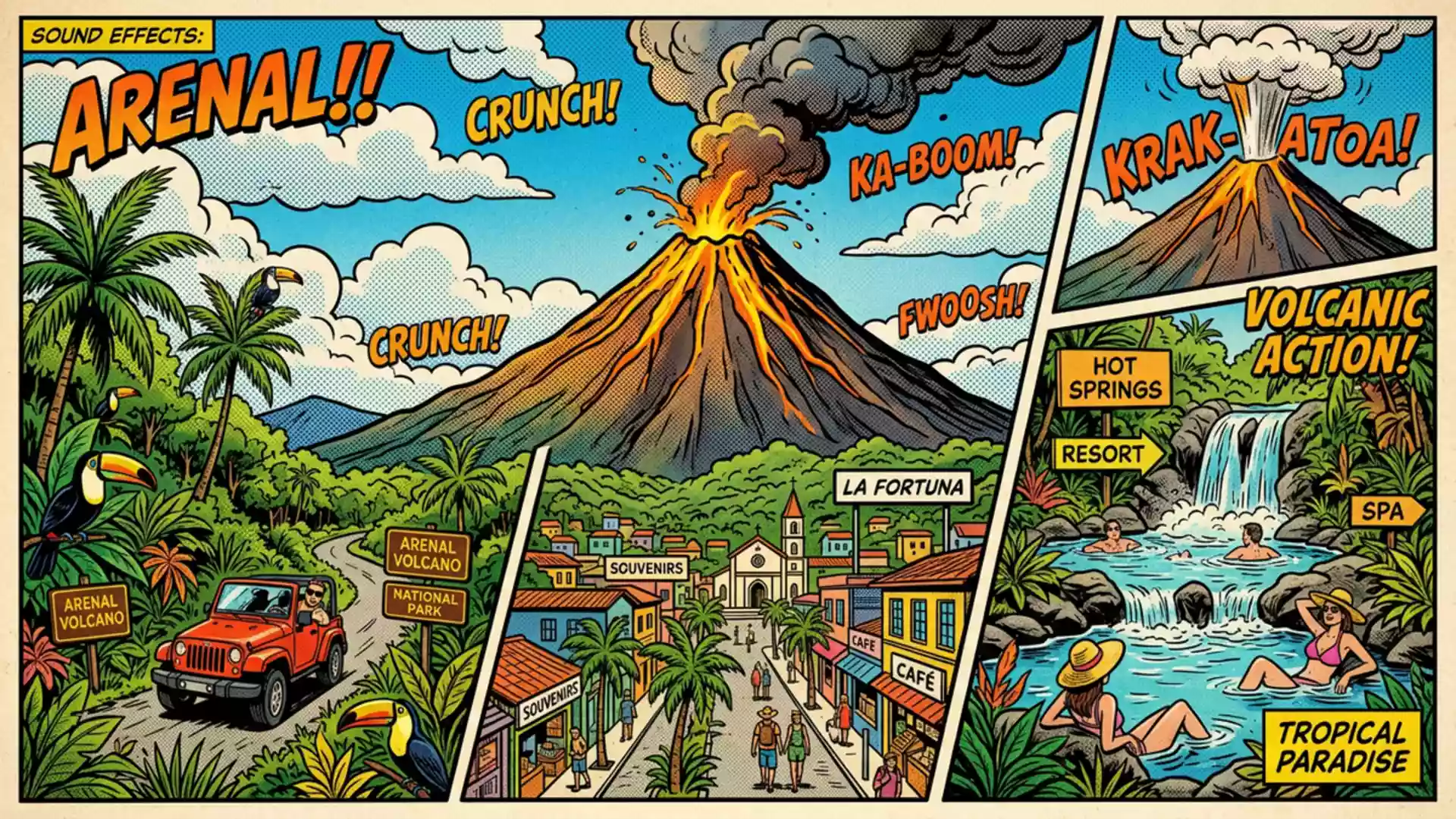
Volcan Arenal, the perfect cone above La Fortuna
Published on 09/02/2026 at 20:44 | Editorial responsibility: Rafael Müller, Editor-in-Chief AD HOC NEWS
Volcan Arenal is the dominant landmark above La Fortuna in northern Costa Rica, a steep-sided cone that rises abruptly from forest and farmland. Its regular silhouette, coupled with the surrounding rainforest and nearby hot springs, makes this stratovolcano one of the most recognisable volcanic forms in Central America.
The volcanic cone and its setting
Volcan Arenal stands in the province of Alajuela, in the canton of San Carlos and the district of La Fortuna, in the northern zone of Costa Rica.Arenal Volcano The cone rises to about 1,670 m (5,479 ft) above sea level, giving it clear prominence over the surrounding lowlands.1670-m-high andesitic volcano It is an andesitic stratovolcano, built from successive layers of lava and fragmental material, which gives its flanks a markedly uniform slope broken by gullies and younger lava deposits.
The volcano rises close to the eastern shores of Lake Arenal, a large artificial lake used for hydroelectric generation, and lies between the foothills of the Cordillera de Tilarán and the plains of San Carlos.towers above the eastern shores of Lake Arenal Forested slopes climb towards the summit, with areas of secondary growth and older trees where lava flows have cooled and been colonised. On clear days the cone forms a dramatic backdrop to La Fortuna, with its upper slopes often catching cloud and mist above the lower forest.
Arenal Volcano National Park and protection
Volcan Arenal sits within Arenal Volcano National Park, a protected area created in 1991 that preserves the volcano itself and surrounding rainforest, old lava flows and viewpoints.park was established September 30, 1991 The park forms part of Costa Rica’s wider network of conservation areas managed under the Northern Cordillera Volcanica Huetar Arenal programme, which links volcanic landscapes with forest and river corridors.Arenal Volcano National Park - SINAC
Marked trails in the national park cross old lava fields and patches of primary and secondary forest, giving views towards the cone and across Lake Arenal. Some routes pass near a large ceiba tree estimated to be several centuries old, which stands out above the surrounding canopy and represents the long natural history of the area.impressive ceiba tree over 400 years old From certain clearings and miradors, visitors can see the smooth upper slopes of Volcan Arenal and, lower down, the rougher, darker belts of more recent lava.
Activity, geology and neighbouring peaks
The earliest known eruptions of Volcan Arenal date back several thousand years, with activity recognised from around 7,000 years before present onwards.earliest known eruptions For long periods the volcano alternated between explosive phases and quieter episodes of lava effusion that added new material to the cone. In late July 1968 a major explosive eruption opened new vents on its western flank and began an eruptive period that lasted until 2010, building thick lava tongues and pyroclastic deposits that are still visible on the slopes.open-vent eruption at Arenal volcano 1968–2010
Arenal belongs to a volcanic chain that includes the older Cerro Chato, whose summit holds a lake-filled crater.Cerro Chato volcano For a span of millennia the two centres were active concurrently before Cerro Chato’s activity ceased. The alignment of these peaks reflects the regional tectonic and magmatic setting of northern Costa Rica, where the Central American volcanic arc crosses the country and gives rise to several stratovolcanoes rising above forested lowlands and cultivated valleys.
Visiting Volcan Arenal: what travellers from Western Europe should know
- Volcan Arenal lies close to La Fortuna in northern Costa Rica, reached overland from San José and other cities by roads that lead towards Lake Arenal and the national park.Located 15 kilometers from Fortuna
- Trails within Arenal Volcano National Park cross uneven ground, old lava flows and forest paths, and some viewpoints require walking over rocky sections rather than smooth pavements.Arenal Volcano National Park is 29,692 acres in size
- The volcano stands at about 1,670 m (5,479 ft), so approaches involve modest altitude compared with high alpine terrain, but weather on the slopes can bring cloud and rain that affect visibility.
- The official language is Spanish and the currency is the Costa Rican colón.
- Entry requirements depend on your nationality; UK travellers can check the FCDO travel advice at gov.uk/foreign-travel-advice, Irish travellers the Department of Foreign Affairs at ireland.ie.
Searching for Volcan Arenal on social platforms
These links open searches for Volcan Arenal on each platform.
Frequently asked questions about Volcan Arenal
Where is Volcan Arenal located?
Volcan Arenal stands in northern Costa Rica, in the province of Alajuela, near the town of La Fortuna and close to the eastern shores of Lake Arenal.
What can visitors expect on a visit to Volcan Arenal?
Visitors encounter a steep volcanic cone rising from forest, trails across old lava flows and rainforest, and viewpoints that frame the volcano with Lake Arenal and surrounding hills.
What makes Volcan Arenal distinctive among Costa Rican volcanoes?
Its regular cone, long eruptive period from 1968 to 2010 and position above Lake Arenal within a dedicated national park give Volcan Arenal a particularly clear and dramatic profile.