
Volcan Arenal and the steep rainforest cone above La Fortuna
Published on 09/18/2026 at 17:24 | Editorial responsibility: Rafael Müller, Editor-in-Chief AD HOC NEWS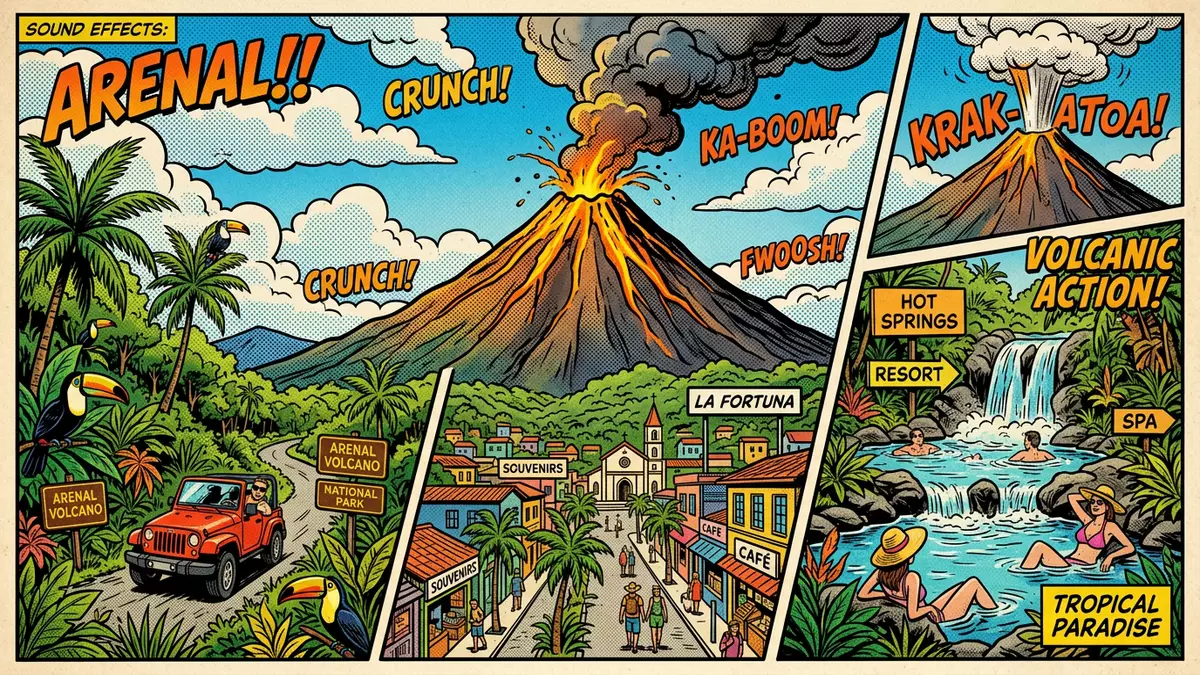
Volcan Arenal rises above La Fortuna in northern Costa Rica as a steep volcanic cone where dark rock, rainforest and old lava flows meet around one mountain in Arenal Volcano National Park. The cone stands in Alajuela Province in the canton of San Carlos and the district of La Fortuna, forming a prominent landmark in the northern zone of Costa Rica and anchoring the protected landscapes around it.Alajuela Province in San Carlos
The cone of Volcan Arenal and its setting
Volcan Arenal is an andesitic stratovolcano with a steep cone that rises to about 1,633 m (5,358 ft) above sea level, giving it a strong profile against the surrounding lowlands.approximately 5,358 feet (1,633 m) The mountain sits near the eastern shore of Lake Arenal, with the waters of the reservoir spread out to the west and the plains of San Carlos to the north and east.Located on the eastern shore of Lake Arenal Between the volcano and the lake, rolling foothills carry pasture, secondary forest and access roads, while closer to the cone the slopes become markedly steeper and more rugged.
The volcano stands between the foothills of the Cordillera de Tilarán mountain range and the lowlands of northern Costa Rica, in a zone where humid tropical air masses feed dense forest on the lower slopes.between the Cordillera de Tilarán and San Carlos plains The cone retains a near-symmetrical outline when seen from many vantage points, with its upper slopes formed of loose volcanic material and lava, and its lower flanks softened by vegetation, ravines and fans of older deposits.a steep volcanic cone rising above the town La Fortuna lies to the north-east of the cone, with streets and lodgings set against views of its upper slopes, so that the volcano forms a constant presence in the background of the town.
Geology, eruptions and Arenal Volcano National Park
Geologically, Volcan Arenal is part of the Central American Volcanic Arc formed by the subduction of the Cocos Plate beneath the Caribbean Plate, and it is characterised as a stratovolcano built from layers of lava flows and explosive deposits.an andesitic stratovolcano in the Central American Volcanic Arc Studies of its deposits indicate that the volcano is relatively young in geological terms, with the earliest known eruptions dating back around 7,000 years, overlying much older regional tuffs and sedimentary rocks.earliest known eruptions about 7,000 years ago Its rock is mainly basaltic andesite, and over millennia Arenal has grown through alternating periods of major explosive eruptions and quieter phases dominated by lava flows that stabilise the cone.
A major event on 29 July 1968 opened new craters on the western flank and began a long eruptive phase in which lava flows, Strombolian explosions and pyroclastic activity reshaped the cone until activity quietened in 2010.1968 lateral blast and activity until 2010 During those decades the volcano was regarded as one of the most active in Costa Rica and the wider region, with almost continuous effusive and explosive activity from the summit area and the upper flanks.last known eruption 2010 CE To safeguard the landscape, Costa Rica established Arenal Volcano National Park in 1991, protecting the cone, neighbouring Chato Volcano and surrounding forest over an area of about 121 km² as part of the Arenal Huetar Norte Conservation Area.Arenal Volcano National Park established in 1991
Trails, forest and views around La Fortuna
Within Arenal Volcano National Park, a network of signed trails leads through lowland and premontane rainforest, secondary growth and old lava fields, enabling visitors to experience the contrast between living forest and the raw surfaces of past eruptions.trails along extensive and authentic rainforest Some paths cross hard, blocky lava from the 1992 flows, where vegetation is beginning to recolonise the rough stones, while others pass towering trees, including a ceiba believed to be several centuries old, and areas where wildlife moves through dense foliage.
Outside the park boundaries, viewpoints and lodges around La Fortuna frame Volcan Arenal with foregrounds of pastureland, forest patches and water, offering wide views towards the cone and the lake beyond.rainforest, lava flows and lake views gather Hot springs resorts draw on geothermal heat from the region, pairing pools and landscaped gardens with views of the volcano’s upper slopes, while roadside lay-bys and miradores offer simpler vantage points for observing the cone, its ravines and the changing light on its flanks.
Visiting Volcan Arenal: what travellers from Western Europe should know
- Volcan Arenal stands in northern Costa Rica in Alajuela Province, near the town of La Fortuna, and is reached over public roads that link the region with San José and other centres.
- Marked trails within Arenal Volcano National Park include sections over uneven lava fields and forest paths with roots, slopes and occasional steps, requiring sure footing and appropriate footwear.
- Lower slopes around La Fortuna lie in humid tropical forest where rain showers are frequent, and cloud often gathers around the upper cone, affecting visibility of the summit.
- The official language is Spanish and the currency is the Costa Rican colón.
- Entry requirements depend on your nationality; UK travellers can check the FCDO travel advice at gov.uk/foreign-travel-advice, Irish travellers the Department of Foreign Affairs at ireland.ie.
Searching for Volcan Arenal on social platforms
These links open searches for Volcan Arenal on each platform.
Frequently asked questions about Volcan Arenal
Where is Volcan Arenal located?
Volcan Arenal is in northern Costa Rica in Alajuela Province, within the canton of San Carlos and the district of La Fortuna, at the centre of Arenal Volcano National Park.
What should visitors expect on a visit to Volcan Arenal?
Visitors can expect views of a steep volcanic cone, forested lower slopes, signed trails through rainforest and old lava flows, and regional hot springs resorts that frame the volcano.
What makes Volcan Arenal distinctive among Costa Rican volcanoes?
Volcan Arenal is distinctive for its relatively young stratovolcano cone, its documented eruptive history over about 7,000 years, and its role as the focal point of Arenal Volcano National Park near La Fortuna.


