
Volcan Arenal and the perfect volcanic cone above La Fortuna
Published on 09/15/2026 at 08:44 | Editorial responsibility: Rafael Müller, Editor-in-Chief AD HOC NEWS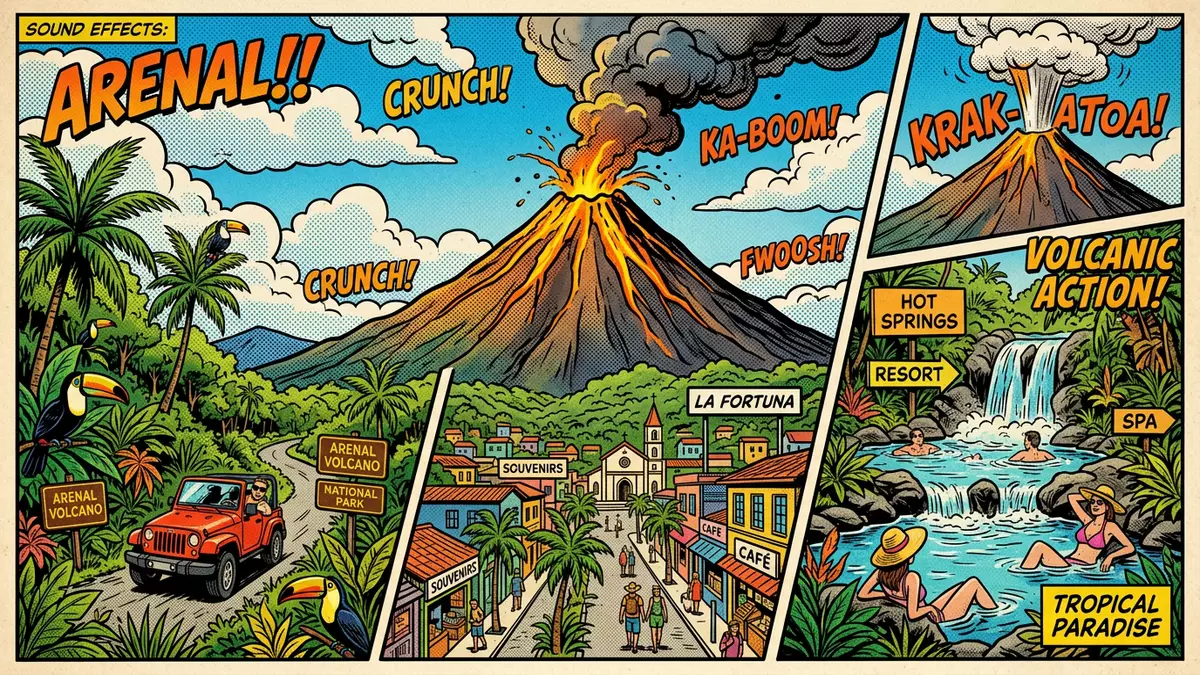
Volcan Arenal is a near-perfect volcanic cone rising above the town of La Fortuna in northern Costa Rica, combining recent volcanic history with lush tropical forest. The volcano is part of Arenal Volcano National Park and forms one of the most recognisable silhouettes in the country’s northern zone.
A conical stratovolcano in northern Costa Rica
Volcan Arenal is an andesitic stratovolcano in the Alajuela Province of north-western Costa Rica, in the canton of San Carlos and district of La Fortuna. Its summit reaches well over 1,600 m (about 5,300 ft) above sea level, and the cone rises steeply above surrounding foothills, giving the mountain a distinctly symmetrical profile that is visible from many points around La Fortuna.andesitic stratovolcano in Costa Rica The volcano stands near the eastern shores of Lake Arenal, the country’s largest inland lake, which has been enlarged by hydroelectric works and forms a broad sheet of water against the lower slopes.above the eastern shores of Lake Arenal
The wider volcanic setting places Arenal within the Central America Volcanic Arc, a chain of volcanoes running along the region’s Pacific margin. The cone forms the youngest known stratovolcano in Costa Rica, rising on the southern margin of Lake Arenal and occupying a central position within Arenal Volcano National Park.youngest stratovolcano in Costa Rica To the south-east lies the older Chato volcano, part of the same protected area, while forest and pastureland surround the base of Arenal itself, creating alternating views of open slopes and dense vegetation.
From long dormancy to twentieth-century eruptions
For centuries Arenal lay dormant, its cone forming a quiet backdrop to farms and forest in northern Costa Rica. That apparent calm ended abruptly on 29 July 1968, when a violent explosive eruption began after this long interval of quiescence.violent explosion on 29 July 1968 Over the following three days, new craters opened on the western flank and pyroclastic flows and ash devastated nearby villages, causing dozens of fatalities and altering the landscape around the mountain.three new craters on the western flank
The 1968 eruption marked the beginning of a long open-vent eruptive phase that extended into the early twenty-first century. Researchers describe this episode as lasting until 2010, with activity passing through several distinct phases characterised by changes in magma supply, explosive behaviour and cone evolution.1968–2010 open-vent eruption During these decades, the volcano produced frequent strombolian eruptions, lava flows and gas emissions, making Arenal one of the best-known active volcanoes in Costa Rica and giving visitors regular night-time views of glowing material on the slopes. Activity decreased around 2010, and the volcano has since been described as dormant, with no lava or explosive eruptions recorded over recent years.quiet since 2010 with no lava or explosions
Arenal Volcano National Park and the surrounding landscape
Volcan Arenal stands at the centre of Arenal Volcano National Park, a protected area in Costa Rica’s northern zone that combines volcanic terrain, secondary forest and areas of regenerating pasture.Arenal Volcano National Park in the northern zone Trails in the park cross old lava fields, patches of woodland and viewpoints where the cone rises above tree canopies and the waters of Lake Arenal. From certain vantage points, visitors can see the scarred western flank where the 1968 craters opened, contrasting with smoother slopes on other sides of the mountain.
The wider landscape around La Fortuna features rivers, forested hills and geothermal activity linked to the volcanic system. Hot springs resorts use naturally heated water, while viewpoints north of the volcano look across pastures towards the lake and the distant Guanacaste mountains. Within the national park, designated miradors provide clear sightlines to the summit when clouds permit, and the juxtaposition of lake, cone and forest gives Arenal a distinctive spatial setting among Costa Rican volcanoes.1657-m-high andesitic volcano above Lake Arenal
Visiting Volcan Arenal: what travellers from Western Europe should know
- Volcan Arenal rises south-west of the town of La Fortuna in northern Costa Rica, with access by road from the wider region and signed routes leading towards Arenal Volcano National Park.
- The terrain around the volcano includes uneven lava fields and forest paths, and certain viewpoints require walking on rocky ground with moderate gradients.
- Lake Arenal lies near the volcano’s western side, and roads along its shore give views of the cone rising above the water and surrounding pasture.
- The official language is Spanish and the currency is the Costa Rican colón.
- Entry requirements depend on your nationality; UK travellers can check the FCDO travel advice at gov.uk/foreign-travel-advice, Irish travellers the Department of Foreign Affairs at ireland.ie.
Searching for Volcan Arenal on social platforms
These links open searches for Volcan Arenal on each platform.Frequently asked questions about Volcan Arenal
Where is Volcan Arenal located?
Volcan Arenal is in Alajuela Province in northern Costa Rica, near the town of La Fortuna and close to the eastern shores of Lake Arenal.
What can visitors expect when visiting Volcan Arenal?
Visitors see a steep volcanic cone rising above forest, lava fields and pasture, with trails and viewpoints in Arenal Volcano National Park offering different perspectives on the mountain and nearby lake.
What makes Volcan Arenal distinctive among Costa Rican volcanoes?
Its symmetrical cone, documented twentieth-century eruptive phase from 1968 to 2010 and setting above Lake Arenal together give Volcan Arenal a distinctive profile within Costa Rica’s volcanic landscape.


