
Vizcaya Museum and Gardens turns Miami into an Italian villa
Published on 09/23/2026 at 14:04 | Editorial responsibility: Rafael Müller, Editor-in-Chief AD HOC NEWS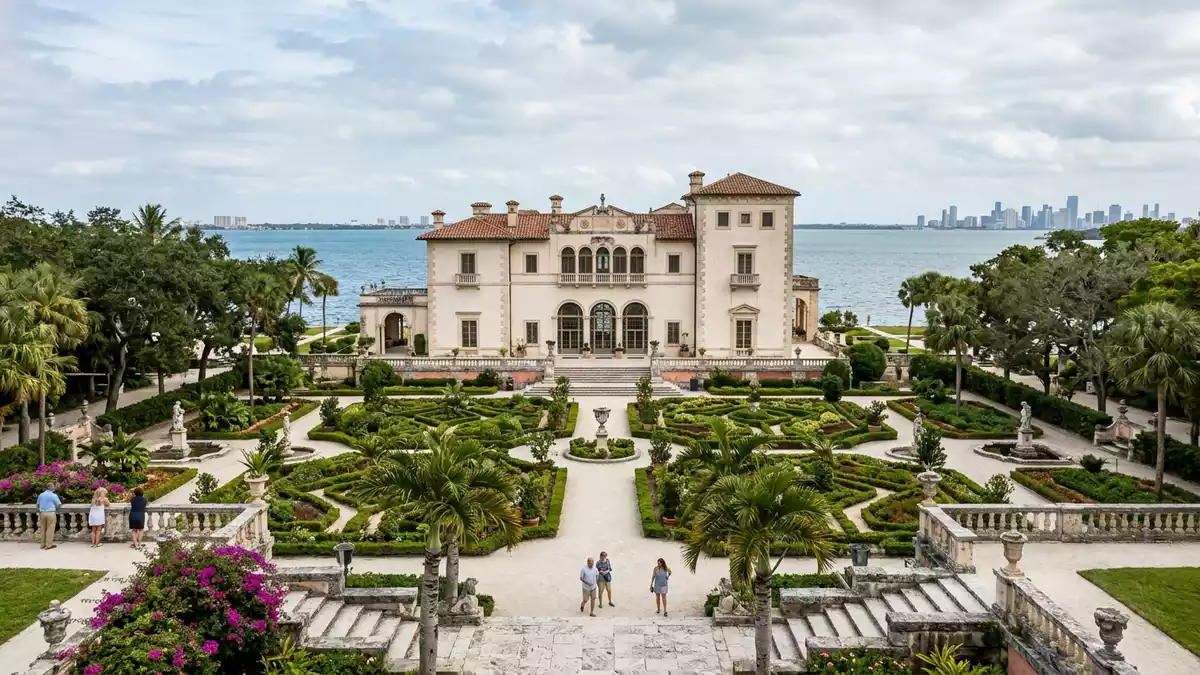
Vizcaya Museum and Gardens places a Mediterranean-style villa, formal gardens and Biscayne Bay in one carefully composed Miami estate. Built for industrialist James Deering between 1914 and 1922, the property combines eighteenth-century Italian references with reinforced concrete, early twentieth-century technology and tropical planting.
Vizcaya’s Main House and its Mediterranean language
The Main House stands in Coconut Grove on the shore of Biscayne Bay. Its architectural vocabulary recalls country villas in Italy’s Veneto region, with terraces, loggias, elaborate interiors and a courtyard at the centre of the living quarters.
James Deering took up his first winter residency on 25 December 1916. The house was designed by F. Burrall Hoffman, with Paul Chalfin directing the decorative programme and Diego Suarez shaping the gardens. The Main House history records the building’s period and its connection with Deering.
Behind the Baroque appearance sits a technically advanced residence. Reinforced concrete, generators, water filtration, lifts, refrigeration, ventilation and an automated telephone switchboard belonged to the house’s early twentieth-century character.
Rooms assembled from art, furniture and architectural fragments
Vizcaya’s interiors are arranged around objects as much as around rooms. Reception rooms, the Library, Music Room and Dining Room surround the central courtyard, while the upper level contains bedrooms, a Breakfast Room and the kitchen.
Paul Chalfin drew on several Italian traditions rather than following one historical style. Rooms evoke Milan, Palermo and Venice, while furniture from the Rococo, Neoclassical, Renaissance and Napoleonic periods appears within richly decorated ensembles.
The collection extends from ancient objects to works associated with Deering’s era. Furniture, panelling, gates, fireplaces, paintings and sculpture form part of the architectural setting, while the interiors retain a deliberately layered appearance.
The gardens continue this dialogue between old and new. Statues, busts, vases and urns stand among tropical vegetation, with sculpture ranging from antiquity and the Renaissance to twentieth-century works.
Ten acres of Italianate gardens beside Biscayne Bay
Diego Suarez designed the ten-acre gardens between 1914 and 1917. His plan adapts Renaissance and Baroque garden forms to Miami’s subtropical landscape, using formal areas, water features, terraces, planting and sculpture.
A monumental sculpture by Filippo Barigioni forms the centre of the Fountain Garden. The Barge by Alexander Stirling Calder lies in the water before the Main House, shaped as a boat and decorated with carvings of mythical Caribbean creatures.
The gardens also contain a Roman altar, eighteenth-century sculptures and works by artists including Gaston Lachaise, Charles Cary Rumsey and Robert Winthrop Chanler. The ten-acre gardens form part of a wider historic landscape that includes subtropical forest ecosystems and the estate’s former service village.
Vizcaya Museum and Gardens became a public museum in 1953. Its designation as a National Historic Landmark dates from 1994, giving the estate a formal place within the recorded heritage of the United States.
Visiting Vizcaya Museum and Gardens: what travellers from Western Europe should know
- Vizcaya Museum and Gardens is at 3251 South Miami Avenue in Coconut Grove, south of central Miami and beside Biscayne Bay. The Metrorail station named Vizcaya serves the area.
- The estate combines indoor rooms with formal gardens, terraces, waterfront edges and landscaped paths. Visitors move between architectural interiors and an open subtropical setting.
- The Main House contains several levels, while the gardens include changes in elevation, steps, paved routes and water features.
- The official language is English and the currency is the United States dollar.
Searching for Vizcaya Museum and Gardens on social platforms
These links open searches for Vizcaya Museum and Gardens on each platform.
Frequently asked questions about Vizcaya Museum and Gardens
Where is Vizcaya Museum and Gardens?
Vizcaya Museum and Gardens is in Coconut Grove, Miami, at the edge of Biscayne Bay. Its address is 3251 South Miami Avenue.
What can visitors see there?
The estate contains the Main House, decorated interiors, formal gardens, sculptures, terraces, waterfront features and surviving subtropical forest landscapes.
What makes the estate distinctive?
Its distinctive character comes from the combination of an Italianate villa, early twentieth-century technology, historical collections and ten acres of formal gardens beside the bay.


