

Vinicunca’s mineral stripes above Cusco’s high plateau
Published on 09/03/2026 at 12:09 | Editorial responsibility: Rafael Müller, Editor-in-Chief AD HOC NEWS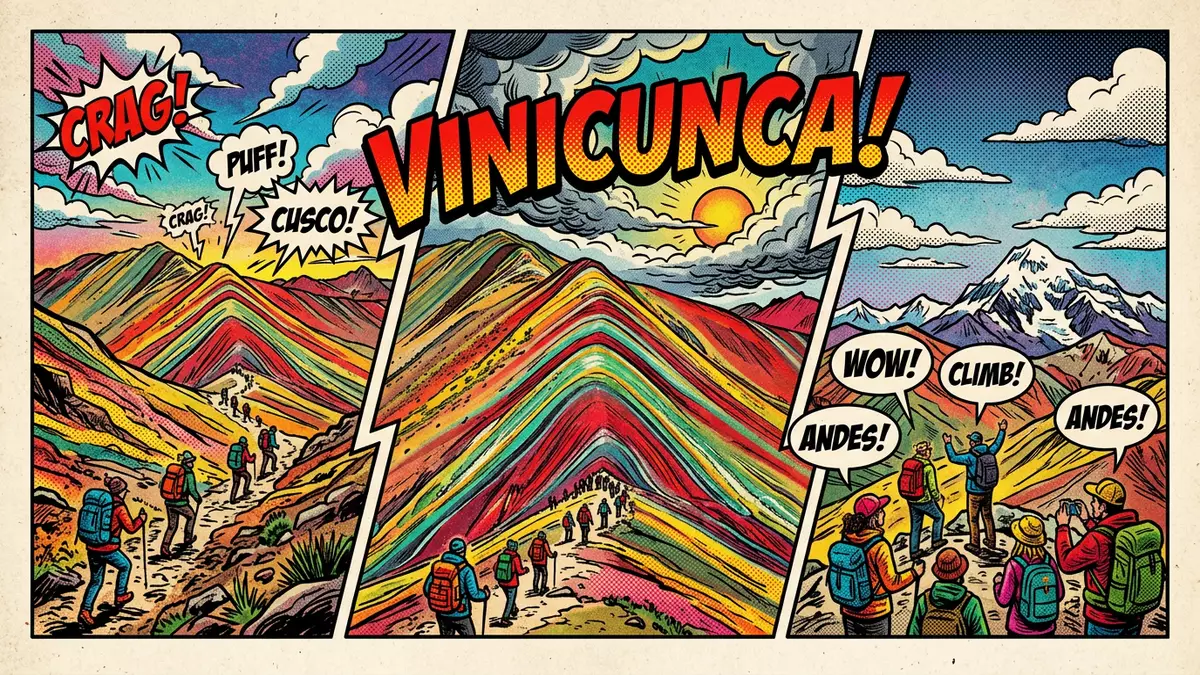
Vinicunca, also known in English as Rainbow Mountain, rises above the high plateau southeast of Cusco with slopes banded in distinct mineral colours. This Andean peak in the Cusco region reaches a summit of about 5,036 m (16,522 ft) above sea level, placing it among the higher accessible viewpoints in southern Peru.
A striped Andean mountainside of minerals and altitude
Vinicunca forms part of the Vilcanota range in the Peruvian Andes, a chain that also includes the glaciated massif of Ausangate to the east.The mountain stands in the Cusco region between the districts of Cusipata and Pitumarca, on the high ground south-east of the city of Cusco.Its summit lies at an elevation of roughly 5,036 m above sea level. Travellers reach the area after a drive through upland valleys and then a final approach on foot across open grazing land.
The name Vinicunca appears alongside several Spanish-language names, including Montaña de Siete Colores, Montaña de Colores and Montaña Arcoíris. These labels all point to the same feature: a shoulder of mountain where layers of sedimentary rock emerge as parallel coloured bands that follow the slope. On clear days the contrast between the mineral stripes and the pale sky above the ridge underlines how high the viewpoint stands above the surrounding plateau.
The geological palette behind “Rainbow Mountain”
The colour effect that gives Vinicunca its rainbow associations comes from the chemistry of its rocks rather than from vegetation. Iron-rich sediments contribute red and pink tones, while other minerals add shades that range from yellow to green and bluish hues along the exposed bands.The result is a sequence of stripes that run across the mountainside in lines that can be followed for considerable distances. In dry conditions, the lack of dense plant cover on these slopes leaves much of the bare rock visible, emphasising the colour differences between adjacent layers.
Vinicunca belongs to the broader geological setting of the southern Peruvian Andes, where uplift and erosion have exposed ancient marine and fluvial sediments. Over long periods, changes in oxygen levels, water content and mineral deposition produced contrasting bands within these deposits.At Vinicunca these bands appear on a high ridge near Ausangate, creating a colour scheme that stands out against the more uniform tones of nearby peaks. Standing at the viewpoint, visitors see not a single block of colour but a sequence of natural stripes that wrap around the contours of the mountain.
Vinicunca’s place in the Cusco highlands
Vinicunca lies within the administrative boundaries of the Cusco region, between the provinces of Quispicanchi and Canchis, on land used by highland communities for grazing.Access routes branch off the main road that links Cusco with the high plateau towards Puno, climbing towards the Vilcanota range before ending at trailheads above 4,000 m (13,123 ft). From these starting points, a path follows gently rising ground and then steeper slopes to a viewpoint that faces the striped mountain flank. The air at these altitudes is thin and the landscape largely treeless, with views that extend across open valleys towards snow-covered summits.
The mountain also sits in a cultural landscape shaped by Quechua-speaking communities, whose livelihoods in this part of the Andes centre on herding and small-scale agriculture. Place names such as Winikunka and references to Ausangate as an important apu, or mountain spirit, reflect long-running local relationships with this high terrain.The route towards Vinicunca passes hamlets and pastureland before rising above the last scattered houses. From the viewpoint near the ridge, the striped slope of Vinicunca forms the focal point, but the broader setting of high passes, distant glaciers and wide skies remains an integral part of the experience.
Visiting Vinicunca: what travellers from Western Europe should know
- Vinicunca lies south-east of Cusco in the Peruvian Andes, in the Cusco region between the districts of Cusipata and Pitumarca. Access usually combines road travel from Cusco with a final section on foot along a high-altitude trail.
- The approach path runs across open highland terrain above 4,000 m (13,123 ft), with a noticeable gradient near the final viewpoint. Visitors follow a trodden route over compacted earth and stone, with sections that feel steep at altitude.
- Vinicunca stands in Peru, where the official language is Spanish and the currency is the Peruvian sol.
- Entry requirements depend on your nationality; UK travellers can check the FCDO travel advice at gov.uk/foreign-travel-advice, Irish travellers the Department of Foreign Affairs at ireland.ie.
Searching for Vinicunca on social platforms
These links open searches for Vinicunca on each platform.Frequently asked questions about Vinicunca
Where is Vinicunca?
Vinicunca is a mountain in the Vilcanota range of the Peruvian Andes, in the Cusco region of Peru, south-east of the city of Cusco.
What should visitors expect on a visit to Vinicunca?
Visitors can expect a high-altitude hike across open Andean terrain to a viewpoint facing a mountainside striped with mineral colours, with thin air and broad views.
What makes Vinicunca distinctive among Andean peaks?
Vinicunca is distinctive for its clearly visible bands of red, yellow, green and other hues, formed by exposed mineral layers that create a natural striped pattern across the slope.


