

Vinicunca and the mineral stripes of Rainbow Mountain
Published on 08/30/2026 at 14:31 | Editorial responsibility: Rafael Müller, Editor-in-Chief AD HOC NEWS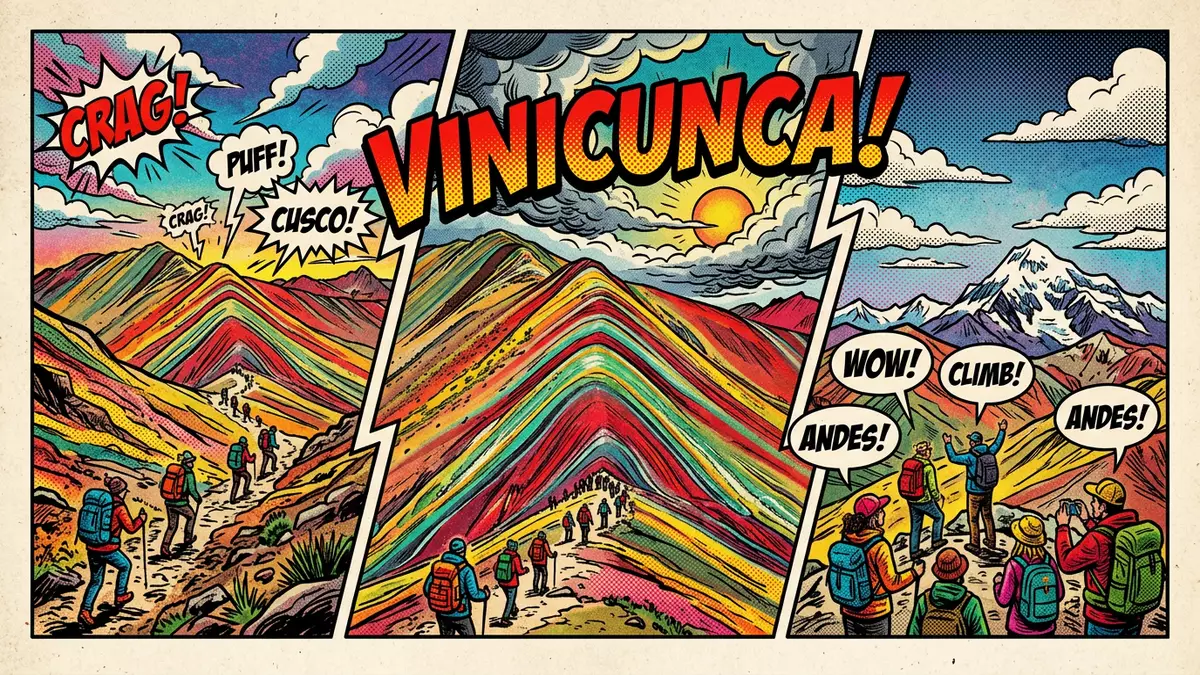
Vinicunca in the Cusco region of Peru is a high Andean mountain whose slopes are marked by vivid mineral stripes, giving rise to its English name Rainbow Mountain. The peak lies on the road towards Ausangate in the Vilcanota range and reaches an altitude above 5,000 m (around 16,400 ft), placing it firmly in thin-air terrain.
Vinicunca in the Vilcanota range
Vinicunca sits within the Vilcanota section of the Andes south-east of Cusco, in the southern highlands of Peru. The mountain forms part of a broader high plateau and ridge system linked to Ausangate, a glaciated summit that dominates this part of the range.the Cusco region Administratively, Vinicunca lies between the districts of Cusipata in the province of Quispicanchi and Pitumarca in the province of Canchis, a border that follows the high ground rather than the valley floors.Cusipata and Pitumarca districts
The summit of Vinicunca is given in several sources at around 5,036 m (16,522 ft) above sea level, with some topographic data placing the highest points of the ridge closer to 5,200 m (17,060 ft).5,036 m above sea levelaltitude of 5,200 metres This elevation places the viewpoint and summit ridge well above the surrounding valleys, which already sit at around 4,000 m (13,100 ft), and frames the coloured slopes against pale highland grassland and distant snowfields.
The striped geology of Rainbow Mountain
The lead characteristic of Vinicunca is the series of coloured bands that run across its flanks, formed by sedimentary strata that have been lifted and exposed by Andean tectonics.bands of pink, red, green, brown and yellow These layers are not painted or artificially treated; they are geological formations in which differing mineral contents give each band its dominant hue. The effect is most striking on the main slope facing the approach trail, where strips of red, pink, cream, green and brown stand out against the surrounding earth tones.
Geological studies of Vinicunca and neighbouring ridges link the red and pink tones to iron oxides in claystones and other iron-rich rocks, the yellow and mustard shades to sulphur-bearing sandstone, and the white areas to calcium carbonate-rich marl and quartzose sandstone.distinct layers of sedimentary rockminerals behind the colours Green and turquoise bands are associated with minerals such as chlorite and other copper-related compounds, while earthier brown tones arise from magnesium-rich rock. Over millions of years these differing deposits settled in layers, were compressed, and then uplifted as the Nazca and South American plates collided, giving Vinicunca its stratified appearance.
Names, altitude and Andean context
Vinicunca is known by several names in Spanish and Quechua alongside its primary name. Local communities refer to it as Montaña de Siete Colores, Montaña Arcoíris and Montaña de Colores, names that all highlight the coloured bands on its slopes.Montaña de Siete Colores In Quechua, forms such as Winikunka appear, reflecting indigenous naming patterns in the region. English-language usage generally settles on Rainbow Mountain as a descriptive alternative, but Vinicunca remains the name tied to the specific peak and its ridge.
The mountain stands within a cultural landscape where Ausangate has long held significance as an apu, a revered high peak in Andean belief. Approaches to Vinicunca pass highland pasture and small settlements where llamas and alpacas graze, and the broader area combines mineral-rich slopes with glaciated summits and cold high-altitude wetlands.Rainbow Mountain natural setting The coloured ridge itself forms one part of this wider landscape, and its viewpoint looks back towards Ausangate and across the Vilcanota range.
Visiting Vinicunca: what travellers from Western Europe should know
- Vinicunca lies south-east of Cusco in the Cusco region of Peru, reached by road towards the villages around Pitumarca and Cusipata and then by a high-altitude walking trail.
- The terrain is high Andean ground with a trail that climbs from around 4,300 m (14,100 ft) to above 5,000 m (16,400 ft), demanding steady walking on unpaved paths and awareness of altitude.
- The area around Vinicunca forms part of a wider highland landscape near Ausangate, with exposed slopes, limited shelter and weather that can change quickly at elevation.
- The official language is Spanish and the currency is the Peruvian sol.
- Entry requirements depend on your nationality; UK travellers can check the FCDO travel advice at gov.uk/foreign-travel-advice, Irish travellers the Department of Foreign Affairs at ireland.ie.
Searching for Vinicunca on social platforms
These links open searches for Vinicunca on each platform.Frequently asked questions about Vinicunca
Where is Vinicunca located in relation to Cusco?
Vinicunca lies in the Cusco region of Peru, south-east of the city of Cusco, between the districts of Cusipata and Pitumarca in the Andean highlands.
What should visitors expect on a visit to Vinicunca?
Visitors can expect a high-altitude trail on unpaved ground, cold Andean conditions and views of a mountain slope striped by coloured mineral bands above a broad valley.
What makes Vinicunca distinctive among Andean peaks?
Vinicunca is distinctive for the banded sedimentary layers on its slopes, where differing mineral contents create parallel stripes of red, pink, green, yellow and brown.


