
Villa Cimbrone and the cliff?edge gardens of Ravello
Published on 09/18/2026 at 22:11 | Editorial responsibility: Rafael Müller, Editor-in-Chief AD HOC NEWS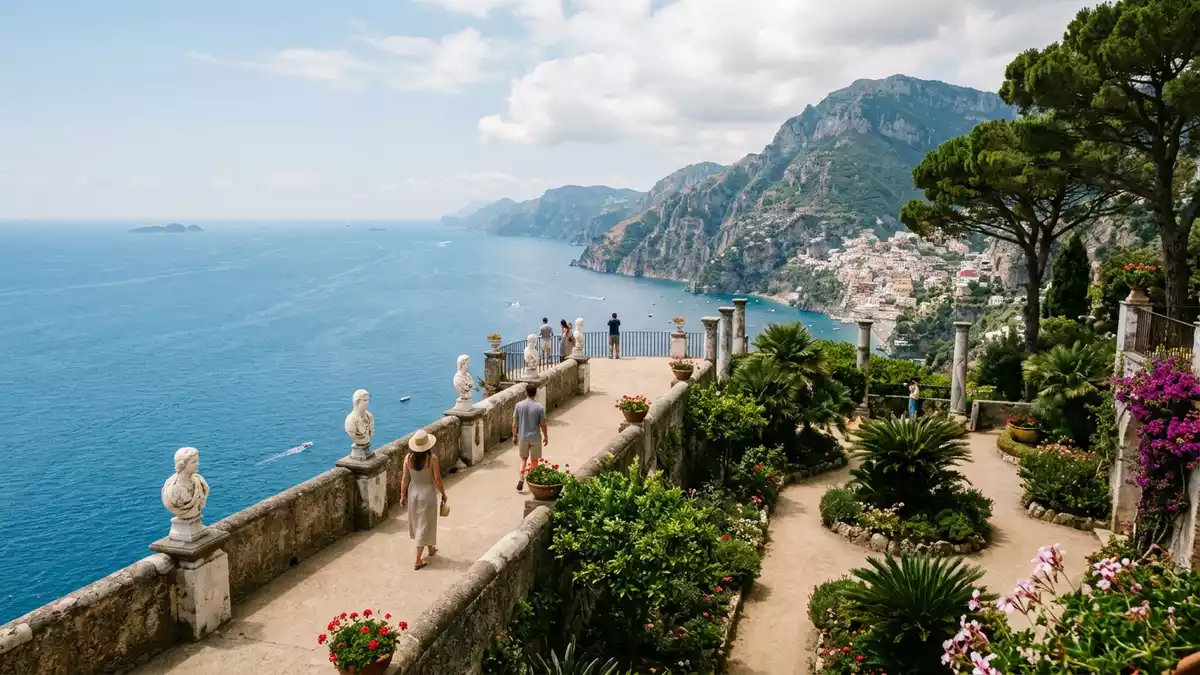
High above the Amalfi Coast in southern Italy, Villa Cimbrone combines a medieval estate with an early twentieth?century transformation and gardens that culminate in the celebrated Terrace of Infinity. Set on the rocky outcrop once known as Cimbronium, the villa overlooks the Tyrrhenian Sea and links Ravello’s long history with the cosmopolitan culture that reshaped it in the 1900s.
A medieval estate on a rocky outcrop
Villa Cimbrone stands on a projecting spur of rock on the southern edge of Ravello, facing the coast far below. The name comes from “Cimbronium”, an earlier term for the rock and the large estate that once covered it, a property with extensive vegetation used for timber and agriculture.the origins of its name The first reliable references to the villa date to the eleventh century, when the estate belonged to the aristocratic Acconciagioco family during Ravello’s medieval prosperity.eleventh?century references
Ownership passed over the centuries to other prominent families from Ravello and the wider region, including the Fusco family, who are recorded in medieval documents as landowners on this part of the slope. The fortified structures nearby, linked to religious foundations such as the convent of Santa Chiara, underline the strategic value of the outcrop and the long continuity of settlement above the coast.historic ownership of the estate Across these centuries, the villa evolved from a farmhouse and fortified residence into a complex property, leaving only limited traces of its earliest fabric visible in the present layout.
Ernest William Beckett and the early twentieth?century transformation
By the late nineteenth century the villa had fallen into neglect, its buildings and grounds no longer maintained with the care recorded in earlier periods. In 1904 the estate was purchased by Ernest William Beckett, an English banker and peer better known as Lord Grimthorpe, who undertook a far?reaching remodelling of both the house and the surrounding gardens.the 1904 purchase by Beckett Beckett drew on Gothic, Moorish, Venetian and English Romantic precedents, incorporating architectural fragments from different parts of Italy into the rebuilt structure.
The architectural situation of Villa Cimbrone is therefore complex: relatively little of the visible building belongs to the medieval period, while much of what visitors see reflects Beckett’s work in the early years of the twentieth century.early twentieth?century monumentalisation His collaborator Nicola Mansi from Ravello oversaw aspects of the rearrangement, integrating salvaged columns, arches and decorative pieces into loggias, courtyards and garden structures. After the Second World War, the villa’s status as British property led to state confiscation and a further period of neglect, before the Vuilleumier family acquired it in the 1960s and began a careful restoration that returned the ensemble to consistent use as a historic residence and hotel.post?war confiscation and restoration
Gardens ending at the Terrace of Infinity
The gardens of Villa Cimbrone extend from the villa along a central avenue towards the cliff edge, combining formal planting with classical references and garden architecture. Statues, small temples, pergolas and fountains punctuate the paths, creating a sequence of spaces that reflect the influence of classical literature and the reinterpretation of a Roman villa garden.the romantic gardens of Villa Cimbrone The path leads eventually to the belvedere known as the Terrace of Infinity, a balcony facing the sea and coastline far below.
Dating from Beckett’s early twentieth?century phase, the Terrace of Infinity has become the most recognisable element of the gardens, lined with statues and bordered by balustrades that frame long views along the Amalfi Coast.the famous Terrace of Infinity The combination of the cliff?edge position, the axial approach through the avenue and the arrangement of sculpture and masonry gives the terrace a theatrical character, marking the culmination of a garden walk that links the reconstructed villa with its dramatic landscape setting.
Visiting Villa Cimbrone: what travellers from Western Europe should know
- Villa Cimbrone stands on the southern side of Ravello on the Amalfi Coast, reached on foot along Via Santa Chiara from the town’s central piazza and nearby streets.
- The approach from Ravello involves a sustained walk along paved lanes and paths, with gradients and stairways that reflect the town’s hillside position above the sea.
- The villa itself operates as a hotel, while the surrounding gardens, including the Terrace of Infinity, form a distinct area reached through the garden entrance.
- The official language is Italian and the currency is the euro.
Searching for Villa Cimbrone on social platforms
These links open searches for Villa Cimbrone on each platform.Frequently asked questions about Villa Cimbrone
Where is Villa Cimbrone?
Villa Cimbrone is in Ravello in southern Italy, on a rocky outcrop above the Amalfi Coast, reached along lanes such as Via Santa Chiara from the town centre.
What should visitors expect on a visit?
Visitors encounter a historic residence that functions as a hotel and gardens laid out along avenues, statues and garden structures, ending at the cliff?edge Terrace of Infinity.
What makes Villa Cimbrone distinctive?
Villa Cimbrone is distinctive for its combination of medieval origins, Ernest William Beckett’s early twentieth?century remodelling and gardens whose main axis leads to the Terrace of Infinity above the sea.


