
Villa Adriana and Hadrian’s vast imperial retreat
Published on 09/08/2026 at 13:08 | Editorial responsibility: Rafael Müller, Editor-in-Chief AD HOC NEWS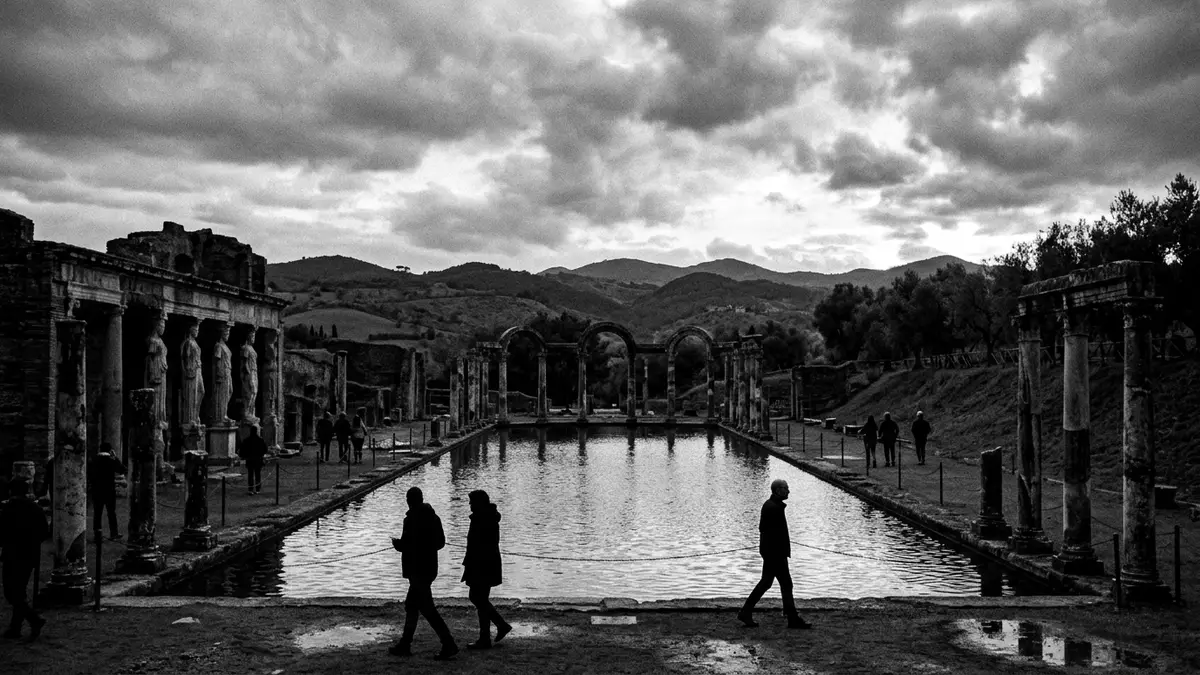
Villa Adriana in Tivoli is a vast imperial complex linked to Hadrian and the second century AD. Its ruins spread across a broad archaeological landscape of buildings, water features and gardens, with Roman, Greek and Egyptian echoes visible in the plan and decoration. The scale is the first thing that registers: this is not a single villa, but a projected imperial world in fragments.
Hadrian’s landscape in stone and water
The site is associated with the emperor’s name because it was built under Hadrian and completed across the years 118 to 138. UNESCO lists it as a World Heritage Site, and the official description places it among the major classical ensembles of the Roman world. The surviving remains include residences, baths, pavilions, nymphaea and gardens, all arranged as parts of a single imperial estate.
One of the most striking features is the way the complex combines built forms with open space and water. The surviving structures sit in a low archaeological setting rather than a dense urban streetscape, so the eye moves between walls, pools, paths and planted ground. The result is a place where fragmentary masonry and large voids share the same stage.
Classical forms on a Roman scale
Villa Adriana is often described as an architectural synthesis, because it brings together forms associated with Ancient Greece, Rome and Egypt. The estate is also linked to classical architecture and to the Roman habit of turning elite residence into a landscape of power. In that sense, the site reads as an estate, a retreat and an imperial statement at once.
The remains are spread out rather than compressed into a single monumental block. That layout makes the villa feel like a sequence of distinct zones: bath buildings, formal courts, garden spaces and service areas. The architectural variety is part of the attraction, because the place can be read as a collection of separate inventions within one planned whole.
From imperial residence to archaeological park
The place is best understood through its changing function. It began as an imperial residence for Hadrian, then became a ruin explored and studied over centuries, and it now survives as a major archaeological site. Its identity today rests on what remains visible: masonry, fragments, routes through the grounds and the broad setting near Tivoli.
That long life is visible in the mix of intact walls, broken volumes and open ground. The visitor sees both the ambition of the original estate and the archaeological reality of what survives. Few places preserve that contrast so clearly in one landscape.
Visiting Villa Adriana: what travellers from Western Europe should know
- The site lies in Tivoli, east of Rome, in Lazio. It is reached by road from the Rome area and sits near the ancient Tibur.
- The terrain is open and spread out, with uneven ground, long sightlines and many exposed architectural fragments. Comfortable footwear matters for the archaeological surface.
- The official language is Italian and the currency is the euro.
- Entry requirements depend on your nationality; UK travellers can check the FCDO travel advice at gov.uk/foreign-travel-advice, Irish travellers the Department of Foreign Affairs at ireland.ie.
Searching for Villa Adriana on social platforms
These links open searches for Villa Adriana on each platform.
Frequently asked questions about Villa Adriana
Where is Villa Adriana?
Villa Adriana lies in Tivoli, in Lazio, east of Rome. It is the archaeological site of Hadrian’s imperial villa.
What does a visit involve?
The site is spread across a broad outdoor area with ruins, paths, water features and open ground. It reads as a landscape of separated buildings rather than a compact museum complex.
What makes Villa Adriana distinctive?
Its scale, imperial association and mixture of Roman, Greek and Egyptian references set it apart. The surviving estate still shows how ambition and landscape were joined in Hadrian’s world.


