

Vigelandsanlegget: Gustav Vigeland’s sculpted axis in Oslo
Published on 08/26/2026 at 12:48 | Editorial responsibility: Rafael Müller, Editor-in-Chief AD HOC NEWS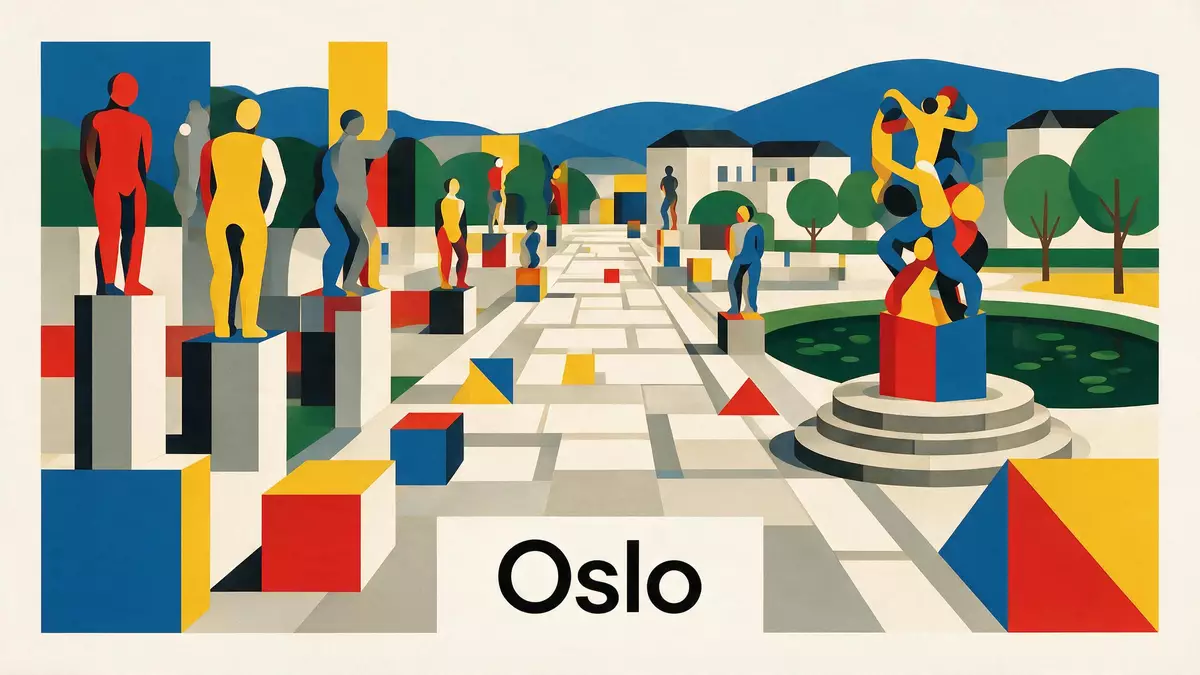
Vigelandsanlegget is the sculpture installation that runs through Frogner Park in Oslo, a long axis of granite and bronze shaped by the Norwegian sculptor Gustav Vigeland in the first half of the twentieth century. The ensemble gathers more than 200 of his figures into a single, carefully arranged progression, making the park one of the clearest places to see how his work developed over several decades.
The sculpted parkway through Frogner
Frogner Park is a large urban green space in western Oslo, and Vigelandsanlegget occupies a defined strip within it that functions as a sculpted parkway. From south to north, the axis stretches for around 850 m (2,789 ft), threading its way between lawns and lines of trees and tying separate groups of sculptures into a single walk.Parken er 850 meter lang The park section assigned to the installation covers dozens of hectares, giving the works space to sit in open air rather than in a confined garden.Vigelandsanlegget omfatter 320 mål i Frognerparken
Although visitors experience Vigelandsanlegget as a park in its own right, it is formally an installation within Frogner Park rather than a separate fenced area.kunstinstallasjon i Frognerparken Ordinary city life continues around it: paths cross, residents walk dogs or cycle, and the lawns away from the main axis serve as everyday recreation space. This makes the sculpture route feel woven into Oslo’s fabric, not set apart like a museum courtyard.
Gustav Vigeland’s life work in stone and bronze
Gustav Vigeland was born in 1869 and became one of Norway’s best known sculptors; Vigelandsanlegget in Frogner Park is widely associated with his name as a permanent outdoor installation.a permanent sculpture installation in Frogner Park Over roughly forty years he produced the figures that populate the park, working in both bronze and granite and refining recurring themes of human bodies, family groups and the passage of life.over 40 years of work
The sculptures were created between 1907 and 1942, then installed in the park mainly in the 1940s, turning the lawns and paths into an open-air gallery of Vigeland’s work.1907 bis 1942 entstanden The finished ensemble contains just over 200 sculptures, executed in granite and bronze, with wrought-iron details on the gates and railings.over 200 sculptures in granite, bronze and wrought iron For visitors familiar with galleries and indoor museums, the scale of this open-air display gives a different sense of how one artist’s work can inhabit a landscape.
From main gate to Monolith plateau
Vigelandsanlegget is laid out as a sequence of five principal zones, aligned along the central axis of Frogner Park. Entering from the south, visitors first encounter the main gate, which sets the tone with wrought-iron work and stone pillars. From there, the route crosses a wide bridge flanked by bronze figures, including groups with children that form part of the installation’s best-known imagery.fem større enheder
Beyond the bridge stands the fountain, a large bronze structure ringed by sculpted trees and figures, and further north the path climbs to the Monolith plateau, where a single tall granite column rises from a stepped platform surrounded by more figures.Fontænen, Monolitplateauet The axis ends at the Wheel of Life, a circular grouping of figures that closes the progression with another compact symbol of human cycles.Livshjulet Walking the full route reveals how Vigeland developed recurring motifs, and how the park’s topography supports their arrangement.
Material, detail and recurring figures
Across Vigelandsanlegget the dominant materials are granite and bronze, chosen for durability in Oslo’s climate and for their contrasting textures. Granite figures stand pale and weighty against the sky or lawns, while bronze adopts a darker tone that changes slightly with light and weather.granite, bronze and wrought iron Gates and railings carry wrought-iron ornament, extending the sculptural language into the boundaries of each zone.
The figures themselves range from single standing bodies to complex clusters of intertwined forms. Many depict everyday gestures between adults and children, or groups that suggest different stages of life. Certain sculptures have acquired short nicknames that make them easy to identify, such as the figure of a small boy on the bridge with a tense expression; guidebooks and maps often highlight these works along with the Monolith and the Wheel of Life as key stops.highlights including The Angry Boy, The Monolith, and The Wheel of Life
Visiting Vigelandsanlegget: what travellers from Western Europe should know
- Vigelandsanlegget lies inside Frogner Park in western Oslo, and the area around it is served by city tram lines that stop close to the main gates.
- The sculpted axis runs for hundreds of metres along a gentle gradient, with several flights of steps leading up to the Monolith plateau that require a steady climb.
- Oslo has a temperate climate with snow in winter, so surfaces in the park can be wet or icy in colder months and dry underfoot in warmer periods.
- The Vigeland Museum, housed in the sculptor’s former studio building near the park, gives additional context through plaster models and sketches related to the outdoor sculptures.
- The official language is Norwegian and the currency is the Norwegian krone.
Searching for Vigelandsanlegget on social platforms
These links open searches for Vigelandsanlegget on each platform.Frequently asked questions about Vigelandsanlegget
Where is Vigelandsanlegget located in Oslo?
Vigelandsanlegget sits inside Frogner Park in the western part of Oslo, forming the park’s central sculpted axis rather than a separate enclosure.
What can visitors expect on a walk through the installation?
A visit follows a long route from the main gate across a bridge, past a fountain and up to the Monolith plateau, with granite and bronze figures lining the way.
What makes Vigelandsanlegget distinctive among sculpture parks?
It is the concentrated life’s work of Gustav Vigeland, gathering more than 200 of his sculptures into one open-air installation in a single city park.


