

Vigelandsanlegget: Gustav Vigeland’s human landscape in Oslo
Published on 08/28/2026 at 08:43 | Editorial responsibility: Rafael Müller, Editor-in-Chief AD HOC NEWS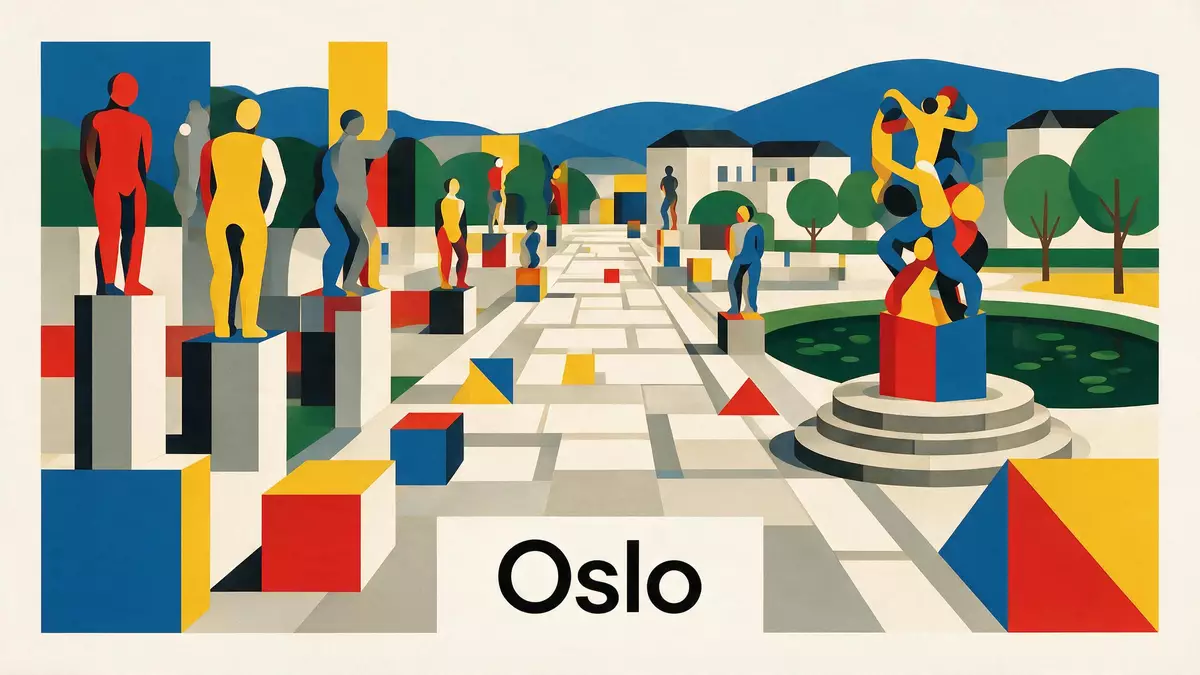
In the western part of Oslo’s Frogner Park, Vigelandsanlegget gathers hundreds of human figures into a single, carefully arranged landscape. Conceived and executed by Norwegian sculptor Gustav Vigeland in the early twentieth century, this installation turns lawns, paths and terraces into a continuous story told in bronze, granite and wrought iron.
A sculpture park shaped as a journey through life
Vigelandsanlegget is the name given to the permanent arrangement of sculptures within Frogner Park, distinct from the wider expanse of lawns, ponds and sports fields that surround it.permanent arrangement of sculptures The installation runs along a central axis, guiding visitors from a monumental main gate through a sequence of sculptural groups, each section focused on a different stage of human life. Granite and bronze figures appear in clusters along this route, forming a progression from playful childhood scenes to concentrated studies of adult relationships and ageing bodies.central axis with main gate, bridge, fountain, monolith and wheel of life
The core line of Vigelandsanlegget stretches for several hundred metres between the southern entrance and a high plateau in the north, divided into distinct sections: the main gate, the bridge, the fountain, the Monolith plateau and the Wheel of Life.five main sections of Vigelandsanlegget Each part carries its own sculptural rhythm. On the bridge, bronze figures stand close to the balustrades, their bodies turned inward and outward in varied poses, while around the fountain heavier granite reliefs encircle the basin. Moving northwards, the path rises towards the Monolith, where the density of sculpture increases and the figures become more tightly interwoven.
Gustav Vigeland’s life work in granite, bronze and wrought iron
Gustav Vigeland, born in 1869 in Norway, devoted decades of his career to the sculptures that form Vigelandsanlegget.Norwegian sculptor Gustav Vigeland The figures, modelled over a span from 1907 into the early 1940s, were installed mainly during the 1940s, when the park axis was laid out to accept the finished works.installed mainly in the period 1940-1949 Vigeland worked in granite, bronze and wrought iron, and the installation brings these materials together across more than two hundred sculptures and a series of gates and railings.over 200 sculptures in granite, bronze and wrought iron
Vigelandsanlegget contains more than two hundred human figures, all designed by Vigeland, arranged along the axis in groups that reflect different human relationships and ages.212 bronze and granite sculptures Infants, children, adults and older people recur in varying constellations: a parent lifting a child, couples facing one another, individuals curled or leaning in thought. Ironwork gates and railings frame these scenes; their vertical bars and patterns provide a structural counterpoint to the more organic forms of the figures. The result is a coherent sculptural field whose elements were conceived as a single project rather than as separate pieces scattered across a park.
The Monolith and the Wheel of Life: dense centres of the park
The most concentrated part of Vigelandsanlegget rises on the Monolith plateau, an elevated terrace reached by broad steps from the central path.Monolith plateau in Vigelandsanlegget At its centre stands the Monolith itself, a single granite column carved with intertwined human bodies from base to top. Around this column, granite figures stand on separate plinths in a wide ring, their positions mirroring different attitudes and stages of life, from sitting and resting to lifting children or supporting one another.
At the northern end of the axis lies the Wheel of Life, a compact granite group rendered as a ring of human figures holding one another in a continuous loop.Wheel of Life section Where the Monolith stacks bodies vertically, the Wheel of Life gathers them into a circular movement, echoing themes found elsewhere in the park. Together with the fountain, which occupies a broad basin further south, these focal pieces punctuate the walk through the installation and give structure to the long sequence of sculptural groups.
Visiting Vigelandsanlegget: what travellers from Western Europe should know
- Vigelandsanlegget stands within Frogner Park in the western part of Oslo, a short distance north-west of the Royal Palace, and is reached by city tram and bus services that stop near the park’s main entrances.location about 2 km from the Royal Palace
- The terrain within the installation includes long, gently rising paths and several flights of steps, especially around the Monolith plateau, where stone staircases lead up to the highest terrace.
- Frogner Park, including Vigelandsanlegget, lies among residential districts and sports grounds; nearby landmarks include Frogner Manor, which houses the Oslo City Museum, and other open lawns and ponds within the wider park area.Frogner Manor and Oslo City Museum in the southern part of the park
- Norway’s official language is Norwegian and the currency is the Norwegian krone.
Searching for Vigelandsanlegget on social platforms
These links open searches for Vigelandsanlegget on each platform.
Frequently asked questions about Vigelandsanlegget
Where is Vigelandsanlegget located within Oslo?
Vigelandsanlegget lies inside Frogner Park in the western part of Oslo, on an axis running north from a main gate towards the Monolith plateau.location of Vigeland installation in Frogner Park
What can visitors expect when walking through Vigelandsanlegget?
Visitors encounter a sequence of granite and bronze sculptures portraying human figures at different ages, arranged along a central path that links gates, a bridge, a fountain, the Monolith and the Wheel of Life.main sections and materials
What makes Vigelandsanlegget distinctive among sculpture parks?
Vigelandsanlegget is distinctive as a single artist’s life work, comprising more than two hundred sculptures in a unified layout that traces human life through recurring figures and relationships.Gustav Vigeland's life work with over 200 sculptures


