
Vieux-Quebec, the walled historic heart of Quebec City
Published on 09/04/2026 at 15:26 | Editorial responsibility: Rafael Müller, Editor-in-Chief AD HOC NEWS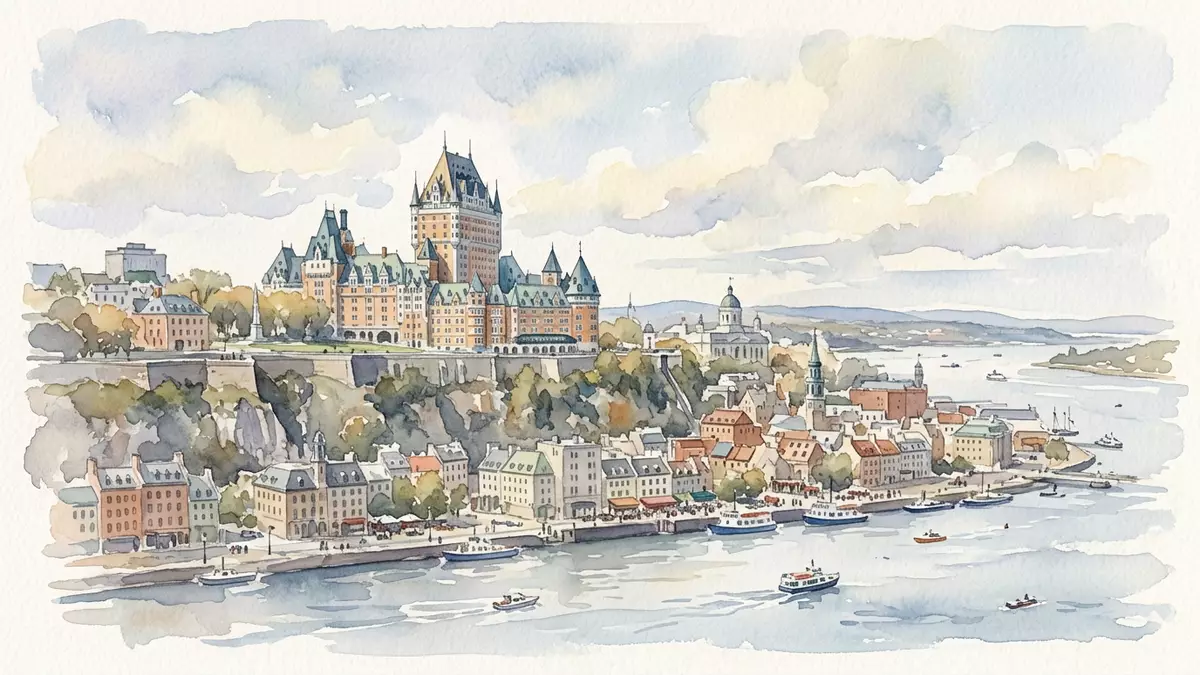
Vieux-Quebec is the historic district of Quebec City, a walled urban quarter on the north shore of the Saint Lawrence River where an upper town and a lower town still form one continuous cityscape. Founded as a French colonial settlement in 1608 under Samuel de Champlain and later reshaped under British rule, it is recognised as the Historic District of Old Quebec and has been inscribed on the UNESCO World Heritage List since 1985.
A fortified city quarter above and below Cap Diamant
Vieux-Quebec occupies the high ground of Cap Diamant and the lower streets close to the harbour, with the escarpment between them marking a clear divide that is still legible in the street pattern.The Historic District of Old Québec covers an urban area of about 135 hectares, large enough to read as a compact city quarter rather than a single monument.Le site patrimonial du Vieux-Québec Within this territory, the upper town sits on the promontory and is ringed by fortifications, while the lower town occupies a narrow band of land between the cliff, the Saint-Charles River and the Saint Lawrence.
The fortification system is one of the defining features of Vieux-Quebec, enclosing the upper town with ramparts, bastions and a citadel that recall its centuries as a military stronghold.Quebec's Old Town The walls are the most complete example of a fortified colonial town north of Mexico, giving the district a rare continuity of defensive works in an otherwise modern North American city.Old Quebec as a UNESCO-listed fortified city Walking the perimeter of the ramparts reveals views over the river, the lower town and the broader city, while passing gates where traffic now enters through openings once designed for controlled access.
Four centuries of French and British architecture in one streetscape
Architecture is the second backbone of Vieux-Quebec, where more than a thousand buildings record the settlement’s evolution from the seventeenth century onwards.Four centuries of architecture Early French colonial houses and religious complexes share the streets with later British military structures and public buildings whose forms draw on palladian and neoclassical traditions, while later nineteenth-century constructions layer more eclectic influences from Britain, France and the United States.
UNESCO’s inscription of the Historic District of Old Quebec in 1985 was based on this concentrated ensemble of colonial urban planning and architecture, preserved with coherence across the upper and lower town.UNESCO World Heritage inscription in 1985 The district bears witness to Quebec City’s role as the capital of New France and, after 1760, of a British colony, making its streets and squares a visible record of changing political and cultural authority over several centuries.Old Québec as the historic and cultural heart Within the walls, churches, convents, military installations, commercial buildings and residences stand close together, so a short walk passes institutional, religious and domestic architecture in quick succession.
Vieux-Quebec as a cradle of French North America
The origins of Vieux-Quebec lie in the foundation of Quebec City by Samuel de Champlain in 1608, when a French trading post and fortified settlement were established on the promontory above the narrowing of the Saint Lawrence.Old Quebec as cradle of French civilisation in America From this base, French colonial administration and religious communities spread their influence along the river valley, making Vieux-Quebec a focal point in the expansion of French-speaking North America.
After the British conquest in 1760, Quebec City’s role changed but its historic core remained a seat of colonial government, and British authorities added new public buildings and military works to the existing French fabric.Historic stages in European settlement In the twentieth century, the government of Quebec enacted protections for the old city, creating a historic district in the 1960s that was later recognised internationally through UNESCO listing.Arrondissement historique du Vieux-Québec The combination of French and British legacies, preserved across streets that still follow early colonial alignments, makes Vieux-Quebec a rare example of a North American city quarter where layers of European settlement can be read directly in stone and brick.
Visiting Vieux-Quebec: what travellers from Western Europe should know
- Vieux-Quebec lies within Quebec City in eastern Canada, on the north bank of the Saint Lawrence River; it is reached from elsewhere in the city by road and local public transport.
- The district has steep streets and staircases linking the upper town on Cap Diamant with the lower town near the harbour, so walking between levels involves gradients and steps.
- Within the fortifications the streets are compact and closely built up, and many routes through the old town are on foot, with cobbled or paved surfaces rather than wide carriageways.
- French is the official language of Quebec and the currency is the Canadian dollar.
- Entry requirements depend on your nationality; UK travellers can check the FCDO travel advice at gov.uk/foreign-travel-advice, Irish travellers the Department of Foreign Affairs at ireland.ie.
Searching for Vieux-Quebec on social platforms
These links open searches for Vieux-Quebec on each platform.
Frequently asked questions about Vieux-Quebec
Where is Vieux-Quebec and what area does it cover?
Vieux-Quebec is the historic district within Quebec City in eastern Canada, on the north side of the Saint Lawrence River, and its protected urban area extends over about 135 hectares.
What should visitors expect when walking through Vieux-Quebec?
Visitors encounter compact streets lined with historic buildings, fortifications around the upper town and steep links between upper and lower levels, with architecture reflecting French and British colonial periods.
What makes Vieux-Quebec distinctive among North American city districts?
Vieux-Quebec stands out for its intact fortification walls, its continuous urban fabric dating back to the seventeenth century and its recognition as a UNESCO World Heritage Site that preserves French and British colonial legacies in one coherent quarter.


