
Vesuvio above Neapel: walking the rim of a restless volcano
Published on 08/26/2026 at 09:04 | Editorial responsibility: Rafael Müller, Editor-in-Chief AD HOC NEWS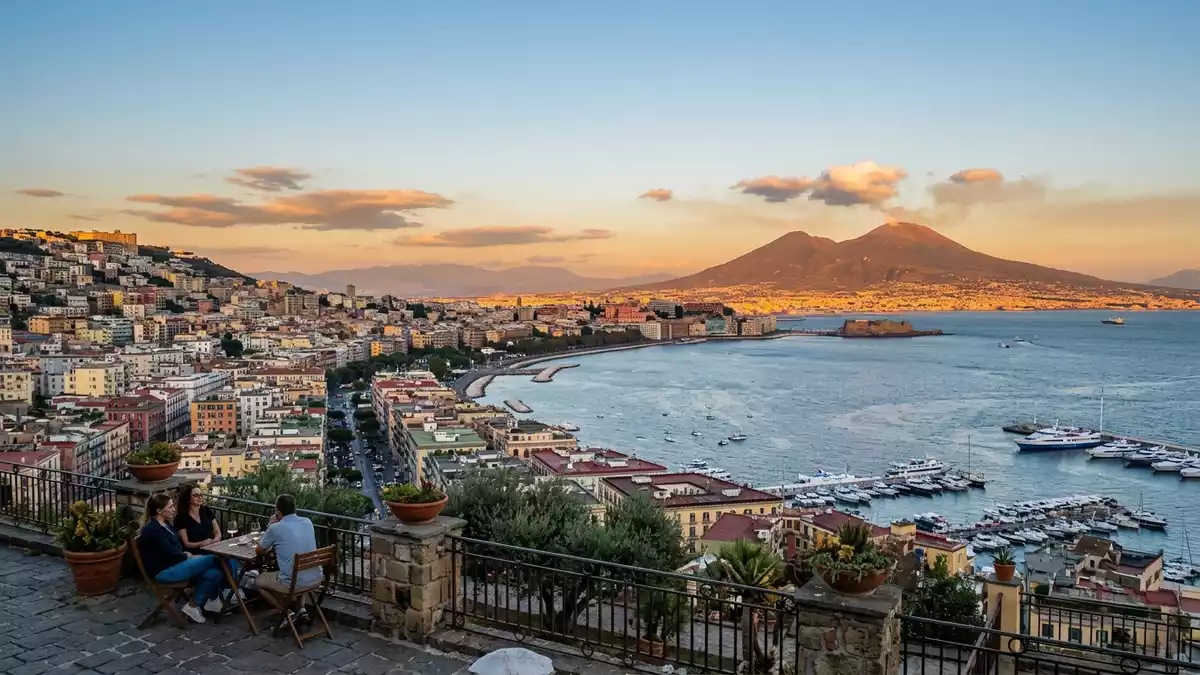
Vesuvio, known in English as Mount Vesuvius, rises above the Bay of Naples as an active stratovolcano with a broad crater and sweeping views over Neapel and the sea. Its explosive eruption in AD 79 buried Roman towns such as Pompeii and Herculaneum under ash and debris, fixing Vesuvio in the historical record as one of the most closely watched volcanoes in Europe.
A crater landscape above the Bay of Naples
Vesuvio stands in the Campania region of southern Italy, east of Neapel and close to the shoreline of the bay. The volcano forms a prominent cone with a summit elevation of about 1,281 m (4,203 ft), though this height has varied after major eruptions.
At the summit, the active cone is cut by a large crater several hundred metres deep, edged by bare rock and ash. Around the upper slopes, paths cross loose volcanic material and patches of hardy vegetation, with the coastline and the sprawl of Neapel visible far below.
From Roman disaster to protected landscape
The eruption of AD 79 destroyed the Roman settlements of Pompeii, Herculaneum and Stabiae, burying streets, houses and public buildings beneath pyroclastic material. The remains of these towns lie to the south and south-east of Vesuvio, where excavations at sites such as Pompeii and Ercolano have revealed remarkably preserved murals, mosaics and everyday objects.
In 1997, UNESCO designated the Somma-Vesuvio and Miglio d'Oro area as a biosphere reserve, bringing the volcano, surrounding slopes and coastal strip into a framework that combines conservation with long-term human presence.Somma-Vesuvio and Miglio d'Oro This landscape also includes the Vesuvius National Park, created in 1995 to protect the volcano and its biodiversity.Vesuvius National Park
Structure, geology and quiet activity
Geologically, Vesuvio is part of a complex volcanic system made up of the remains of an older volcano, often called Mount Somma, and a more recent cone known as Gran Cono. The current cone and crater sit within the older, broader structure, creating a distinctive outline above the plain of Campania.union of Mount Somma and Vesuvius
Vesuvio is classified as an active volcano, with a last major eruption in 1944 that reshaped the summit area and left fresh lava and ash deposits on the slopes. Since 1944, monitoring networks operated by Italian scientific institutions have tracked seismic activity and fumaroles in and around the crater, while civil protection authorities use hazard zones to plan for any future eruption.civil protection information on Vesuvio
Visiting Vesuvio: what travellers from Western Europe should know
- Vesuvio rises east of Neapel in the Italian region of Campania, with road access climbing towards the upper slopes from towns on the volcano’s flanks.
- Approaches near the summit involve walking on loose volcanic ash and gravel, with sections that can feel steep underfoot and exposed to sun and wind.
- The terrain at higher levels is largely treeless, with dark lava and ash contrasting with occasional low shrubs and views towards Pompeii and the Bay of Naples.
- The official language is Italian and the currency is the euro.
Searching for Vesuvio on social platforms
These links open searches for Vesuvio on each platform.
Frequently asked questions about Vesuvio
Where is Vesuvio?
Vesuvio stands in the Campania region of southern Italy, east of Neapel and beside the Bay of Naples.
What should visitors expect on Vesuvio?
The upper slopes are covered in volcanic ash, rock and sparse vegetation, with paths leading towards a broad summit crater and wide coastal views.
What makes Vesuvio distinctive?
Vesuvio is an active somma–stratovolcano whose AD 79 eruption buried Pompeii and Herculaneum, and its summit crater sits within an older volcanic structure.


