
Vesuvio above Neapel: the volcanic cone that shapes Campania
Published on 09/10/2026 at 16:39 | Editorial responsibility: Rafael Müller, Editor-in-Chief AD HOC NEWS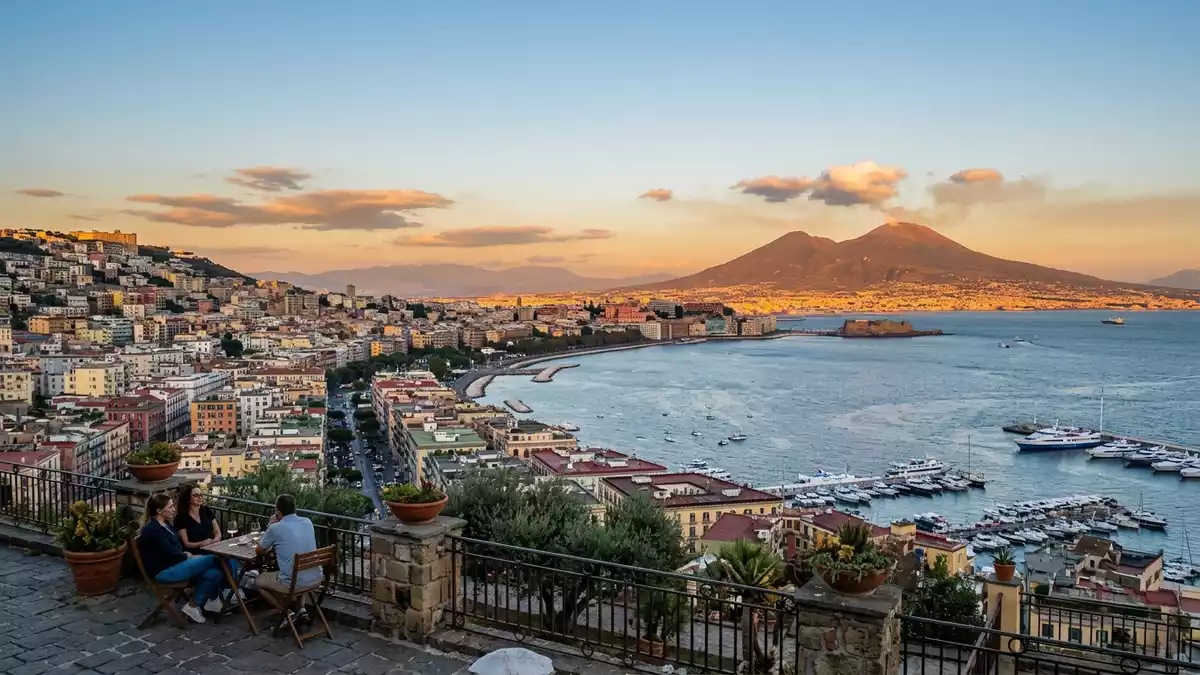
Vesuvio, known in English as Mount Vesuvius, rises above Neapel as an active volcano with a broad cone and a distinct crater set within protected parkland in Campania. The mountain stands on the Gulf of Naples in southern Italy, forming part of the wider Campanian volcanic arc that has shaped this region’s landscape over millennia.
The volcanic cone above the Bay of Naples
Vesuvio is a somma–stratovolcano on the Gulf of Naples in Campania, its main cone rising above a plain south-east of Neapel and close to the shoreline of the bay.somma–stratovolcano on the Gulf of Naples The volcano’s profile is marked by a truncated cone whose highest point reaches over 1,200 m (3,937 ft) above sea level, with the crater forming a deep hollow at the summit.highest point reaches over 1,200 m The crater itself has a substantial diameter and depth, giving visitors a clear view into the heart of the volcanic structure.
The volcano belongs to the Campanian volcanic arc, a chain of volcanic centres that includes nearby fields such as Campi Flegrei and other vents on the Italian mainland.Campanian volcanic arc Vesuvio’s flanks descend towards coastal towns and archaeological sites including Pompei and Ercolano, whose remains stand on the lower slopes and plain below the volcano.Pompei and Ercolano The combination of a prominent volcanic cone, surrounding settlements and the bay beyond gives the mountain a strong visual presence in the landscape.
Parco Nazionale del Vesuvio: a protected volcanic landscape
Vesuvio and its surrounding terrain lie within Parco Nazionale del Vesuvio, a national park established on 5 June 1995 to conserve the Somma–Vesuvio complex and its biodiversity.Parco Nazionale del Vesuvio The park extends over 8,482 hectares in the metropolitan area of Naples and includes territories of thirteen municipalities on and around the volcano’s slopes.thirteen municipalities on and around the slopes Within this area, the protected zone covers lava fields, Mediterranean scrub, reforested areas and vantage points from which the cone and crater can be viewed.
The national park has a network of numbered footpaths with a combined length of around 54 km (33.6 mi), giving structured access to different sides of the volcanic edifice.network of numbered footpaths Paths climb across older lava surfaces and ash-covered slopes, pass through stands of pine and other vegetation, and reach viewpoints where the crater rim and the Bay of Naples can be seen together. The park’s administration is based in Ottaviano at the Castello Mediceo, a historic building that serves as the headquarters for managing conservation and visitor access across the Somma–Vesuvio complex.Castello Mediceo in Ottaviano
An active volcano with a long-recorded history
Vesuvio is classified as an active volcano, rising above the Bay of Naples as one of Italy’s best documented volcanic centres.classified as an active volcano Its eruptions have been recorded since antiquity, with the destruction of Roman settlements such as Pompei and Ercolano in the first century AD forming part of the volcano’s enduring historical profile.Roman settlements such as Pompei and Ercolano Later eruptions in subsequent centuries continued to modify the cone and crater, adding layers of lava and ash that can be traced in the geological record.
In the twentieth century Vesuvio’s last major eruption occurred in 1944, after which the volcano entered a quiescent stage characterised by low seismicity and fumarolic activity at the summit.last major eruption occurred in 1944 The volcano’s monitoring falls under Italy’s civil protection framework, reflecting its status as an active system rising in a densely settled part of Campania. For visitors, this long history is visible in the layered rock faces, older crater forms on the surrounding ridge and the proximity of archaeological sites that preserve ancient responses to Vesuvio’s eruptions.
Visiting Vesuvio: what travellers from Western Europe should know
- Vesuvio stands south-east of Neapel in the Italian region of Campania, above the coastal plain beside the Bay of Naples; roads climb towards the volcano from towns such as Ercolano and Torre del Greco.
- The terrain on the upper slopes consists of ash, loose rock and compacted lava, with approaches to the crater area following paths over uneven ground at altitude.
- Parco Nazionale del Vesuvio surrounds the volcano, and designated trails give structured access to viewpoints, lava fields and sections of Mediterranean vegetation on its flanks.
- The official language is Italian and the currency is the euro.
Searching for Vesuvio on social platforms
These links open searches for Vesuvio on each platform.
Frequently asked questions about Vesuvio
Where is Vesuvio in relation to Neapel and the Bay of Naples?
Vesuvio stands south-east of Neapel on the Gulf of Naples in Campania, rising above the coastal plain close to the shoreline of the bay.
What can visitors expect when they travel to Vesuvio?
Visitors encounter a prominent volcanic cone with a summit crater, paths across ash and lava surfaces, and views that link the mountain to Neapel and the surrounding bay.
What makes Vesuvio distinctive among Italy’s volcanic landscapes?
Vesuvio combines an active stratovolcano, a national park created in 1995 and a setting above major archaeological sites such as Pompei and Ercolano, giving it a rare blend of geology and history.


