
Vesuvio above Neapel, a volcano shaped by its crater rim
Published on 08/28/2026 at 20:50 | Editorial responsibility: Rafael Müller, Editor-in-Chief AD HOC NEWS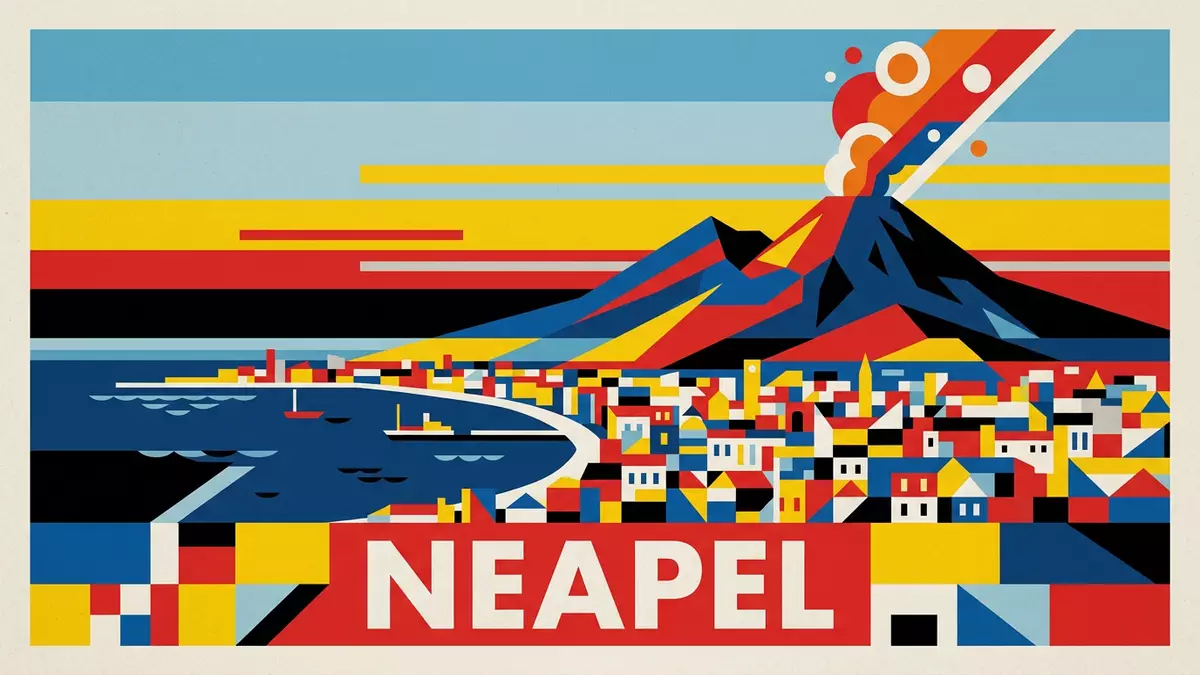
Vesuvio, known in English as Mount Vesuvius, is the active volcano that dominates the Bay of Naples and the urban sprawl of Neapel in southern Italy. It forms the core of the Parco Nazionale del Vesuvio, a protected landscape established in 1995 around the Somma?Vesuvio volcanic complex.
The volcano and its double rim
Seen from Neapel and the surrounding coast, Vesuvio presents a distinctive profile formed by the younger cone rising within the older caldera rim of Monte Somma. The volcano stands on the coastal plain of Campania a short distance inland from the bay, forming a backdrop to the city and its neighbouring towns.active volcano above the Bay of Naples The wider Somma?Vesuvio complex shows the remnants of earlier structures encircling the modern cone, giving the mountain a layered appearance when approached from different sides.Somma-Vesuvius volcanic complex
The crater of Vesuvio opens at the summit of the cone, with a diameter of about 450 m (1,476 ft) and a depth of roughly 300 m (984 ft).crater dimensions The highest peak reaches around 1,277 m (4,190 ft) above sea level, placing the volcano above the surrounding lowlands but below the alpine heights further north in Italy.summit elevation Standing at the rim, the contrast between the steep inner walls and the broader Campanian plain below makes clear how closely the volcano and the settled landscape are intertwined.
A long history of eruptions and a protected park
Human history around Vesuvio is closely tied to its eruptions, most famously the event in 79 AD that buried the Roman towns of Pompeii and Herculaneum under ash and pyroclastic deposits.eruption of 79 AD The volcano has produced a series of major eruptions over roughly the last 17,000 years, alternating between periods of activity and quieter phases in which vegetation and settlement spread across its slopes.major eruptions over millennia The most recent eruption occurred in 1944, leaving fresh lava and ash deposits that still appear as darker, younger rock against the older, weathered surfaces.
To safeguard both the geological features and the living landscape, the Italian state created the Parco Nazionale del Vesuvio on 5 June 1995.national park established in 1995 The park extends over thousands of hectares on the metropolitan territory of Naples, covering the slopes of the Somma?Vesuvio complex and surrounding hills.protected Vesuvian landscape Within this area, forest patches, scrub, lava fields and cultivated terraces sit side by side, reflecting centuries of farming, forestry and settlement under volcanic influence.
Trails on ash and lava
One of the most accessible ways to experience Vesuvio is through the network of marked footpaths that cross the national park. The official trail system comprises eleven routes with a combined length of around 54 km (33.6 miles), ranging from short loops on lower slopes to longer itineraries approaching the cone.eleven trails over 54 km Surfaces vary between compacted ash, loose scoria and older rock, with stretches of woodland alternating with open viewpoints over the bay and the surrounding towns.
Near the summit, paths climb towards the Gran Cono, the upper part of the cone and the crater rim. These routes typically involve a steady ascent on ash and gravel, with sections that can feel exposed above the steep inner walls of the crater. Lower down, other paths lead through pine stands, Mediterranean scrub and areas shaped by past lava flows, offering close views of the volcanic materials that built the mountain. Wayfinding on the official trails relies on numbered routes and signposts at junctions, complemented by interpretation panels explaining geological features and local flora where provided.
Visiting Vesuvio: what travellers from Western Europe should know
- Vesuvio rises above the Bay of Naples in Campania, south of Neapel, and the main access points for the cone and crater lie within the Parco Nazionale del Vesuvio near towns such as Ercolano and Ottaviano. Road approaches from the A3 motorway link the coastal plain to car parks higher on the slopes.
- Walking on Vesuvio involves gradients and uneven surfaces of ash, gravel and rocky ground, particularly on the ascent to the Gran Cono and around the crater rim, where paths follow slopes above steep drops.
- The wider park landscape includes forested sections and open lava fields, and approaches to many trails begin at roadside car parks or small visitor areas on the flanks of the volcano rather than in dense urban districts.
- The official language is Italian and the currency is the euro.
Searching for Vesuvio on social platforms
These links open searches for Vesuvio on each platform.Frequently asked questions about Vesuvio
Where is Vesuvio located?
Vesuvio stands on the Gulf of Naples in Campania, Italy, east of Neapel, within the metropolitan territory of the city and its surrounding towns.
What should visitors expect on a visit?
Visitors encounter an active volcano with a summit crater, ash and lava surfaces, changing gradients on footpaths and wide views over the Bay of Naples and the Campanian plain.
What makes Vesuvio distinctive among European volcanoes?
Vesuvio is the only active volcano on the continental mainland of Europe and combines a double rim profile, a large summit crater and dense urban settlement close to its slopes.


