
Vesuvio: a volcano within an older volcanic mountain
Published on 09/24/2026 at 08:29 | Editorial responsibility: Rafael Müller, Editor-in-Chief AD HOC NEWS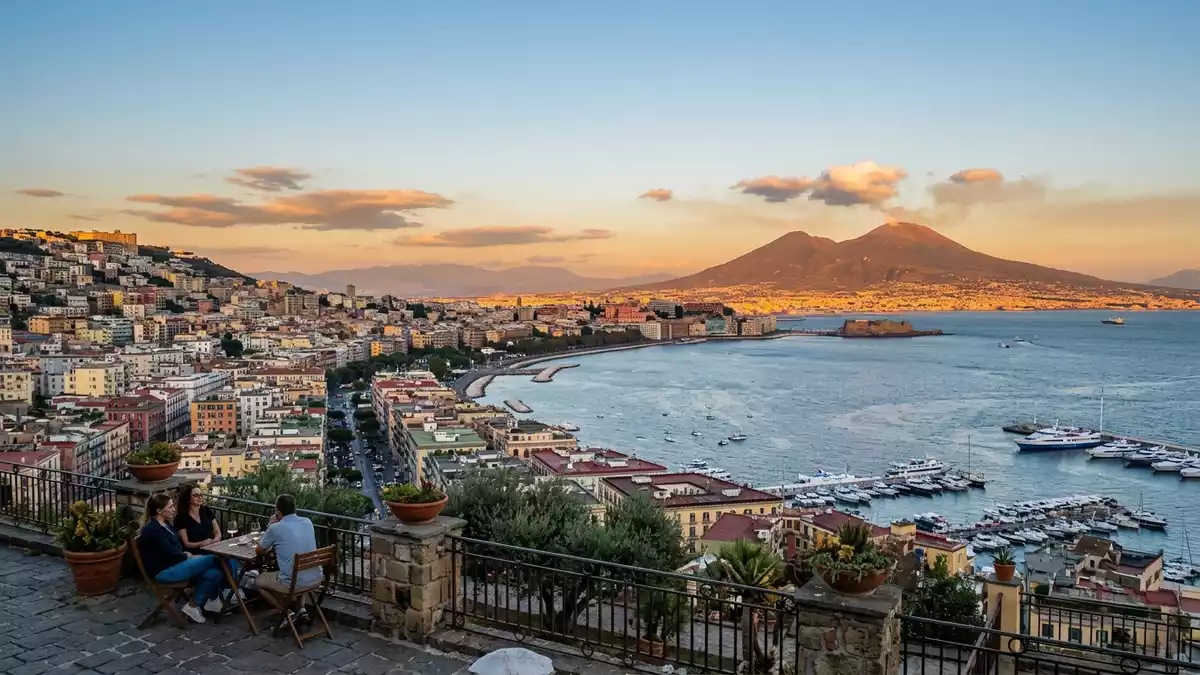
Vesuvio rises above Neapel as a steep volcanic cone inside the older structure of Mount Somma. Its summit reaches 1,277 metres, while the crater forms a broad, dark hollow near the top.
Vesuvio’s cone inside Mount Somma
The mountain has a frustum-shaped profile, narrowing towards the summit. The Gran Cono of Vesuvio occupies part of Mount Somma’s ancient caldera, creating a volcanic landscape with an outer ridge and an inner cone.
Mount Somma reaches 1,132 metres at Punta Nasone. Its broken crater rim forms an arc around Vesuvio, with Valle del Gigante between the older volcanic structure and the newer cone. Valle dell’Inferno lies to the east, while Atrio del Cavallo lies to the west.
Lava, ash and the record of eruptions
The Somma-Vesuvio complex began forming roughly 400,000 years ago within a much older volcanic area. Repeated explosive and effusive eruptions produced layers of lava, pumice, ash, lapilli and volcanic rock. The geology of Vesuvio remains visible in the grooves and dark rock bands across its slopes.
The eruption of 79 AD buried Pompeii, Herculaneum, Stabia and Oplonti beneath volcanic material. Pliny the Younger described the event, giving the explosive eruption type its name: Plinian. A later eruption in 1631 caused extensive destruction around the mountain, while lava from the 1944 eruption reached the lower slopes near San Sebastiano al Vesuvio.
A crater, fumaroles and a protected volcanic landscape
The summit crater measures about 450 metres across and reaches a depth of about 300 metres. Small fumaroles occur within the Gran Cono and along parts of the mountain, where water vapour rises through the volcanic ground.
Vesuvio belongs to the Vesuvius National Park, established in 1995. The protected area includes the volcanic complex, lava formations, woodland, cultivated land and archaeological landscapes connected with eruptions. Chestnut, locust, birch, Italian maple and alder grow on parts of Mount Somma.
The mountain’s materials include lava flows and pyroclastic deposits. Scoriaceous lava has a rough, irregular surface, while pumice and lapilli appear among deposits created by explosive eruptions. Leucite occurs in Vesuvio’s volcanic rocks as pale crystals within lava, lapilli and volcanic bombs.
Visiting Vesuvio: what travellers from Western Europe should know
- Vesuvio rises east of Neapel in Campania. Road access reaches the upper mountain from the Herculaneum side, while local transport serves the approaches from towns on the volcano’s lower slopes.
- The summit route crosses steep volcanic ground and loose rock. The crater rim lies at high altitude, with exposed sections and uneven surfaces near the Gran Cono.
- Mount Somma has wooded slopes and deep erosion channels called lagni. The upper volcanic landscape changes from forested ground to dark scoria and ash.
- The official language is Italian and the currency is the euro.
Searching for Vesuvio on social platforms
These links open searches for Vesuvio on each platform.
Frequently asked questions about Vesuvio
Where is Vesuvio?
Vesuvio is in Campania, east of Neapel, within the Vesuvius National Park. The mountain rises near Herculaneum, Pompeii and other archaeological sites associated with its eruptions.
What can visitors expect on the mountain?
The upper route crosses volcanic rock, ash and steep ground around the Gran Cono. Views include the crater, Mount Somma’s broken rim and the urban plain surrounding Neapel.
What makes Vesuvio distinctive?
Vesuvio is a younger cone inside the older Mount Somma volcano. Its crater, lava formations and record of the 79 AD eruption place geology, archaeology and landscape within the same mountain.


