
Varanasi Ghats: stone steps between city and sacred river
Published on 09/10/2026 at 12:09 | Editorial responsibility: Rafael Müller, Editor-in-Chief AD HOC NEWS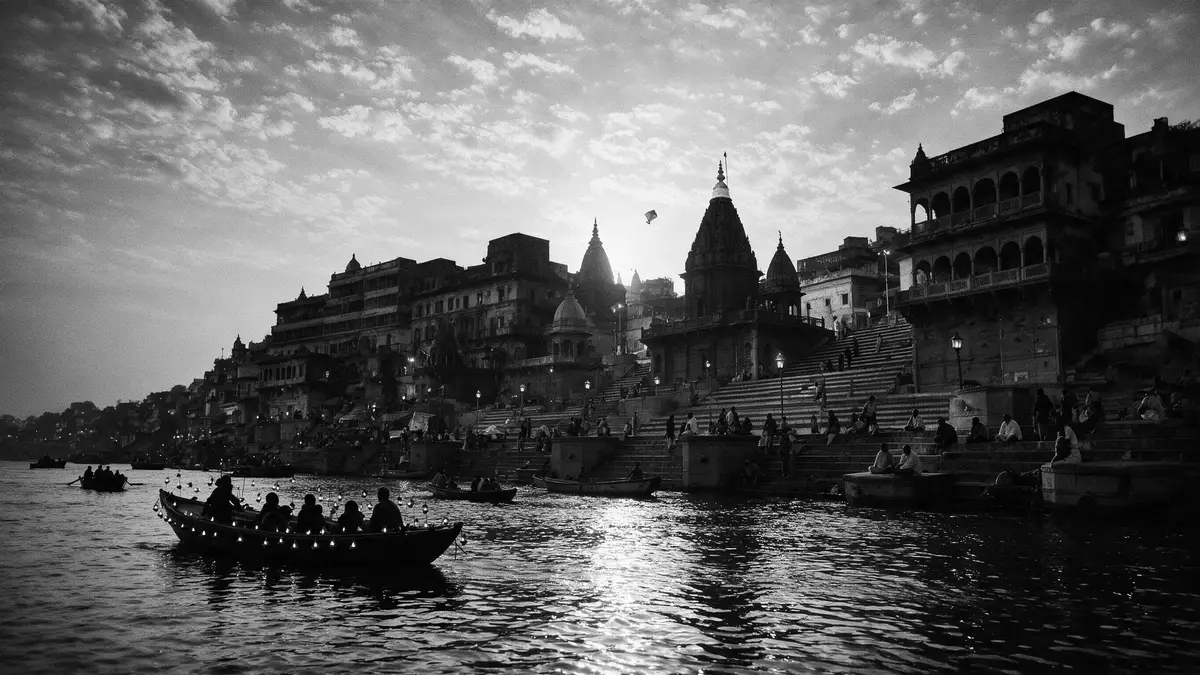
Varanasi Ghats are a continuous riverfront of stone steps on the Ganges where the dense fabric of Varanasi meets the water in a single, sloping edge. Stretching along the western bank in eastern Uttar Pradesh, this sequence of ghats has grown into one of the most distinctive sacred landscapes in India and remains closely tied to Hindu ritual life from the early modern period onwards.
Stone staircases, water and the city above
At its simplest, a ghat in Varanasi is a broad staircase of stone descending from the city level to the river, turning the natural bank into a series of terraces that can be used in many ways.Flights of stone steps line the Ganges for several kilometres, creating a largely continuous frontage interrupted only by the inlets and projections of individual ghats.Stone staircases lining the western bank
Behind the ghats, the city rises almost immediately, with tightly packed houses, temple courtyards and lanes known locally as galis forming a dense backdrop. Many ghats carry their own shrines and platforms at intermediate levels between the water and the upper streets, so that rituals can be held even when the river shifts. The riverfront occupies the historic core often called Kashi, and the ghats face the main channel of the Ganges rather than side streams.Location within Varanasi city
A long sequence of named ghats
Varanasi Ghats are not a single structure but a linked series of individual embankments, each with its own name and associations. Modern surveys describe between 88 ghats running for over 6.5 km and about 84 ghats along the riverfront, a span that reflects differing counting methods but agrees on the basic scale: several kilometres of almost uninterrupted steps.
At the southern end stands Assi Ghat, named for the small Assi River that meets the Ganges nearby and widely recognised as one of the most important bathing ghats in the city.Assi Ghat among the Panchtirtha Moving northwards, sequences of ghats carry names such as Tulsi, Kedar, Chet Singh and Ahilyabai, marking associations with poets, rulers or patrons. At the northern end of the main riverfront lies Adi Keshava Ghat, where the Ganges bends away and the stepped embankments give way to a different shoreline character.Assi to Adi Keshava span
Ritual bathing, cremation and everyday use
The central role of Varanasi Ghats lies in their use. Most ghats function as bathing and ceremonial spaces where pilgrims and residents enter the water of the Ganges to bathe, perform puja rituals and mark religious occasions.Bathing and puja ceremonial ghats Platforms and steps provide surfaces for offerings, lamps and temporary installations linked to Hindu observances.
Two ghats stand apart for their exclusive association with cremation: Manikarnika Ghat and Harishchandra Ghat are known as permanent sites for funerary rites, where pyres are arranged on terraces close to the river.Manikarnika and Harishchandra as cremation ghats Elsewhere, ritual bathing coexists with more everyday uses. Stone steps serve as places to wash clothes, sit in groups, conduct small trades or simply cross between neighbourhoods and the boats moored along the river’s edge.
Dashashwamedh, Manikarnika and the Panchtirtha
Within the long series of Varanasi Ghats, certain names recur in guidebooks and local tradition as particularly significant. Dashashwamedh Ghat, close to the Vishwanath Temple, is often described as the main ceremonial focus among the bathing ghats and anchors a dense cluster of temples and commercial activity around its steps.Dashashwamedh Ghat near Vishwanath Temple
A traditional grouping known as Panchtirtha singles out five particularly sacred ghats: Assi, Dashashwamedh, Manikarnika, Panchganga and Adi Keshava.Panchtirtha of Varanasi Manikarnika combines its membership of this set with its role as the principal cremation ghat, while Panchganga rises in tiers that include mosque architecture at the upper level. Together, these named points give structure to the otherwise continuous riverfront, marking stations along the curve of the city where particular narratives and practices have become attached to specific flights of steps.
Visiting Varanasi Ghats: what travellers from Western Europe should know
- Varanasi Ghats lie along the western bank of the Ganges in Varanasi, a major city in the state of Uttar Pradesh in northern India. The riverfront is reached from the city’s upper streets by lanes and stairways descending to the ghats.
- The terrain consists of long stone staircases, with sections that rise steeply from the water to the built-up city above. Moving along the ghats often involves walking on uneven stone and stepping up and down between terraces.
- Several ghats, including Manikarnika and Harishchandra, are used for cremation rites. Visitors encounter funerary activity at close quarters and should be prepared for smoke, crowded terraces and areas where photography may be considered intrusive.
- The official language is Hindi and the currency is the Indian rupee.
- Entry requirements depend on your nationality; UK travellers can check the FCDO travel advice at gov.uk/foreign-travel-advice, Irish travellers the Department of Foreign Affairs at ireland.ie.
Searching for Varanasi Ghats on social platforms
These links open searches for Varanasi Ghats on each platform.Frequently asked questions about Varanasi Ghats
Where are Varanasi Ghats located?
Varanasi Ghats line the western bank of the Ganges within the historic core of Varanasi city in the state of Uttar Pradesh in northern India.
What should visitors expect on a visit to the ghats?
Visitors encounter long stone stairways leading to the river, Hindu ritual bathing, shrines and cremation areas, all set against a dense urban backdrop of temples and houses.
What makes Varanasi Ghats distinctive among riverfronts?
The ghats combine an extended sequence of named stone embankments, continuous contact between city and sacred river, and the coexistence of everyday activity with major Hindu ritual and cremation sites.


