
Varanasi Ghats and the stone stairways of the Ganges riverfront
Published on 08/21/2026 at 08:11 | Editorial responsibility: Rafael Müller, Editor-in-Chief AD HOC NEWS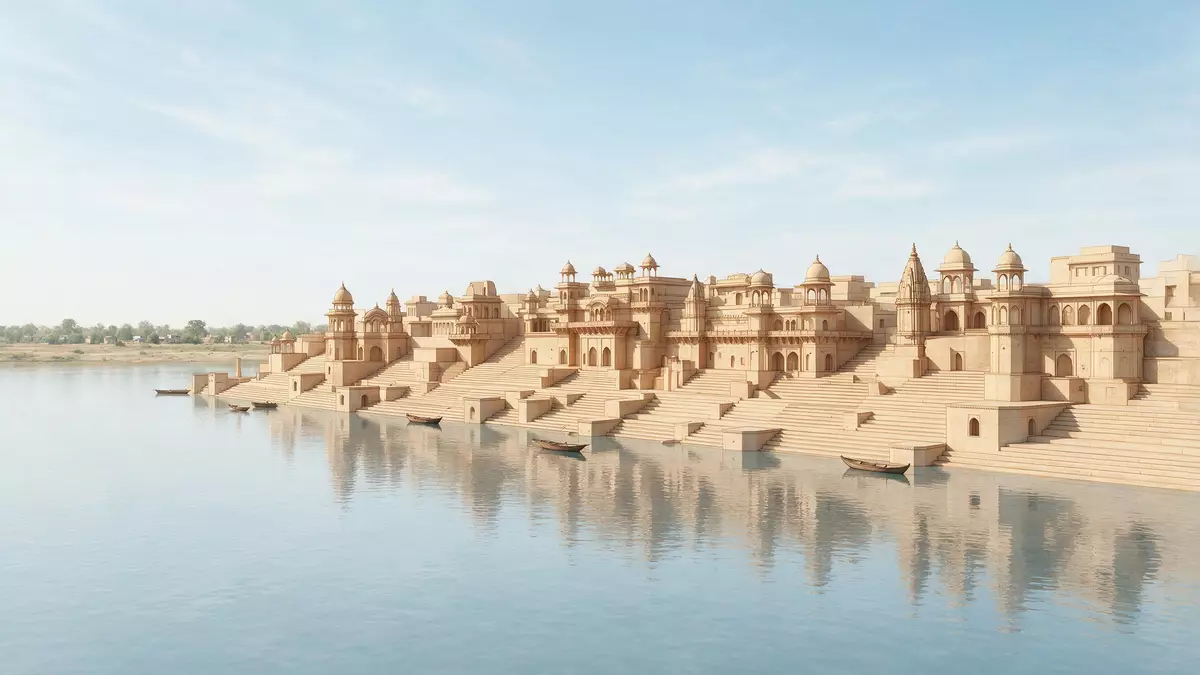
Varanasi Ghats are the stepped riverfront along the Ganges in Varanasi, India, where stone stairways descend to the water and frame rituals, crossings and everyday life. The riverfront as a sacred landscape is documented from the early centuries of the first millennium CE, with stone-built ghats beginning to appear from the fourteenth century and many rebuilt under Maratha patronage in the eighteenth century, giving the present sequence its layered historical form.
The riverfront as a continuous sacred landscape
Standing on the riverbank in Varanasi, the defining impression is a continuous terrace of stone steps and platforms following the curve of the Ganges for a considerable stretch of the city. Sources on the riverfront describe the history of ghats as reaching back to the eighth and ninth centuries, with stepped masonry constructions added from the fourteenth century and later extended and rebuilt, creating the long sequence of bathing places, ceremonial zones and access points seen along the water today.history of waterfront sacred spots The riverfront appears in pilgrim geography as a site where the Ganges is approached by formalised steps rather than a natural bank, an arrangement that supports ritual bathing, offerings and boat landings.
Descriptions of the ghats note that the majority of the present structures were reconstructed in the eighteenth century, when Varanasi’s riverfront fell under the influence of Maratha rulers and associated houses such as the Shindes and Holkars.eighteenth-century Maratha reconstruction Many ghats combine these later masonry interventions with older associations recorded in texts and local tradition, linking specific stairways with particular deities, rituals or episodes. The result is a riverfront where physical construction dates from the medieval and early modern periods, while the devotional landscape tied to it is rooted in earlier centuries.
Dashashwamedh Ghat: ritual steps beside Kashi Vishwanath
Among the named ghats, Dashashwamedh Ghat occupies a central position on the riverfront and lies close to the Kashi Vishwanath temple complex in the old city. Information on its religious name explains that “Dash” refers to ten, “Ashwa” to horses and “Medh” to sacrifice, connecting the ghat with a myth in which Lord Brahma performs a sacrificial rite involving ten horses to welcome Lord Shiva to Kashi.Dashashwamedh Ghat name origin The stairways at this point lead to a broad riverside platform facing the Ganges, framed by temples and buildings that step back from the waterline.
Historical summaries of Dashashwamedh Ghat trace its documented status to early references associated with the Naga dynasty and later building campaigns in the eighteenth century. One account identifies the first masonry ghat as being constructed by Balaji Bajirao between 1738 and 1740, with further renovation attributed to Maharani Ahilyabai Holkar in 1765.eighteenth-century works at Dashashwamedh Subsequent works in the twentieth century added and repaired stairways, giving the ghat an arrangement of multiple flights of steps descending to the river, punctuated by shrines and small platforms used for ceremonies.
Assi Ghat: southern anchor of the main riverfront
At the southern end of the principal sequence of ghats lies Assi Ghat, located where the Assi watercourse meets the Ganges and forming a recognised boundary of Kashi’s main riverfront. It is described as the southernmost of Varanasi’s principal ghats and one of the largest, with broad steps and open paved areas leading down to the water.southernmost Assi Ghat The convergence of the Assi and Ganges is part of the ghat’s religious identity, and accounts of its mythology link the Assi River with narratives involving Goddess Durga.
Assi Ghat appears in multiple summaries as a place where pilgrims and residents visit a Shiva lingam placed beneath a peepal tree, and where cultural programmes at sunrise incorporate music and other activities referencing the idea of “Subah-e-Banaras”, or the morning of Banaras.Assi Ghat and Subah-e-Banaras Over time, it has also become associated with longer stays by students and researchers drawn to the riverfront, while remaining part of the wider circuit of ghats linked in puranic texts and devotional itineraries.
Visiting Varanasi Ghats: what travellers from Western Europe should know
- Varanasi Ghats extend along the Ganges in the city of Varanasi in northern India, and are most readily reached by road from the city’s inner neighbourhoods and river-facing lanes leading down to the steps.
- The terrain at the ghats consists of long flights of stone steps and paved platforms descending towards the river, with some stairways steep and without handrails, and access often involving uneven surfaces.
- Assi Ghat marks the southern end of the main riverfront sequence, while Dashashwamedh Ghat lies closer to the old city centre and Kashi Vishwanath temple area, so different approaches through the lanes lead to different sections of the riverfront.
- Varanasi lies in the northern plains of India, where the Ganges experiences seasonal variation in water level; in periods of higher river flow, lower steps at some ghats can stand under water while upper platforms remain accessible.
- The official language is Hindi and the currency is the Indian rupee; entry requirements depend on your nationality; UK travellers can check the FCDO travel advice at gov.uk/foreign-travel-advice, Irish travellers the Department of Foreign Affairs at ireland.ie.
Searching for Varanasi Ghats on social platforms
These links open searches for Varanasi Ghats on each platform.
Frequently asked questions about Varanasi Ghats
Where are Varanasi Ghats located?
Varanasi Ghats line the western bank of the Ganges River in the city of Varanasi in northern India, forming a stepped riverfront of stone stairs and platforms.
What should visitors expect when approaching the ghats?
Visitors encounter stairways leading down to the river, with boats moored at the water’s edge, temples and residential buildings backing the steps, and different ghats marked by shrines, platforms and riverside spaces.
What makes Varanasi Ghats distinctive among riverfronts?
The ghats combine a long, largely continuous suite of stone steps built from the fourteenth century onwards with specific named places such as Dashashwamedh Ghat and Assi Ghat, each carrying its own religious associations and historical reconstructions under patrons including eighteenth-century Maratha rulers.


