
Varadero’s long blue beach on Cuba’s Hicacos Peninsula
Published on 09/14/2026 at 12:32 | Editorial responsibility: Rafael Müller, Editor-in-Chief AD HOC NEWS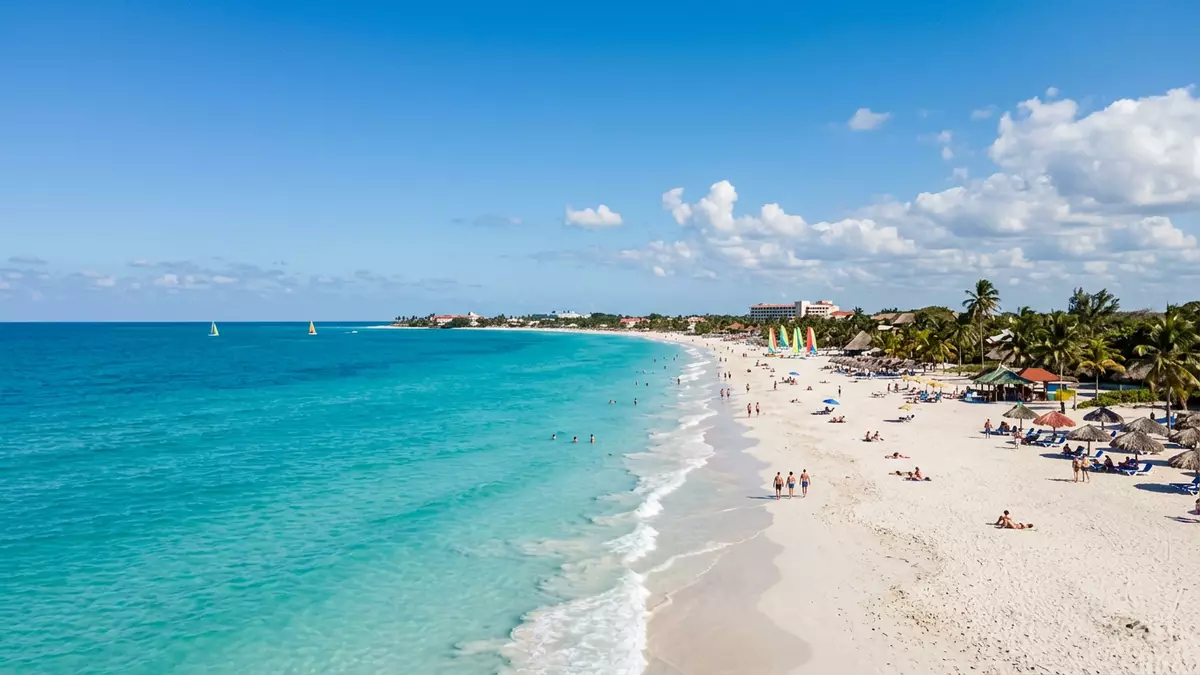
Varadero in northern Cuba is a resort town laid out along the Hicacos Peninsula, where a long, pale belt of sand and shallow Caribbean water shapes every part of the settlement. Founded as a planned coastal town in the late nineteenth century, Varadero has grown into one of the largest resort areas in the Caribbean while remaining closely tied to its continuous beach and double maritime setting.
A town built along a narrow peninsula
Varadero occupies much of the Hicacos Peninsula on the northern coast of Cuba, in Matanzas Province, administratively forming part of the municipality of Cárdenas.Hicacos Peninsula The peninsula is a narrow tongue of land extending out between the Straits of Florida on its northern side and the Bay of Cárdenas to the south, so that the town’s streets and buildings sit between two distinct bodies of water rather than facing a single open coast.between the Straits of Florida and the Bay of Cárdenas
The Hicacos Peninsula runs for over 20 km (12.4 mi), and much of that length carries Varadero’s built-up strip of hotels, houses and resort complexes close to the shore.extension of land about 22 km long Behind the seafront, low limestone, patches of mangroves and planted areas mark the transition from sand to the interior of the peninsula, but the settlement largely follows the coastline, reflecting its origin as a place created for access to the beach rather than a harbour town or inland centre.Varadero stretches along the Hicacos Peninsula
From nineteenth-century plan to Caribbean resort
Varadero’s modern history is closely tied to the late nineteenth century, when wealthy families from nearby Cárdenas began to establish summer residences on the peninsula. On 5 December 1887 the municipal council in Cárdenas approved a formal town layout prepared by surveyor José López Martínez, dividing the new settlement into blocks and plots and giving Varadero an official founding date.official date of the founding of Varadero That decision transformed what had been a coastal area used for ship careening and salt extraction into a recognised town whose plan followed the shoreline rather than a traditional inland grid.
Over the twentieth century Varadero developed from a small settlement with villas and early hotels into a resort area with a continuous zone of tourist accommodation along its beach. The transformation drew on earlier economic activity at the Las Salinas salt mines on the peninsula and on the growing interest of Cuban and foreign visitors attracted by the geography of the narrow spit of land and its exposure to sea breezes.salt mines operated on the peninsula By the later twentieth century Varadero had become one of the Caribbean’s major resort belts, its townscape characterised by a long chain of hotels, apartment buildings and leisure facilities sharing the limited width between beach and lagoon.
The long belt of sand called Playa Azul
The defining feature of Varadero is its continuous white-sand beach, traditionally known as Playa Azul, which runs for more than 20 km (12.4 mi) along the seaward edge of the Hicacos Peninsula.Playa Azul The pale sand forms a broad arc facing north towards the Straits of Florida, with shallow, clear water and a gently shelving seabed that has drawn visitors to this coast for generations.20-km long Varadero beach The relationship between town and shore is unusually direct: streets often terminate close to the sand, and many properties stand within a short walk of the beach line.
Because the peninsula is relatively narrow, Varadero’s beach and the southern bayside environment sit close together, separated by only a small band of land. This gives the town a distinctive double aspect, with views either towards the open straits or across calmer water towards the Cuban mainland. The open coast is lined with resort developments, promenades and access paths through low dunes, while the southern side includes marinas and inland waters where boats shelter away from the surf. The name Varadero itself derives from the Spanish verb “varar”, linked to beaching or running vessels aground, and reflects the long history of this coastline as a place where ships were brought ashore for work before its era as a leisure destination.the name itself comes from the Spanish word “varar”
Visiting Varadero: what travellers from Western Europe should know
- Varadero lies on the Hicacos Peninsula in Matanzas Province on the northern coast of Cuba, reached by road from inland towns such as Cárdenas and by routes east from Havana.
- The terrain is coastal and low-lying, with stretches of white sand, patches of mangroves and sections of limestone, and many resort areas are arranged directly beside the beach.
- Varadero’s resort strip includes hotels and other accommodation close to the shoreline, so movement through the town often alternates between built-up areas and open sections of beach.
- The official language is Spanish and the currency is the Cuban peso.
- Entry requirements depend on your nationality; UK travellers can check the FCDO travel advice at gov.uk/foreign-travel-advice, Irish travellers the Department of Foreign Affairs at ireland.ie.
Searching for Varadero on social platforms
These links open searches for Varadero on each platform.
Frequently asked questions about Varadero
Where is Varadero in Cuba?
Varadero is a resort town in Matanzas Province on Cuba’s northern coast, occupying much of the Hicacos Peninsula between the Straits of Florida and the Bay of Cárdenas.
What should visitors expect on a first trip to Varadero?
Visitors encounter a long coastal town arranged along an extensive white-sand beach, with hotels and other resort facilities closely aligned with the shoreline and low-lying terrain.
What makes Varadero distinctive among Caribbean resort areas?
Varadero’s distinctiveness lies in its long continuous beach known as Playa Azul and in the way its resort town is built along a narrow peninsula framed by two bodies of water.


