
Vang Vieng’s karst valley along the Nam Song River
Published on 09/14/2026 at 13:41 | Editorial responsibility: Rafael Müller, Editor-in-Chief AD HOC NEWS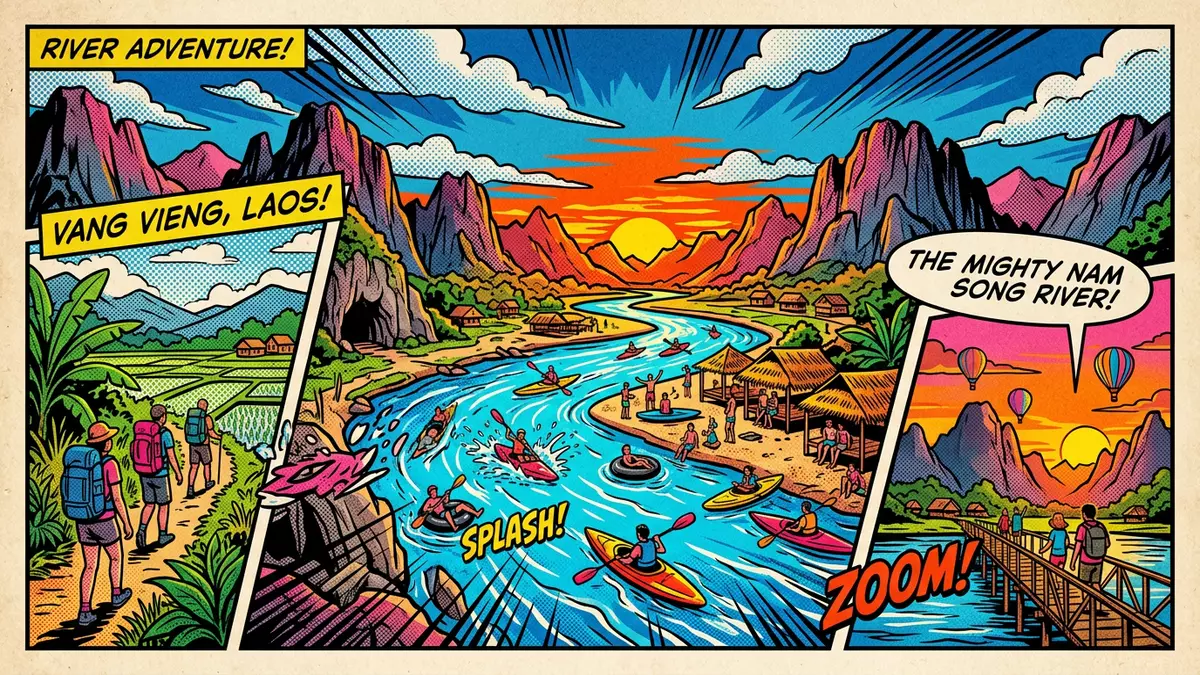
Vang Vieng in central Laos is a small riverside town set in a broad valley where the Nam Song River runs beneath steep limestone hills, caves and pools carved into a karst landscape.Vientiane Province provides the wider setting, but the defining impression is the way limestone towers cluster around the town and rise sharply from rice fields and braided channels of the river.Nam Song River flows through the centre, making Vang Vieng feel both like a settlement and a landscape at once.
Limestone towers, river and valley floor
The karst landscape around Vang Vieng consists of rugged limestone massifs that form pinnacles, domes and cliffs above a relatively flat valley floor.limestone karst valley These outcrops rise from fields and tracks in abrupt walls, some covered in dense vegetation and lianas, others showing pale, almost sheer faces of rock. Between them, broad alluvial plains carry rice paddies, farm plots and minor watercourses flowing towards the Nam Song, giving clear views from the town towards the surrounding cliffs.
The limestone peaks in the wider karst sector around Vang Vieng reach elevations well above the valley floor, with named heights such as Pha Nampin and Pha Deng recorded in descriptions of the region.named peaks such as Pha Nampin Paths from the town lead across fields towards the bases of these hills, and simple tracks continue onto slopes, where viewpoints look out over the Nam Song and the mosaic of cliffs and farmland. The overall impression is of a compact basin of rock and water, with Vang Vieng’s streets sitting near the river while limestone blocks ring the horizon.
Caves under the hills: Tham Chang and the karst underworld
One of the clearest ways to see how karst has shaped Vang Vieng is to visit the caves that open at the foot of the hills, where limestone has been dissolved by water over long periods.limestone karst landscape Slightly acidic rainwater and river water have acted on the limestone bedrock to form underground channels, caverns and depressions, leaving a network of caves along valley margins and at the bases of cliffs.karst landscapes formed through dissolution of limestone Many of these caves have chambers where stalactites and stalagmites have developed from dripping water, giving a view into the slow geological processes that produced the landscape above.
Tham Chang Cave, also written Tham Jang, is among the best known caves near Vang Vieng and lies a short distance south of the town centre on the banks of the Nam Song River.Tham Chang Cave Visitors reach it by crossing a bridge over the river and climbing a staircase that leads up into the rock, where interior chambers spread across more than one level.two-level cave system From openings near the cave entrance, there are views back over the Nam Song and the valley, linking the underground formations with the cliffs and fields outside.
Blue lagoons, viewpoints and the wider karst basin
The same karst geology that created caves has also produced pools of clear, mineral-rich water around Vang Vieng, often known as blue lagoons, where water gathers at the foot of limestone hills.blue lagoons around Vang Vieng These lagoons, including named spots such as Lagoon 1 and Lagoon 3 in descriptions of the area, sit beside forest and rock, with simple platforms or banks that allow access to the water. They form another way in which surface water and limestone meet, contrasting with the flowing river and the dry cliffs nearby.
Beyond the immediate edge of the town, the karst basin around Vang Vieng extends for several kilometres along the right bank of the Nam Song, creating a continuous belt of limestone terrain.continuous belt of limestone terrain Viewpoints such as Nam Xay are described as routes that climb onto ridges or summits from which travellers can see jagged cliffs, rice fields and the line of the river in one frame.Nam Xay viewpoint Taken together, the town, river, caves, lagoons and peaks form a single landscape, with Vang Vieng functioning as a base within the karst rather than a separate urban centre.
Visiting Vang Vieng: what travellers from Western Europe should know
- Vang Vieng lies in Vientiane Province in central Laos, beside the Nam Song River, reached overland from Vientiane and Luang Prabang by road routes and bus services.
- Tracks and paths from the town towards caves and viewpoints cross fields and climb slopes, including staircases up cliff faces, so visiting often involves walking on uneven ground and ascending long flights of steps.
- The surrounding terrain combines riverbanks, rice fields and limestone hills, with access routes that may include simple bridges over the Nam Song and narrow paths at the base of cliffs.
- The official language is Lao and the currency is the Lao kip.
- Entry requirements depend on your nationality; UK travellers can check the FCDO travel advice at gov.uk/foreign-travel-advice, Irish travellers the Department of Foreign Affairs at ireland.ie.
Searching for Vang Vieng on social platforms
These links open searches for Vang Vieng on each platform.
Frequently asked questions about Vang Vieng
Where is Vang Vieng and what kind of place is it?
Vang Vieng is a town in Vientiane Province in Laos on the Nam Song River, enclosed by a dense limestone karst landscape of hills and caves.
What should travellers expect when visiting Vang Vieng?
A visit centres on the contrast between the compact town, the river and the surrounding limestone towers, with paths, staircases and tracks reaching caves, lagoons and viewpoints.
What makes Vang Vieng distinctive among landscapes in Laos?
Its defining feature is the way a small riverside town sits inside a continuous karst basin, combining cliffs, caves, blue lagoons and rice fields within a relatively small area.


