
Valparaiso, Chile’s hillside port of elevators and colour
Published on 09/17/2026 at 10:38 | Editorial responsibility: Rafael Müller, Editor-in-Chief AD HOC NEWS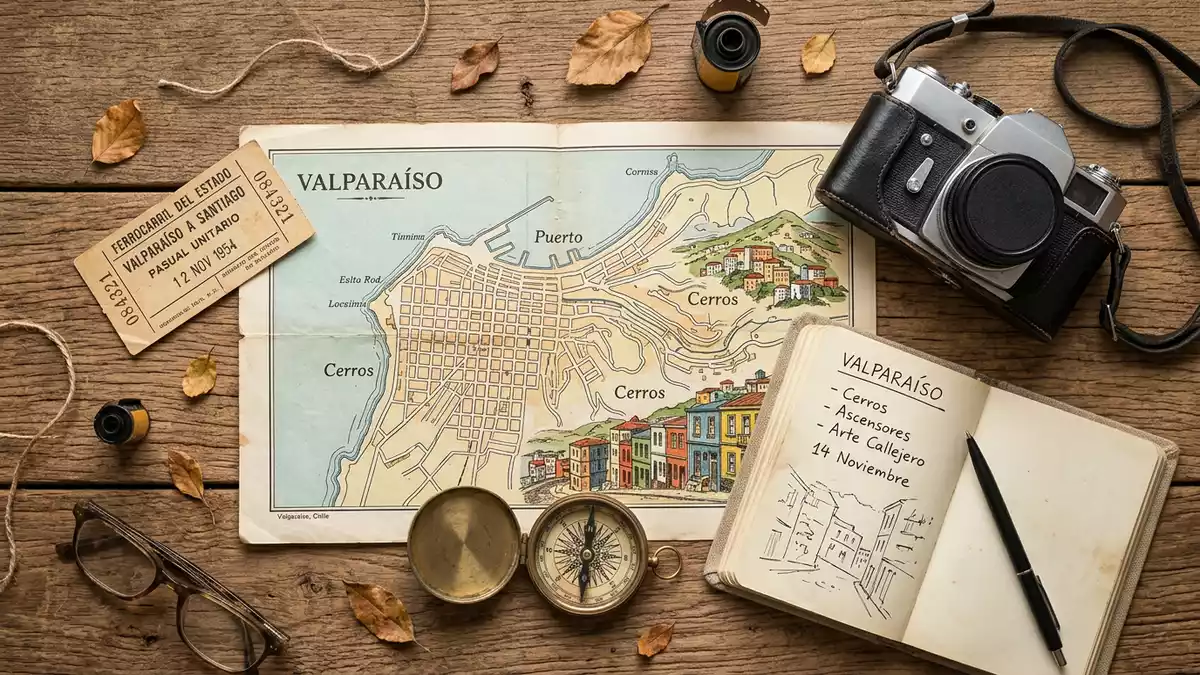
Valparaiso on the Pacific coast of Chile rises from a working harbour into steep hillsides, where funicular elevators and painted houses form a distinctive layered cityscape rooted in maritime trade of the nineteenth century.
Valparaiso between ocean, plain and hills
Valparaiso lies on central Chile’s Pacific shoreline, where a narrow coastal plain meets abrupt hills that frame the bay in a kind of natural amphitheatre.central Chile’s Pacific coast The port-level area, often referred to as the plan, holds the harbour installations, commercial streets and key civic squares, while the residential districts climb the slopes above on terraces cut into the terrain.amphitheatre-like setting
The historic quarter extends across parts of the plain and the adjoining hills, reflecting Valparaiso’s period as a leading merchant port in the late nineteenth and early twentieth centuries.early phase of globalisation Neighbourhoods close to the harbour, such as the areas around Sotomayor Square and Prat Pier, concentrate monumental public buildings and broad plazas, while hillside districts above, including Cerro Alegre and Cerro Concepción, are reached by narrow streets, stairways and the upper stations of the funiculars.
A World Heritage harbour town of funiculars and cerros
In 2003 the historic quarter of Valparaiso was inscribed on the UNESCO World Heritage List as a cultural site, recognised for its testimony to the era when the city served as a major merchant port on the Pacific routes of South America.historic quarter declared a UNESCO World Heritage SiteHistoric Quarter of the Seaport City of Valparaíso (2003) The listed area combines public spaces, port infrastructure and residential slopes, and large parts of it are also protected as a National Monument under Chilean law.Área Histórica de la Ciudad-Puerto de Valparaíso
One of Valparaiso’s defining features is the network of funicular elevators, locally known as ascensores, that link the harbour-level streets with the cerros above.numerous ‘elevators' on the steep hillsides These short inclined railways climb the steep slopes to upper stations serving hillside neighbourhoods, and several of them date from the late nineteenth century.funicular elevators, 1883–1916 The cerros themselves form a patchwork of streets, staircases, small plazas and viewing points, with Cerro Alegre and Cerro Concepción particularly known for their mixture of historic houses, church spires and elevated promenades.
Painted houses, street art and immigrant architecture
Valparaiso’s hillsides are characterised by an irregular fabric of housing adapted to the slopes, with buildings perched on terraces and supported on structures that follow the contours.vernacular urban fabric adapted to the hillsides Many facades carry strong colours, and corrugated cladding is common on the exterior walls, giving the streets a varied, textured appearance when seen from across the bay or from neighbouring hills.
Cerro Alegre and Cerro Concepción together form a hillside district where nineteenth-century houses built by German and English immigrant communities stand beside later additions, lining narrow streets and elevated walks.two hills of Cerro Alegre and Cerro ConcepciónCerros Alegre y Concepción In several cerros, including Bellavista and parts of Alegre and Concepción, building-scale murals and smaller street paintings cover retaining walls, stair risers and house fronts, creating open-air galleries that are visible along walking routes up and across the slopes.extraordinary outdoor street art
Visiting Valparaiso: what travellers from Western Europe should know
- Valparaiso lies on Chile’s central Pacific coast north-west of Santiago and is reached overland from the capital, with intercity buses using terminals in both cities.
- The historic quarter combines level streets by the harbour with steep hillsides above, connected by staircases and funiculars; moving between districts on foot involves gradients and flights of steps.
- The main protected area includes port squares such as Plaza Sotomayor and hillside neighbourhoods like Cerro Alegre and Cerro Concepción, so walking routes frequently alternate between busy harbour zones and quieter elevated streets.
- The official language is Spanish and the currency is the Chilean peso.
- Entry requirements depend on your nationality; UK travellers can check the FCDO travel advice at gov.uk/foreign-travel-advice, Irish travellers the Department of Foreign Affairs at ireland.ie.
Searching for Valparaiso on social platforms
These links open searches for Valparaiso on each platform.
Frequently asked questions about Valparaiso
Where is Valparaiso and what kind of place is it?
Valparaiso is a port city on the central Pacific coast of Chile, built on a narrow coastal plain and steep hills rising above its harbour.
What should visitors expect when exploring Valparaiso?
Visitors encounter a combination of busy harbour squares, hillside neighbourhoods reached by funiculars and staircases, and streets lined with colourful houses and extensive street art.
What makes Valparaiso distinctive among Chilean cities?
Valparaiso’s combination of nineteenth-century port heritage, World Heritage status, hillside funicular network and painted urban slopes gives it a distinctive character within Chile.


