
Valparaiso and the hills above the port
Published on 09/08/2026 at 22:29 | Editorial responsibility: Rafael Müller, Editor-in-Chief AD HOC NEWS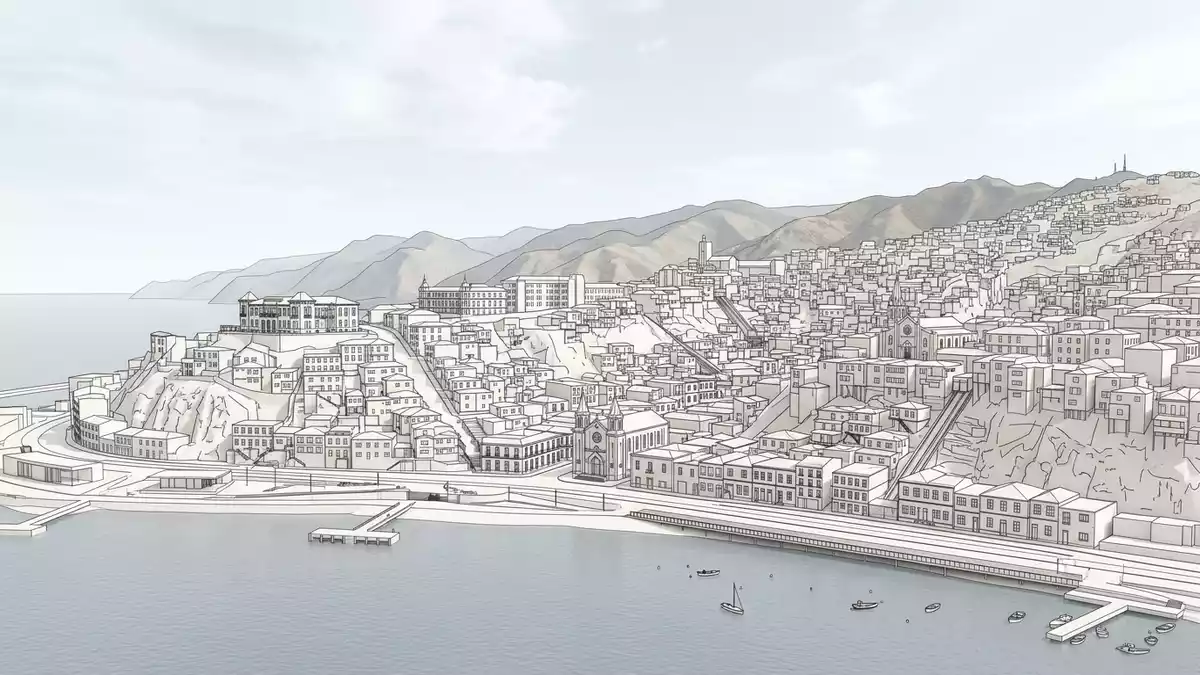
Valparaiso in Chile rises above the Pacific on steep hills, with a historic quarter recognised by UNESCO in 2003. The seaport city’s historic quarter gives the place its strongest shape: a port town built across slopes, stairs and linked neighbourhoods.
Valparaiso’s hills, port and stairways
The city’s lower streets meet a hillside fabric of lanes, houses and long climbs. UNESCO describes Valparaiso as a living historic town and an exceptional example of industrial-age heritage tied to sea trade. The historical area covers a group of buildings rather than a single monument, and that suits a city read in fragments as much as in panorama.
The hills are part of the city’s identity, and the slopes carry the historic elevators known locally as ascensores. Valparaiso is also linked to Juan de Saavedra, who is credited with naming it in 1536, and the name still frames the city’s earliest European chapter. Juan de Saavedra remains one of the names most closely tied to its beginnings.
Valparaiso and its world heritage quarter
The World Heritage quarter brings together port infrastructure, commercial streets, squares and hill neighbourhoods. Its fabric reflects a late nineteenth-century port city, with British and German influence visible in parts of the residential hills and in the city’s commercial past. The Alegre and Concepción hills sit alongside quay-side spaces and the flat lower town, keeping the city’s layers legible.
The quarter also includes the elevators, which are part of the city’s architecture as much as its transport history. They remain one of the clearest signs of how Valparaiso is built: not as a level grid, but as a city of inclines, terraces and vertical connections. Valparaíso funiculars are the most visible expression of that form.
Valparaiso’s early history and colonial setting
Valparaiso is a city in central Chile, on the Pacific coast, and it is the capital of the Valparaíso Region. Its historical profile begins in the sixteenth century, with 1536 as the date most closely linked to Juan de Saavedra and the city’s European naming. The name Juan de Saavedra belongs to that early chapter.
The UNESCO listing describes the city as an example of late nineteenth-century urban development in Latin America. Its amphitheatre-like setting, hillside streets and preserved early industrial features give Valparaiso a profile that is architectural as much as maritime. That mix of port, slope and old infrastructure is the city’s lasting visual grammar.
Visiting Valparaiso: what travellers from Western Europe should know
- Valparaiso lies on central Chile’s Pacific coast, west of Santiago, and the historic quarter stretches across the port area and the hills above it.
- The city’s terrain is steep in places, with stairways, slopes and linked upper and lower districts. The historic elevators are part of that vertical landscape.
- Entry requirements depend on your nationality; UK travellers can check the FCDO travel advice at gov.uk/foreign-travel-advice, Irish travellers the Department of Foreign Affairs at ireland.ie.
- The official language is Spanish and the currency is the Chilean peso.
Searching for Valparaiso on social platforms
These links open searches for Valparaiso on each platform.
Frequently asked questions about Valparaiso
Where is Valparaiso?
Valparaiso is a port city on central Chile’s Pacific coast. It is also the capital of the Valparaíso Region.
What defines a visit to Valparaiso?
Steep hills, stairways, lower port streets and historic elevators shape the city. The UNESCO-listed quarter brings those elements together in one urban landscape.
What makes Valparaiso distinctive?
Its steep setting and port history give it a layered form, with hills, squares, commercial streets and infrastructure linked to sea trade. The city’s historic quarter was inscribed on the World Heritage List in 2003.


