
Valley of the Queens, Luxor’s resting place of royal women
Published on 09/15/2026 at 14:54 | Editorial responsibility: Rafael Müller, Editor-in-Chief AD HOC NEWS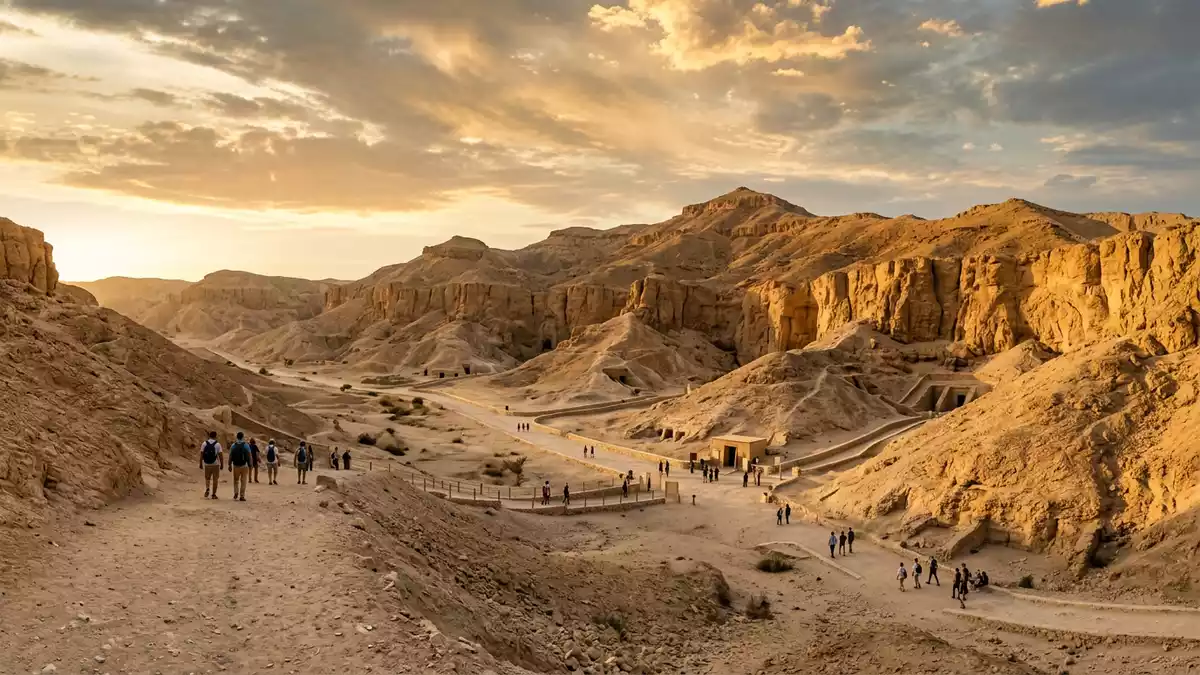
On the west bank of the Nile at Luxor, the Valley of the Queens is a desert side valley cut into the Theban hills, used as a necropolis for royal women and children of Egypt’s New Kingdom. Queens, princes, princesses and high officials were buried here between the sixteenth and eleventh centuries BC, in rock-cut tombs that turn a bare wadi into an underground world of colour and royal symbolism.New Kingdom burial ground
A side valley of the Theban Necropolis
The Valley of the Queens lies in the Theban Necropolis, the broad belt of royal and noble cemeteries and mortuary temples that stretches across Luxor’s west bank desert. It occupies a side wadi at the southern end of the Theban hillside, south of the better known Valley of the Kings and west of the cultivated strip along the Nile.gorge in the hills In ancient Egyptian the valley was called Ta-Set-Neferu, “The Place of Beauty”, a name that connects its harsh cliffs with the decorated spaces cut within them.Ta-Set-Neferu
The necropolis belongs to the wider UNESCO-listed Theban ensemble, which includes the Valleys of the Kings and Queens, Deir el-Medina and the great mortuary temples facing the river.part of the Theban Necropolis Here the desert rises in pale cliffs above the irrigated fields, and the entrance to the valley leads into a dry, rocky hollow dotted with tomb doorways and low modern structures marking excavated shafts.location at Luxor
Queens, dynasties and tomb architecture
Use of the Valley of the Queens began in the eighteenth dynasty, when royal children and courtiers were buried here; it then became the main burial ground for queens and royal offspring of the nineteenth and twentieth dynasties, roughly between 1290 and 1070 BC.eighteenth to twentieth dynastiesburial site of queens and royal children During the reigns of Ramesses II and Ramesses III, wives, daughters and sons of the pharaohs were allocated tombs here, echoing the separation between the kings’ valley and the family necropolis.
Archaeological surveys have recorded more than ninety tombs in the Valley of the Queens, ranging from simple shafts with a small chamber to more elaborate complexes with passages and multiple rooms.over 90 tombs91 recorded tombs Typical plans include a sloping entrance corridor, one or more short halls and a burial chamber where the sarcophagus once stood.entrance passages and sarcophagus chambers Many tombs retain sections of painted decoration, with deities, offering scenes and hieroglyphic texts laid out on plastered walls above the cut rock.
Nefertari’s painted tomb and other decorated burials
The most celebrated tomb in the valley is QV66, the burial of Queen Nefertari, Great Royal Wife of Ramesses II, whose interior paintings rank among the finest surviving works of New Kingdom funerary art.QV66 Nefertari The walls show Nefertari playing senet, meeting gods and travelling through the underworld, with rich reds, blues and yellows set against a pale background that has kept its clarity despite the passage of more than three millennia.painted tomb of Nefertari
Other tombs of the valley include burials of princes such as Khaemwaset and Amunherkhepshef, and of lesser queens and royal sons whose names survive in hieroglyphic bands above their doorways.tombs of Khaemwaset and Amunherkhepshef In several cases the rock has been re-used, with older chambers adapted for later burials during the Ramesside period, illustrating how this side valley evolved as a family cemetery for successive generations of the royal house.
Visiting Valley of the Queens: what travellers from Western Europe should know
- Valley of the Queens lies on the west bank of the Nile opposite Luxor, in a side valley south of the Valley of the Kings and within the wider Theban Necropolis.
- The approach from the cultivated strip leads into a dry desert hollow with low gradients, where paths cross rough ground and short flights of steps connect the entrance area with individual tombs.
- The surrounding region has a hot desert climate and little natural shade inside the valley, so visits involve walking exposed to sun between the entrance area and the tomb doorways.
- The official language is Arabic and the currency is the Egyptian pound.
- Entry requirements depend on your nationality; UK travellers can check the FCDO travel advice at gov.uk/foreign-travel-advice, Irish travellers the Department of Foreign Affairs at ireland.ie.
Searching for Valley of the Queens on social platforms
These links open searches for Valley of the Queens on each platform.Frequently asked questions about Valley of the Queens
Where is Valley of the Queens in relation to Luxor?
Valley of the Queens lies on the west bank of the Nile opposite Luxor, in a desert side valley at the southern end of the Theban hills within the wider necropolis.
What can visitors expect when exploring the site?
Visitors walk through a dry desert hollow with paths leading to rock-cut tomb entrances, some of which preserve painted walls with New Kingdom scenes of gods, royal figures and hieroglyphic texts.
What makes Valley of the Queens distinctive among Egyptian burial sites?
It serves as the main New Kingdom necropolis for royal wives and children, and includes the richly decorated tomb of Queen Nefertari, whose paintings are among the finest preserved works of Ramesside funerary art.


