
Valle dei Templi: Doric temples above Agrigento
Published on 09/09/2026 at 11:06 | Editorial responsibility: Rafael Müller, Editor-in-Chief AD HOC NEWS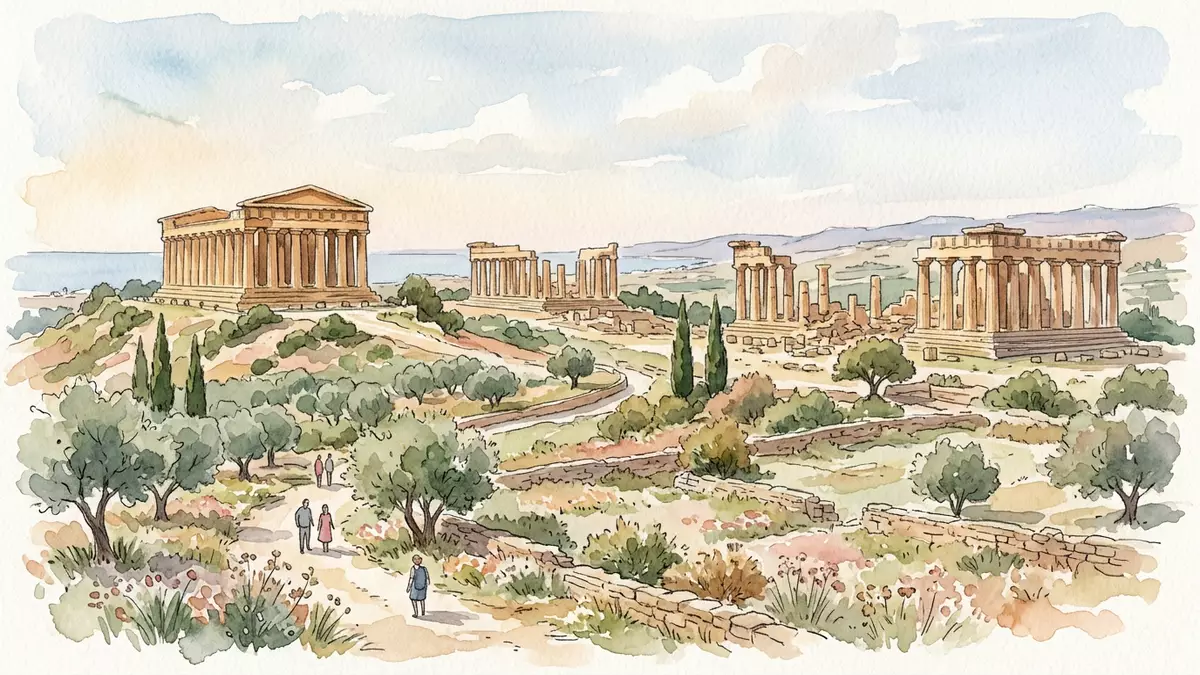
South of Agrigento in Sicily, Valle dei Templi spreads across a rocky ridge where ancient Akragas framed the skyline with Doric temples and defensive walls, now preserved as an extensive archaeological and landscape park. Since 1997 the Archaeological Area of Agrigento, including Valle dei Templi, has been inscribed on the UNESCO World Heritage List for the exceptional integrity of its classical Greek remains and their setting in the Sicilian countryside.
Doric temples along the rocky scarp
Valle dei Templi follows a long rocky scarp that once marked the southern edge of ancient Akragas, with a line of Doric temples set above the surrounding terrain and facing towards the sea. The site corresponds to the monumental core of the Greek city founded as Akragas, which later became Agrigentum under Roman rule, and retains structures from both periodspreserves the monumental heritage of Akragas. The temples occupy a plateau not far from the coast yet within sight of the modern town, so visitors see the colonnades rising above olive groves with Agrigento’s buildings on the higher hill beyondlocated on a plateau not far from the sea.
The alignment includes major sanctuaries traditionally associated with Hera (Juno), Concordia, Heracles (Hercules), Olympian Zeus (Jupiter), the Dioscuri and Hephaistos, forming a colonnaded sequence that reads as a stone avenue of deitiestemples of ancient Akragas. Their Doric order, with sturdy columns and simple capitals, gives the ruins a clear architectural rhythm, and several temples retain substantial portions of their peristyles, cellae and entablatures, allowing the overall proportions of a classical Sicilian temple to be read directly from the standing stone.
From Greek colony to protected archaeological park
Akragas was one of the most important Greek colonies in the western Mediterranean, and its prosperity in the fifth century BC underlies the scale and finish of the temples preserved at Valle dei Templione of the most important Greek colonies. The Temple of Concordia, built around 440–430 BC, is among the best-preserved Doric temples in Magna Graecia, with nearly complete colonnades on all sides and a recognisable interior cella framed by massive sandstone blockstemple was built c. 440–430 BC. In the sixth century the structure was converted into a Christian basilica dedicated to Peter and Paul, a change of use that helped protect the fabric when many pagan sanctuaries elsewhere were dismantled.
The archaeological and landscape park of Valle dei Templi was formally established by regional law in 2000, bringing together the temples, necropolis, extra-mural sanctuaries and broader agricultural landscape within a single protected entity covering around 1,300 hectaresparco archeologico della Regione Siciliana. This scale makes it one of the largest archaeological parks in Europe and the Mediterranean basin, with open areas of countryside forming part of the official site alongside monumental stone architecturelargest archaeological park in Europe. The UNESCO inscription in November 1997 rests on criteria that recognise both the artistic value of the temples and the intact condition of the ancient city’s layout within its rural surroundingsArchaeological area of Agrigento enlisted by UNESCO.
Walking the landscape between temples and museum
Exploring Valle dei Templi involves moving between distinct archaeological zones that together outline the structure of Akragas, from temple ridge to necropolis and urban quarters. Paths follow the rocky scarp beside the main line of temples, passing stretches of fortification wall, stairways cut into the rock and viewpoints that look across cultivated land towards the MediterraneanValley of the Temples in Agrigento. Within the wider park there are areas of ancient housing, hydraulic works and meeting places that give a sense of the everyday city behind the monumental façadesconsists of temples, sanctuaries and quarters.
On the northern side of the park, the Pietro Griffo Regional Archaeological Museum presents thousands of artefacts from the territory, set in chronological order from prehistory through the Greek and Roman periodsPietro Griffo Regional Archaeological Museum. Architectural fragments from the temples, votive objects and everyday ceramics there help connect the standing ruins on the ridge with the people who lived in Akragas, underlining that Valle dei Templi is both a landscape of large-scale stone architecture and a repository of smaller material traces.
Visiting Valle dei Templi: what travellers from Western Europe should know
- Valle dei Templi lies just outside Agrigento in south-western Sicily and is reached over local roads from the city; regional buses and organised excursions link Agrigento with other Sicilian centres.
- The archaeological park covers extensive ground, with long paths along the rocky ridge and through open countryside, so visiting involves sustained walking on uneven surfaces and stone steps.
- The temples stand close to cultivated fields and scattered trees, and shade is limited along some stretches of the ridge, so exposed sections alternate with short sheltered areas beside ruins and vegetation.
- The official language is Italian and the currency is the euro.
Searching for Valle dei Templi on social platforms
These links open searches for Valle dei Templi on each platform.
Frequently asked questions about Valle dei Templi
Where is Valle dei Templi and what kind of site is it?
Valle dei Templi stands just outside Agrigento in south-western Sicily and forms an archaeological and landscape park centred on the monumental remains of ancient Akragas.
What can visitors expect when walking through the park?
Visitors encounter a sequence of Doric temples along a rocky ridge, stretches of city wall, necropolis areas and countryside paths, with the museum presenting artefacts from the wider territory.
What makes Valle dei Templi distinctive among ancient sites?
The combination of large-scale Doric temples from the fifth century BC, the integrity of the ancient city layout and the 1,300-hectare protected landscape gives Valle dei Templi a rare monumental and spatial coherence.


