
Valle dei Templi, a stone-made skyline above Agrigento
Published on 09/14/2026 at 14:00 | Editorial responsibility: Rafael Müller, Editor-in-Chief AD HOC NEWS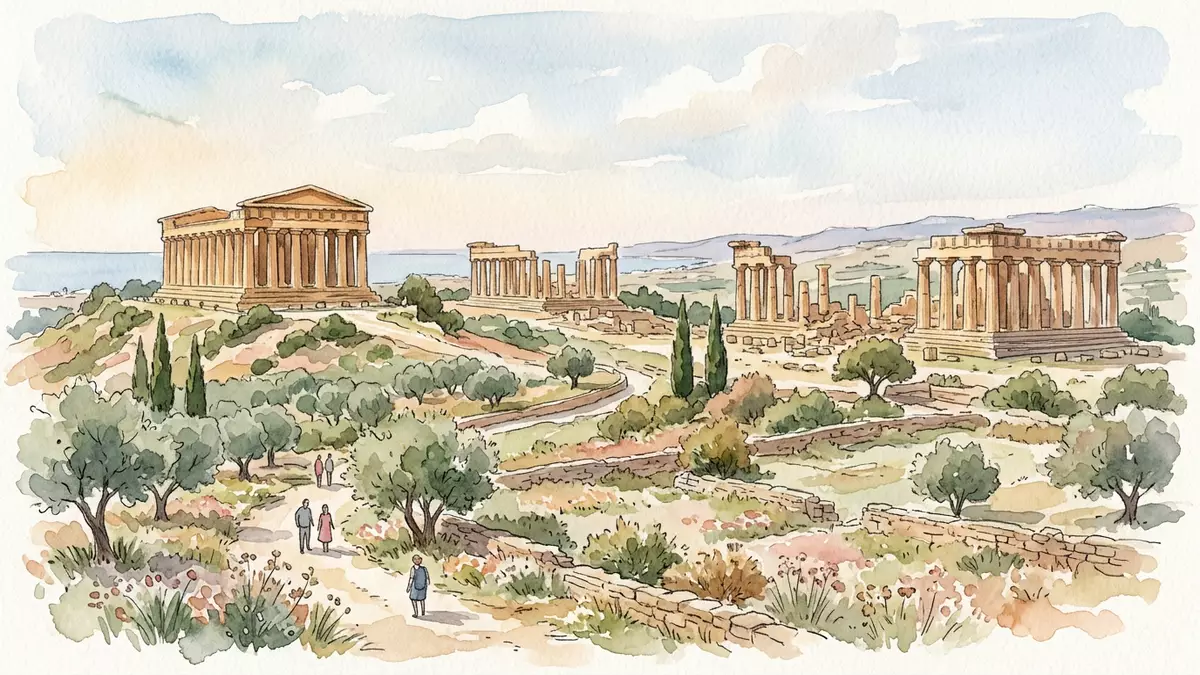
Valle dei Templi outside Agrigento is a long limestone ridge where ancient Greek temples line up like a stone-made skyline above the Sicilian countryside. The archaeological park corresponds to the core of Akragas, the Greek city that later became Roman Agrigentum in the third century BC, and since 1997 it has been inscribed as a UNESCO World Heritage Site for the exceptional preservation of its classical architecture. The lead impression is the way entire temples stand along one rocky shoulder, with the modern town rising on a separate height to the north.
Akragas on the ridge: a Greek city written in stone
The archaeological and landscape park of Valle dei Templi preserves the monumental remains of Akragas, founded as a Greek colony and later transformed into Agrigentum after Roman conquest in 210 BC, within a protected area of around 1,300 hectares.Archaeological and Landscape Park The temples, sanctuaries and city remains occupy a limestone ridge above the plain of the Akragas rivers, forming the acropolis of the ancient city where stone structures follow the line of the terrain rather than clustering on a hilltop.rocky ridge and acropolis of Akragas
Walking along the ridge, successive temple platforms and stretches of fortification wall reveal how the city extended laterally along the height, with necropolis areas and extra-urban sanctuaries spreading beyond the main cluster of monuments.temples, necropolis and sanctuaries Between the temples, traces of housing quarters, early Christian burials and ancient water-management structures show layered re-use of the same ridge over many centuries.
Doric temples along an eastern and western sector
Valle dei Templi is organised into an eastern sector and a western sector, each carrying a group of major Doric temples and associated structures.division into eastern and western sectors In the eastern part, the temples commonly identified with Hera (Juno), Concordia and Heracles stand on aligned terraces, their colonnades rising directly from the sandstone of the ridge and forming a row of classical facades facing the surrounding landscape.eastern sector temples of Juno, Concordia and Hercules
The western sector gathers the remains associated with Zeus (Olympian Jupiter), the Dioscuri and Vulcan, together with the garden of the Kolymbethra and further sanctuaries, giving this side of the ridge a different rhythm of partial colonnades, massive foundations and cultivated spaces.Olympian Jupiter, Dioscuri and Kolymbethra garden Across the park, the temples share the Doric order but vary in state of preservation, with some standing with near-complete colonnades and others surviving as evocative corner sections and stylobates.
A UNESCO World Heritage archaeological and landscape park
Since 1997 the entire Valle dei Templi has formed part of the UNESCO World Heritage List as an archaeological and landscape park, recognising both its classical monuments and the wider setting of olive, almond and carob trees around them.UNESCO World Heritage inscription in 1997 The protected area, established as a regional park in 2000, is often described as the largest archaeological park in Europe and the Mediterranean basin, due to the combination of its extent and the concentration of structures from the Greek and later Roman periods.park area of around 1,300 hectares
Within the perimeter, Valle dei Templi includes principal Doric temples, minor sanctuaries, fortification lines, hypogea carved into the rock for water management and burial, and the regional Museo Archeologico Pietro Griffo close to the eastern boundary, where thousands of artefacts from the site and wider territory are displayed.Museo Archeologico Regionale Pietro Griffo Together, the ridge, the planted fields and the sequence of monuments form a characteristic Sicilian landscape in which ancient stonework is visibly integrated with longstanding cultivation.
Visiting Valle dei Templi: what travellers from Western Europe should know
- Valle dei Templi stands just outside Agrigento in southern Sicily, with the archaeological ridge lying between the modern town and the coast and signposted from major regional roads.
- The terrain of the park follows a limestone ridge, with stone paths, slopes and stairways between temple terraces, so a visit involves walking on uneven surfaces and gradual gradients.
- The archaeological area includes both exposed remains and cultivated zones, with olive and almond trees growing among the monuments and views towards the Mediterranean from sections of the ridge.
- The official language is Italian and the currency is the euro.
Searching for Valle dei Templi on social platforms
These links open searches for Valle dei Templi on each platform.
Frequently asked questions about Valle dei Templi
Where is Valle dei Templi?
Valle dei Templi is an archaeological park near Agrigento in southern Sicily, Italy, set on a limestone ridge between the town and the coastal plain.
What can visitors expect at Valle dei Templi?
Visitors encounter standing Doric temples, partial colonnades, fortification walls, sanctuaries, necropolis areas and cultivated fields with olive and almond trees within a wide protected landscape.
What makes Valle dei Templi distinctive?
The park’s distinctive character comes from its sequence of Greek temples aligned along a single rocky ridge above the countryside, combined with its recognised status as a UNESCO World Heritage archaeological and landscape park.


