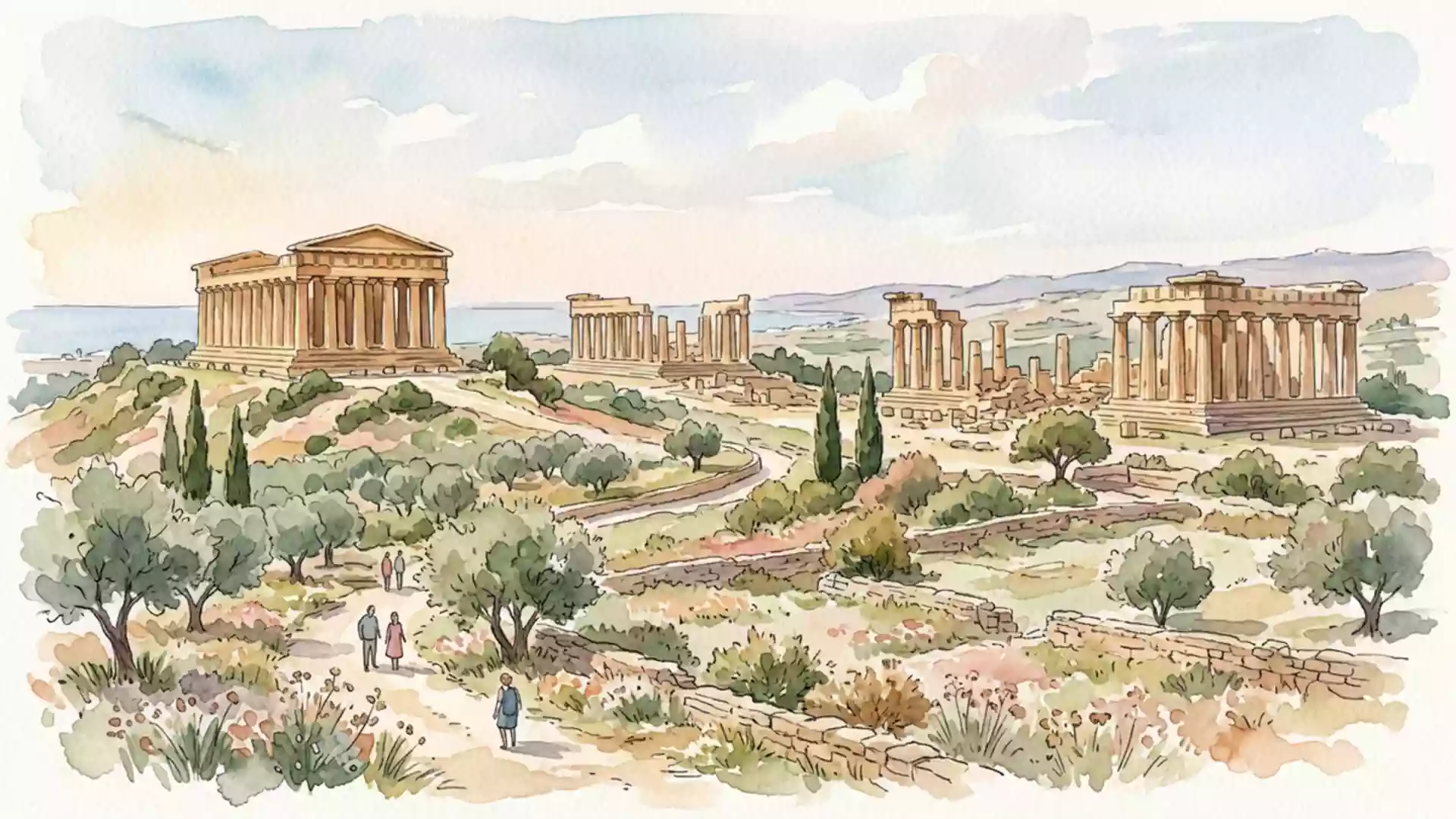
Valle dei Templi: a Greek temple landscape above Agrigento
Published on 09/11/2026 at 07:40 | Editorial responsibility: Rafael Müller, Editor-in-Chief AD HOC NEWS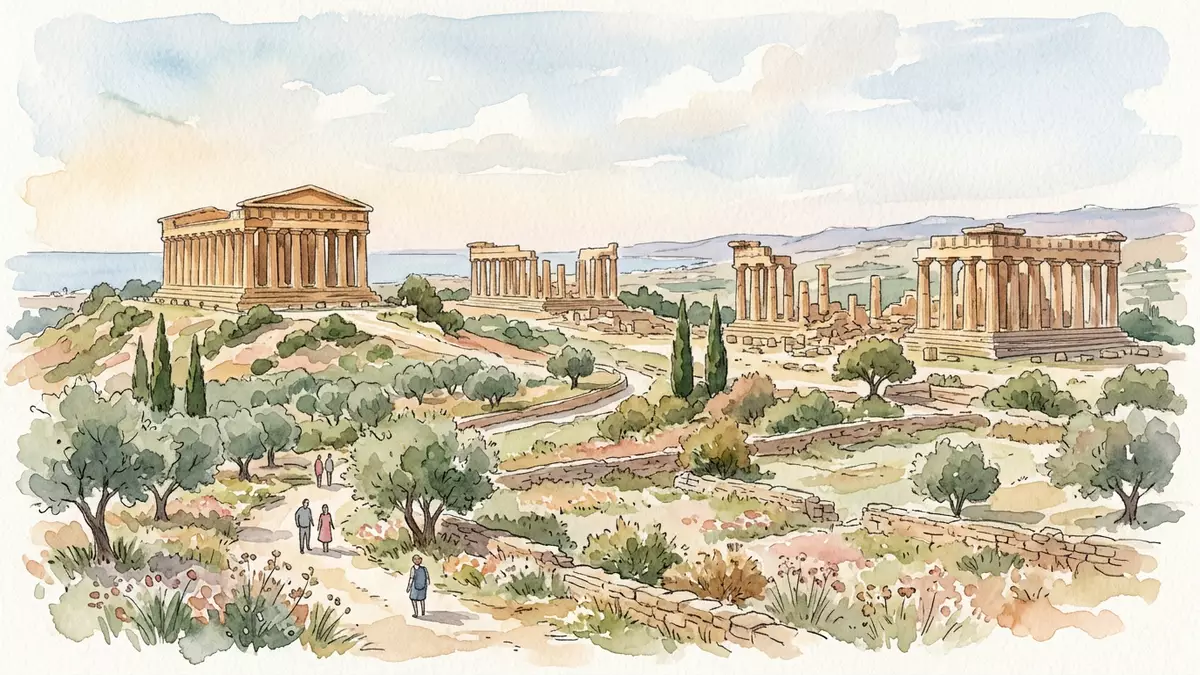
On the southern edge of Agrigento in Sicily, Valle dei Templi stretches along a rocky ridge lined with ancient Doric temples, facing towards the Mediterranean sea and countryside. The archaeological park corresponds to the monumental core of ancient Akragas, a Greek colony founded in the sixth century BC, and has been recognised as a UNESCO World Heritage Site since 1997.UNESCO World Heritage Site since 1997
Akragas and the Greek city behind Valle dei Templi
Valle dei Templi preserves what was once the sacred southern boundary of Akragas, laid out when the colony was established in the sixth century BC on a plateau above the sea.Greek colony founded in 580 BC The ridge chosen for the temples marks the edge of the ancient city, with agricultural land and the coast beyond, so visitors move between urban archaeology and open landscape in a single walk. The park today covers around 1,300 hectares (3,200 acres), making it one of the largest archaeological parks in Europe and the wider Mediterranean region.around 1,300 hectares
The ancient city of Akragas later became Agrigentum under Roman rule, yet the Greek sanctuaries kept their identity and layout along the hill, which is why rows of columns still define the skyline.Akragas became Agrigentum in 210 BC Moving through Valle dei Templi means crossing the former boundary of a major city of Magna Graecia, with traces of sanctuaries, city walls and necropolis areas alongside the better known temples. The permanence of this ancient urban structure is one reason the valley offers a clear sense of how a classical Greek city related to its surroundings, with sacred buildings, burial grounds and cultivated fields forming a continuous zone.
Doric temples along the ridge: Concordia and its neighbours
Several major temples stand along the rocky scarp of Valle dei Templi, each dedicated to a Greek deity and built in the Doric order. The best preserved is the Temple of Concordia, a fifth-century BC structure whose colonnades and entablature still rise in nearly complete form above their stepped base.Temple of Concordia erected around 430 B.C. The temple stands on a platform whose plan measures a little over 42 m by 19 m (about 138 ft by 62 ft), creating a near double-rectangle proportion that gives the building its balanced outline.plan measures a little over 42 m by 19 m A colonnade of Doric columns runs around the cella, with a pronaos and an opisthodomos framing the inner room where votive offerings once gathered.
North-east of Concordia rise the ruins known as the Temple of Hera (Juno) Lacinia, occupying another prominent point on the ridge.Temple of Hera (Juno) Lacinia Further along are the remains of the Temple of Heracles (Hercules), the vast foundations of the unfinished or heavily damaged Temple of Olympian Zeus (Jupiter), and smaller sanctuaries such as those attributed to Castor and Pollux and to Hephaistos (Vulcan). These structures vary in completeness, from standing colonnades to scattered blocks, yet together they trace a line of worship spaces and monumental gateways that defined the city’s southern limit. Even in fragmentary state, their platforms, column drums and carved mouldings reveal the craftsmanship of Greek builders working in local stone.
Landscape, museum and the wider archaeological park
Valle dei Templi is not only a sequence of temples but an entire archaeological and landscape park where ancient architecture is integrated into Mediterranean terrain. The ridge carries olive trees, almond trees and low shrubs between the monuments, while views extend over cultivated fields and towards the sea, so the walk between sanctuaries runs through an open environment rather than a confined site. The area corresponds to the core zone of the Agrigento archaeological park, created as a regional archaeological park in 2000, with management focused on both preservation and landscape.regional archaeological park since 2000
Within the wider complex stands the Regional Archaeological Museum “Pietro Griffo”, which presents thousands of artefacts illustrating the history of this part of Sicily from prehistoric communities through the Greek and Roman periods.Regional Archaeological Museum Pietro Griffo Finds from the valley’s sanctuaries, necropolis and domestic areas help explain how Akragas functioned as a large city of Magna Graecia, complementing the experience of seeing the temples in situ. The combination of standing architecture, archaeological remains and museum collections within the same protected landscape makes Valle dei Templi a compact introduction to the classical cultures that shaped Sicily’s southern coast.
Visiting Valle dei Templi: what travellers from Western Europe should know
- Valle dei Templi lies just outside Agrigento in southern Sicily, reached by road connections from the town and the wider region, with access routes signed towards the archaeological park.
- The terrain of the valley involves walking along paths on a ridge with uneven surfaces and stretches of stone steps between different temple terraces.
- In summer, heat on the exposed ridge can be intense, while in winter the site stands in a more temperate coastal climate, so ground conditions change with the season.
- Nearby, the modern town of Agrigento offers further historic streets and viewpoints over the valley, linking the ancient and present-day settlement on the plateau above.
- The official language is Italian and the currency is the euro.
Searching for Valle dei Templi on social platforms
These links open searches for Valle dei Templi on each platform.
Frequently asked questions about Valle dei Templi
Where is Valle dei Templi located?
Valle dei Templi lies on a ridge just outside Agrigento in southern Sicily, in Italy, overlooking farmland and the Mediterranean coastal plain.
What can visitors expect during a visit?
Visitors walk among ancient Doric temples, sanctuaries and archaeological remains set within a wide landscape, with paths linking monuments and viewpoints over the valley.
What makes Valle dei Templi distinctive among classical sites?
The valley combines a line of major Greek temples from the sixth and fifth centuries BC with an extensive archaeological park and museum inside a single protected landscape.