
Valle de la Luna, a carved desert basin near San Pedro de Atacama
Published on 09/12/2026 at 18:55 | Editorial responsibility: Rafael Müller, Editor-in-Chief AD HOC NEWS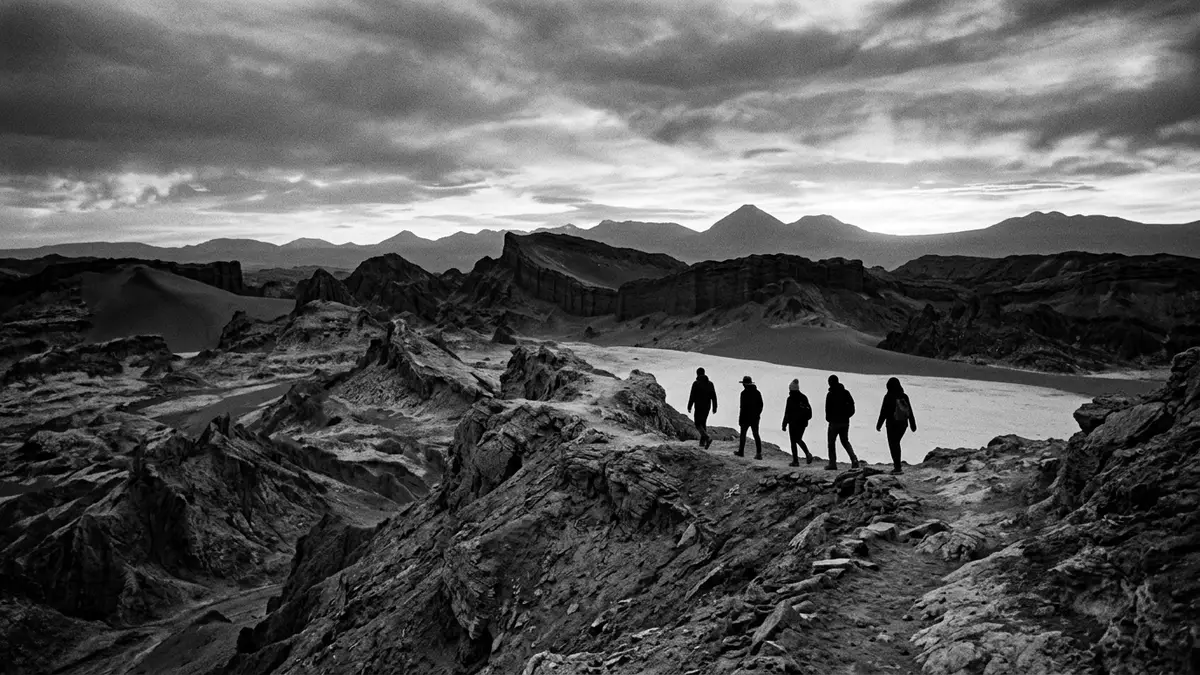
Valle de la Luna in northern Chile is a compact desert basin of salt, sand and stone west of San Pedro de Atacama, shaped over long geological periods into a landscape that resembles the surface of the moon. Set within the Cordillera de la Sal in the Atacama Desert, it forms part of the Los Flamencos National Reserve and has been recognised as a nature sanctuary since 1982, giving formal protection to its fragile terrain and distinctive geology.
A lunar landscape carved from salt and sediment
Valle de la Luna lies roughly 13 km west of San Pedro de Atacama inside the Cordillera de la Sal, a low salt mountain range that rises where the Andes meet the wider Atacama Desert.13 km west of San Pedro The Cordillera began as the floor of a basin that filled with water and evaporated repeatedly, leaving thick layers of halite, gypsum, clay and other minerals later folded and uplifted by tectonic movements.halite, gypsum and clay This raised basin appears today as ridges and depressions in which Valle de la Luna occupies one of the most accessible and visually concentrated sections.
Across the valley floor and its flanks, sedimentary rocks composed of fine sand, clay and mineral layers have been sculpted by wind and rare rain into crests, hollows, dunes and slopes that catch light at different angles.salt, rock and sand Geological descriptions characterise the broader depression around Sierra Orbate as reaching around 2,500 m (8,202 ft) above sea level, with transverse valleys and outcrops of limolite, gypsum, salt, clay and sand shaped by fluvial and aeolian erosion into grey and ochre forms.transverse valleys and elevated outcrops The valley’s mineral crusts and exposed sedimentary structures have made it a reference landscape for studies of planetary surfaces that share similar processes of deposition, uplift and erosion.
Salt ridges, dunes and sculpted formations
Within Los Flamencos National Reserve, Valle de la Luna forms a compact depression of salt ground that contains dunes, eroded ridges and scattered rock formations.compact salt depression Broad sand slopes rise towards walls of stratified rock, while smaller features such as clustered pinnacles and isolated outcrops punctuate the basin floor. The combination of pale salt crusts and darker sediment bands gives the terrain a striped and contoured appearance that shifts with the angle of the sun.
Named viewpoints and formations inside the valley, including the Anfiteatro, the Gran Duna and the Tres Marías rocks, illustrate different ways erosion has cut into the salt and sediment layers.Anfiteatro, Gran Duna and Tres Marías From the higher ridges, visitors see the ridged structure of the Cordillera de la Sal running across the desert, with Valle de la Luna occupying one of its lower central basins.Cordillera de la Sal setting Within this broader setting, the valley’s dunes and sculpted rock surfaces create a concentration of forms that recall crater rims and eroded plateaux on planetary images.
Protected status and scientific interest
Valle de la Luna was declared a nature sanctuary in 1982 under Chilean law and is administered as part of Los Flamencos National Reserve by the national forestry and protected areas corporation.nature sanctuary since 1982 This formal status recognises both the valley’s visual character and the fragility of its salt crusts and sedimentary structures, which can be damaged by trampling and vehicle tracks. Marked paths and designated viewpoints concentrate visitor movement, leaving other areas free from direct impact.
Researchers and geotour programmes describe Valle de la Luna and neighbouring basins as endorheic depressions, where water has no direct outlet to the sea and instead pools and evaporates, concentrating dissolved minerals.endorheic depressions Over geological time scales this has produced limolites and sandstones in hues from yellow to brown and ochre, interbedded with gypsum layers that respond differently to erosion, creating serrated ridges and hollows.limolites and sandstones with gypsum The combination of elevation in the northern Andes region, extreme aridity and exposed mineral sequences makes the valley a natural laboratory for understanding both terrestrial deserts and analogue environments for other planets.
Visiting Valle de la Luna: what travellers from Western Europe should know
- Valle de la Luna lies west of San Pedro de Atacama in northern Chile and is reached by road along Route 23 towards Calama, with the reserve entrance signed from the main highway.
- The terrain inside the valley includes dunes, compacted sand slopes, salt crusts and uneven rock surfaces, so routes involve walking on loose ground and climbing slopes with noticeable gradients.
- Named viewpoints such as the Anfiteatro and ridge-top miradores stand at elevations of around 2,400 to 2,600 m (7,874 to 8,530 ft), and approaches to them use paths with sections of steps and narrow stretches.
- The official language is Spanish and the currency is the Chilean peso.
- Entry requirements depend on your nationality; UK travellers can check the FCDO travel advice at gov.uk/foreign-travel-advice, Irish travellers the Department of Foreign Affairs at ireland.ie.
Searching for Valle de la Luna on social platforms
These links open searches for Valle de la Luna on each platform.Frequently asked questions about Valle de la Luna
Where is Valle de la Luna in relation to San Pedro de Atacama?
Valle de la Luna lies to the west of San Pedro de Atacama in northern Chile, within the Cordillera de la Sal and the Los Flamencos National Reserve.
What should visitors expect on a visit to Valle de la Luna?
Visitors encounter dunes, salt crusts, eroded ridges and designated viewpoints linked by marked paths across an arid basin, with walking on loose sand and compacted mineral surfaces.
What makes Valle de la Luna distinctive compared with other desert areas?
The combination of exposed salt layers, sculpted sedimentary rock, elevated Andean desert setting and protected nature sanctuary status gives Valle de la Luna a pronounced lunar character.


