
Valle de Cocora and its towering wax palm landscape
Published on 08/30/2026 at 14:48 | Editorial responsibility: Rafael Müller, Editor-in-Chief AD HOC NEWS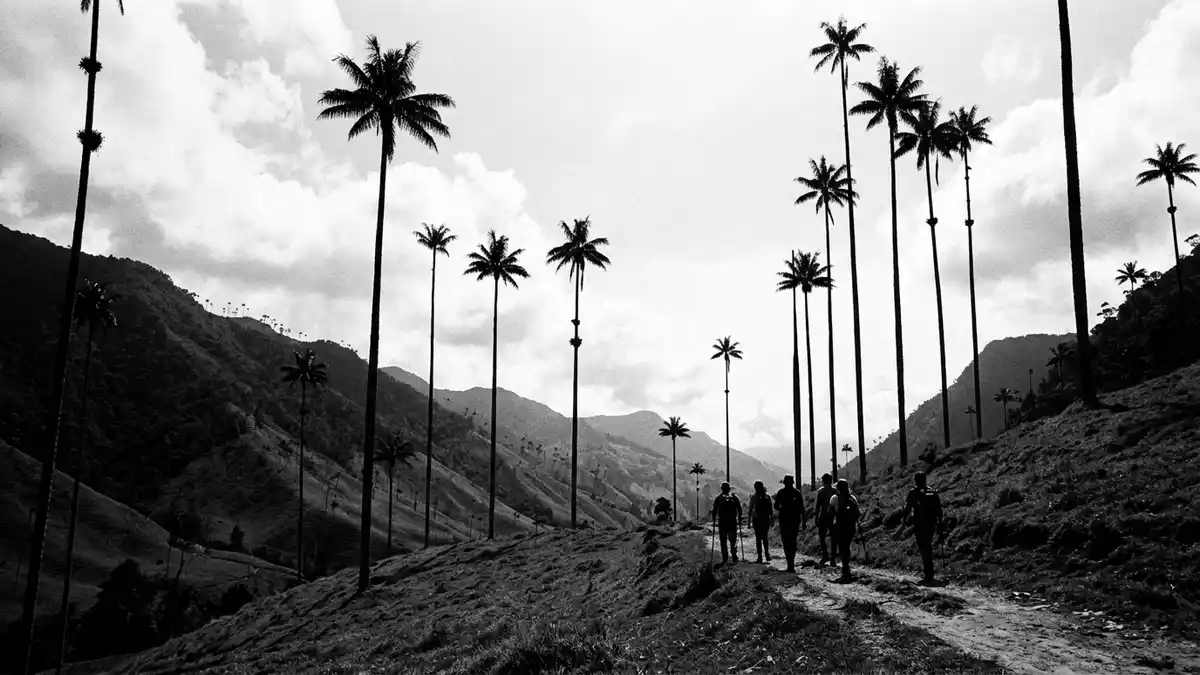
Valle de Cocora, or Cocora Valley, rises above Salento in Colombia’s central Andes as a high, grassy basin studded with extraordinarily tall wax palms and wrapped in cloud forest slopes. Set within the Quindío Department and linked to the wider Los Nevados mountain region, it brings together the country’s coffee landscape with protected highland habitats. The result is a place where slender palm trunks, steep pastures and misty ridgelines share the same view.
An Andean valley shaped by altitude and palms
Valle de Cocora lies in the upper basin of the Quindío River, a mountain stream that gathers its headwaters beneath the surrounding ridges before running down towards Armenia in the lowlands.upper basin of the Quindío River The valley floor sits at elevations of roughly 1,800 to 2,400 m (5,906 to 7,874 ft), high enough that rolling pastures meet cloud belts and Andean slopes.
Geographically, Valle de Cocora belongs to the Quindío Department and falls within the influence area of Los Nevados National Natural Park, a large protected highland region that includes volcanic summits and páramo plateaus.Los Nevados National Natural Park Administratively it sits in the municipality of Salento, with the town lying to the south-east on a separate spur.municipality of Salento The surrounding slopes rise well beyond the valley floor, and trails climb into dense forest and over passes between ridges.
Wax palms and the Coffee Triangle setting
One of the defining features of Valle de Cocora is the presence of wax palms, a species native to Colombia’s high Andean valleys and closely associated with the country’s coffee-growing region.wax palms Their trunks rise high above the grazing land and scattered farm buildings, giving the valley its distinctive vertical rhythm against the grassy slopes. In some pastures the palms stand alone or in small clusters, leaving tall silhouettes against the clouds.
Valle de Cocora sits inside Colombia’s Coffee Triangle, the zone of upland farms and small towns that produce much of the country’s coffee, and Salento is among the best-known settlements in this landscape.Coffee Triangle Timber balconies, colourfully painted houses and coffee shops in Salento form a contrast to the open pastures and forested slopes above. Many visitors pair time among the wax palms with time in the town’s streets, moving between agricultural scenery and the compact urban grid.
Trails, river crossings and cloud forest
From the roadhead in the valley a network of paths runs out across farmland and into forest, forming loops and out-and-back routes that climb towards higher ground.network of paths Bridges cross the Quindío and its side streams at several points, and in places the trail passes close to wooden farm buildings and simple corrals before steepening into woodland.
On the longer circuits the path enters dense cloud forest, where trees carry epiphytes and the understorey closes in around the track.dense cloud forest Sections of these routes gain several hundred metres in height and reach viewpoints over the valley and its palms, while shorter options spend more time among the open slopes and grazed meadows. The combination of steep gradients, soft ground and repeated river crossings makes sturdy footwear a practical choice, especially after periods of heavy rain.
Visiting Valle de Cocora: what travellers from Western Europe should know
- Valle de Cocora lies north of Salento in Colombia’s Quindío Department, with the access road leaving the town and climbing towards the valley; shared Willys jeeps commonly run this route from Salento’s main square.
- The terrain combines farm tracks, pasture paths and steeper forest trails; expect uneven ground, repeated river crossings over simple bridges and sustained gradients on the longer loops.
- The wider area belongs to a high Andean environment, so low cloud and rain are possible in any month and the air at over 1,800 m (5,906 ft) can feel cool compared with lowland Colombia.
- The official language is Spanish and the currency is the Colombian peso.
- Entry requirements depend on your nationality; UK travellers can check the FCDO travel advice at gov.uk/foreign-travel-advice, Irish travellers the Department of Foreign Affairs at ireland.ie.
Searching for Valle de Cocora on social platforms
These links open searches for Valle de Cocora on each platform.Frequently asked questions about Valle de Cocora
Where is Valle de Cocora located?
Valle de Cocora is in the Quindío Department of Colombia, in the municipality of Salento, north-east of the city of Armenia in the central Andes.
What should visitors expect on a visit?
Visitors encounter tall wax palms above pasture, steep trails that can become muddy, repeated river crossings and the possibility of mist and rain in a highland setting.
What makes Valle de Cocora distinctive among Andean valleys?
The combination of extremely tall wax palms, coffee-region farmland and access into protected cloud forest within the Los Nevados highlands gives Valle de Cocora a character that is closely tied to this part of Colombia.


