
Uluru, the sandstone monolith of Australia’s Red Centre
Published on 09/14/2026 at 13:35 | Editorial responsibility: Rafael Müller, Editor-in-Chief AD HOC NEWS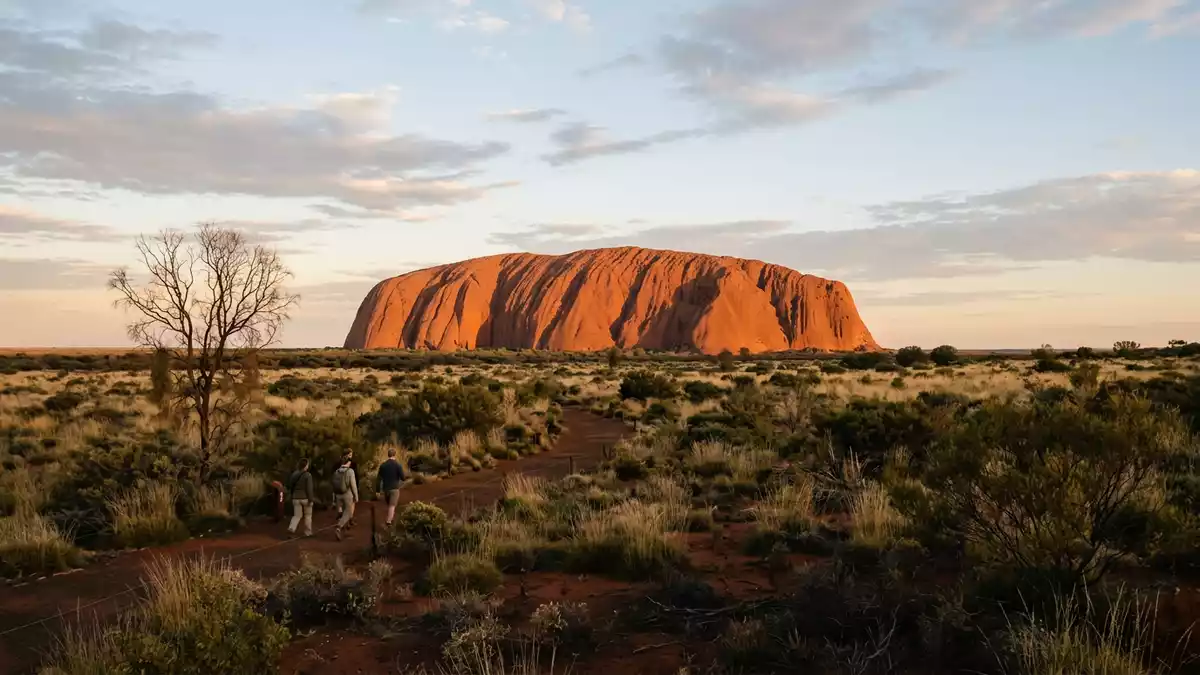
Uluru is a sandstone monolith dominating the desert plains near Yulara in Australia’s Northern Territory, its rust-red bulk forming a single landmark in the country’s arid interior. Rising hundreds of metres above the surrounding plain and stretching for several kilometres, it anchors Uluru-Kata Tjuta National Park, a landscape recognised on the UNESCO World Heritage List for both natural and cultural values.
A single rock on a vast desert plain
Viewed from the approach road, Uluru appears as a single block of sandstone lifting abruptly from the flat expanse of central Australia, with no neighbouring peaks to dilute its presence. Geological descriptions classify it as a monolith and an inselberg, an isolated mass of weathered rock standing alone in the desert, and its exposed dimensions run to several kilometres in length and around a kilometre or more in width.giant monolith These proportions give the rock a perimeter of roughly 9.4 km (5.8 mi) around the base, so that a circuit of the foot takes visitors all the way around a single continuous wall of stone.perimeter of 9.4 km
In vertical scale, Uluru rises about 348 m (1,142 ft) above the surrounding plain, with its summit reaching roughly 863 m (2,831 ft) above sea level.348 m above the plain Much of the formation continues below ground, and descriptions note that the rock extends for at least several kilometres beneath the surface, so the visible monolith is the upper portion of a far larger body of sandstone embedded in the crust.extends down into the ground The exposed sides carry shallow gullies, ribs and ledges carved by erosion, giving the rock a textured appearance instead of a smooth face.
Sandstone, colour and the wider park landscape
Uluru is composed mainly of coarse sandstone, often described as arkose, with jagged grains and feldspar crystals that catch the light on close inspection.coarse sandstone called arkose The surface weathers to a deep red due to oxidation of iron minerals in the rock, and descriptions of the formation emphasise how its colour varies with the angle of the sun, shifting from a muted tone under high light to saturated hues when the sun is low. At times of rain, water flows down the flanks in thin sheets, darkening the stone and feeding small channels at the base.
The monolith stands within Uluru-Kata Tjuta National Park, which also contains Kata Tjuta, a group of rock domes lying to the west of Uluru. The park covers more than 130,000 ha of arid ecosystems near the centre of Australia, with red sandy plains, sparse vegetation and occasional dune ridges around the rock.arid ecosystems close to the centre of Australia Uluru-Kata Tjuta National Park was inscribed on the UNESCO World Heritage List for its natural values in 1987 and for its cultural values in 1994, giving it a dual listing as both a natural property and a cultural landscape.dual World Heritage listing That status reflects the combination of geological formations and the enduring relationship between the land and its Indigenous owners.
Cultural significance and living tradition
For the A?angu Aboriginal people, Uluru and the surrounding land form part of a continuous cultural landscape tied to ancestral stories and ceremonial traditions. Descriptions of the park emphasise that Uluru and Kata Tjuta belong to one of the oldest human societies in the world, with the rock and nearby domes integrated into a belief system that links specific features of the landscape to events and beings from creation stories.traditional belief system of A?angu Many sections of the rock carry ancient rock art, including paintings on the slopes and in shallow recesses, and these are associated with particular narratives and teaching places.
Uluru’s cultural status is reflected in its management arrangements as well as its World Heritage inscription. In 1985, legal ownership of the monolith and surrounding park was returned to the A?angu, who then leased the land back to the Australian government for joint management as a national park, combining conservation of the physical environment with the continuation of cultural practices.ownership returned to A?angu in 1985 The park’s recognition as both a natural World Heritage site and a cultural landscape places its living traditions on the same level as its geology, and it is described in official material as one of a small number of sites worldwide to hold this dual status.World Heritage status for natural and cultural values
Visiting Uluru: what travellers from Western Europe should know
- Uluru lies in the south-western part of Australia’s Northern Territory, near the small service settlement of Yulara. It is reached by road and by air services using Ayers Rock Airport, with long-distance connections from other parts of Australia.
- The base of Uluru sits on an arid, largely flat desert plain with sandy and rocky ground, and walking routes around the monolith involve sustained time on foot in exposed conditions.
- Kata Tjuta, the group of rock domes associated with the same national park, lies to the west of Uluru and is visible from certain viewpoints, offering a second concentration of large rock formations in the surrounding landscape.
- The official language is English and the currency is the Australian dollar.
- Entry requirements depend on your nationality; UK travellers can check the FCDO travel advice at gov.uk/foreign-travel-advice, Irish travellers the Department of Foreign Affairs at ireland.ie.
Searching for Uluru on social platforms
These links open searches for Uluru on each platform.
Frequently asked questions about Uluru
Where is Uluru?
Uluru is in central Australia, in the south-western part of the Northern Territory, near the settlement of Yulara and within Uluru-Kata Tjuta National Park.
What should visitors expect on a visit to Uluru?
Visitors encounter a single sandstone monolith rising from an arid desert plain, with walking routes around its base and views across a broad, sparsely vegetated landscape.
What makes Uluru distinctive among rock formations?
Uluru’s distinction lies in its combination of large sandstone dimensions, isolated position on the desert plain and recognised cultural significance within a World Heritage listed national park.


