

Uluru’s sandstone monolith in Australia’s Red Centre
Published on 08/28/2026 at 22:56 | Editorial responsibility: Rafael Müller, Editor-in-Chief AD HOC NEWS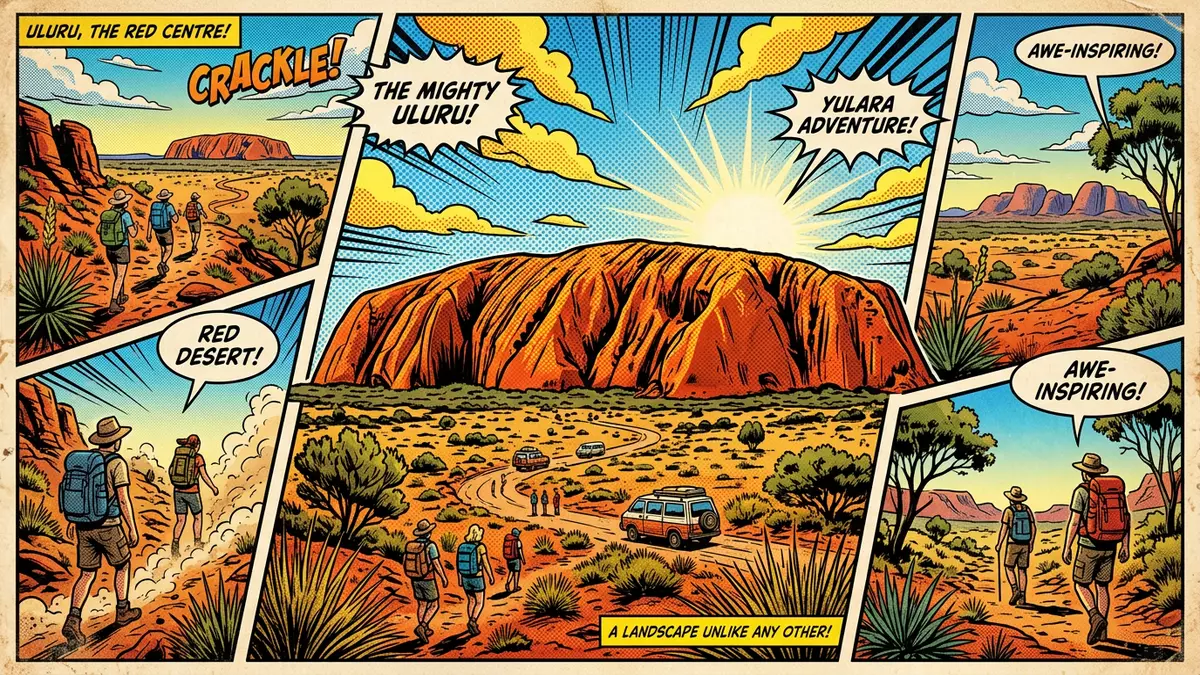
Uluru, rising from the desert near Yulara in central Australia, is a single block of sandstone that has become one of the defining landscapes of the country’s Red Centre. The monolith anchors Uluru-Kata Tjuta National Park, where deep geological time, Anangu culture and a stark desert plain meet in one vast expanse.
A sandstone inselberg shaped over hundreds of millions of years
Uluru stands in the Northern Territory as a solitary mass of arkosic sandstone, a coarse rock rich in feldspar that gives the formation its distinctive character. Geologists describe Uluru as an inselberg, an island mountain rising abruptly above largely flat surroundings, with the visible rock only a fraction of a much larger block that extends far beneath the surface.steeply dipping arkosic sandstone The circumference at the base runs for several kilometres, and the slopes are broad and continuous, with few obvious breaks.
The story of Uluru’s rock reaches back to the Precambrian and early Cambrian periods, when this part of Australia lay within a sedimentary basin known as the Amadeus Basin. Over hundreds of millions of years, layers of sand and mud were laid down on the basin floor, then compressed into rock. Around 550 million years ago a mountain-building episode known as the Petermann Ranges Orogeny folded and buckled these sediments, beginning the long structural history that would eventually produce Uluru.Precambrian arkose some 550 million years old Later movements, including the Alice Springs Orogeny in the Paleozoic era, tilted the sandstone layers close to vertical and raised them above sea level.Palaeozoic Alice Springs Orogeny The softer surrounding rocks eroded away over vast spans of time, leaving Uluru as the exposed remnant.
Uluru-Kata Tjuta National Park and World Heritage protection
Uluru forms part of Uluru-Kata Tjuta National Park, a protected area that also includes the rock domes of Kata Tjuta to the west. The park lies within the traditional lands of the Anangu people, whose presence in the region stretches back tens of thousands of years and whose Tjukurpa, or law and belief system, is closely connected to the landforms.home to Anangu for tens of thousands of years The rock faces around Uluru carry numerous culturally significant sites, though many of these are not interpreted in detail for visitors, reflecting Anangu wishes and the sensitivity of the stories.
The national park has international recognition for both its natural and cultural values. Uluru-Kata Tjuta National Park first entered the UNESCO World Heritage List under natural criteria in 1987, and later also under cultural criteria as an outstanding cultural landscape.inscribed on the World Heritage List The park has also been designated as a Biosphere Reserve under UNESCO’s Man and the Biosphere Programme, recognising the broader ecosystem and the way people and nature interact there.designated a Biosphere Reserve These statuses underline the importance of Uluru not only as a striking geological feature but as part of a living cultural landscape.
The Red Centre setting and the view from above
Uluru stands on a red sandy plain in central Australia, with the nearest service hub at Yulara, where the Ayers Rock Resort and associated facilities were developed on a reservation to the north of the park boundary in the 1980s.tourist facility and associated airport called Yulara From ground level, the monolith dominates the horizon, changing hue with the angle of the sun and the conditions in the sky. Satellite and aerial imagery show its elongated plan and the way the rock rises from otherwise level terrain, making the inselberg form clear from above.Earth from Space view of Uluru The adjacent Kata Tjuta domes appear as a separate cluster of rounded masses further west, together forming a contrasting pair of landforms in the same desert basin.monolith and rock domes contrasting with sand plains
On foot around the base, visitors encounter long slopes of weathered sandstone, gullies and deeply eroded channels, with the rock surface showing variations in colour and texture. The arkose contains quartz and feldspar grains, and oxidation of iron-bearing minerals contributes to the reddish appearance of the outer layers.feldspar-rich arkose In places, water has cut hollows and overhangs into the rock, and rainwater runoff has carved channels leading down to the plain. Vegetation at the foot of Uluru includes desert-adapted shrubs and grasses, with the broader landscape forming part of Australia’s arid interior.
Visiting Uluru: what travellers from Western Europe should know
- Uluru stands in the Northern Territory of Australia, south-west of Alice Springs, with the township of Yulara and its airport serving as the main gateway for travellers.
- The immediate terrain around Uluru consists of desert plains and the sloping sides of the monolith, with walking tracks on largely level ground that can include sandy sections and exposure to sun.
- English is the official language in this part of Australia and the currency is the Australian dollar.
- Entry requirements depend on your nationality; UK travellers can check the FCDO travel advice at gov.uk/foreign-travel-advice, Irish travellers the Department of Foreign Affairs at ireland.ie.
Searching for Uluru on social platforms
These links open searches for Uluru on each platform.
Frequently asked questions about Uluru
Where is Uluru located?
Uluru is in the Northern Territory of Australia, within Uluru-Kata Tjuta National Park near the township of Yulara in the country’s arid interior.
What should visitors expect on a visit to Uluru?
Visitors encounter a large sandstone monolith rising from red desert plains, with walking tracks around its base, extensive open views and a landscape shaped by Anangu culture.
What makes Uluru distinctive among Australian landscapes?
Uluru is a single block of arkosic sandstone tilted close to vertical, standing alone on a desert plain and recognised internationally as both a geological landmark and a cultural landscape.


