

Uluru’s sandstone monolith in Australia’s Red Centre
Published on 08/26/2026 at 14:20 | Editorial responsibility: Rafael Müller, Editor-in-Chief AD HOC NEWS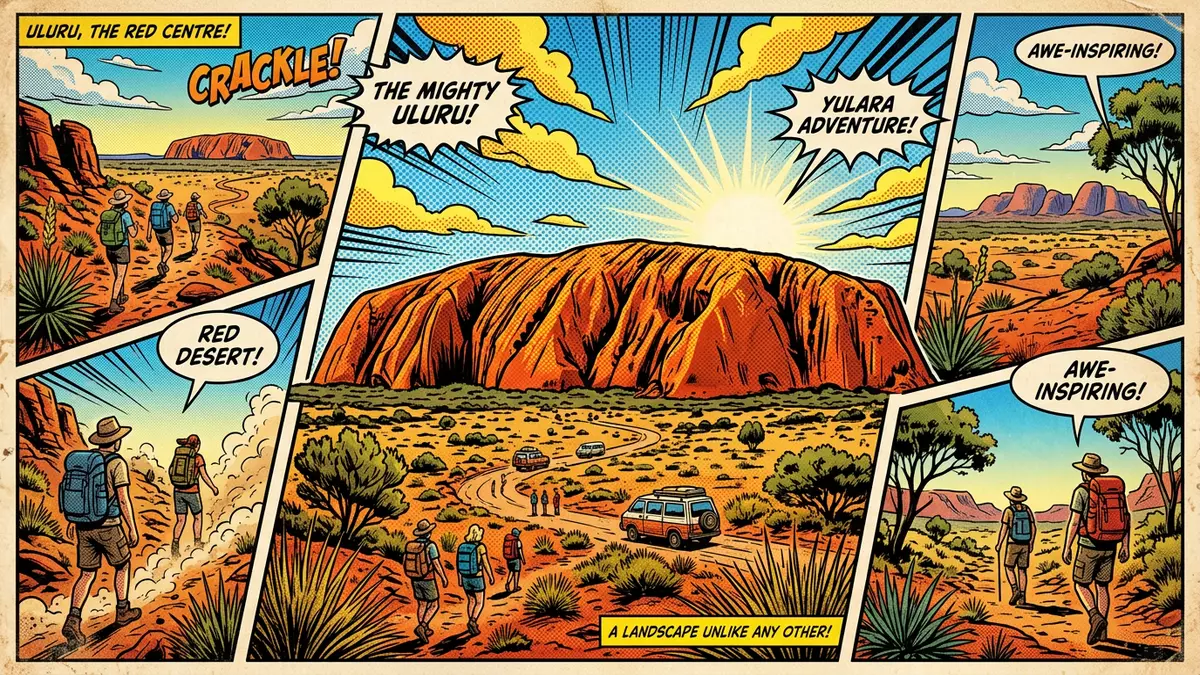
Uluru, also known in English as Ayers Rock, stands as a single vast sandstone monolith in the arid country near Yulara in central Australia. Rising hundreds of metres above the surrounding plain and encircled by a long base track, it anchors both the landscape of the Red Centre and the living culture of the A?angu people.
A sandstone giant in the desert plain
Uluru stands within Uluru-Kata Tjuta National Park in the south-west of Australia’s Northern Territory, close to the small service settlement of Yulara. The rock lies within the broader desert plateau of central Australia, with the nearest larger town being Alice Springs to the north-east.Uluru-Kata Tjuta National Park The monolith rises to an elevation of about 863 m (2,831 ft) above sea level and towers roughly 340 m (1,115 ft) above the surrounding desert plain.rises 348 metres above the surrounding desert plain
The rock itself is composed of arkosic sandstone, giving Uluru its characteristic reds and browns that change in appearance under different angles of sunlight. Around its base, the surface is cut by caves, fluted walls and overhangs, with run-off channels incised into the stone. Much of Uluru’s bulk extends below the present ground surface, so only part of the full rock formation is visible above the sandplains.a huge, rounded, red sandstone monolith 9.4 kilometres in circumference Walkers moving around the base encounter steep faces, shaded recesses and pockets where water can collect after rare desert rain.
World Heritage landscape and Red Centre ecology
Uluru-Kata Tjuta National Park is inscribed on the UNESCO World Heritage List for both natural and cultural values, one of a small number of landscapes worldwide with this dual recognition.Uluru-Kata Tjuta National Park The park first received listing in 1987 for its geological formations, desert ecosystems and visual qualities, and in 1994 the listing was extended to recognise it as a cultural landscape shaped by long-standing human presence.World heritage
The protected area covers more than 130,000 hectares of arid country, including the monolith of Uluru and the nearby domes of Kata Tjuta to the west.covers 132,566 ha of arid ecosystems close to the centre of Australia Between and around the rock formations stretch sandplains, low dunes and desert woodland. Spinifex grasses, acacias and desert oaks grow across the plains, while birds, reptiles and small mammals live in the sparse cover and rocky crevices. From some viewpoints around the park, Uluru and the rounded forms of Kata Tjuta can be seen in the same panorama, under a wide desert sky.
A?angu culture and living Tjukurpa
For A?angu, the Aboriginal people of the region, Uluru lies at the heart of Tjukurpa, the law and belief system that connects ancestral beings, landforms and ongoing ways of living.The religious and cultural traditions that the Anangu people practice are known as Tjukurpa Many features on the rock’s surface correspond to particular ancestral journeys and stories, and A?angu continue to maintain connections to these places through ceremony, teaching and care for country.
Since the late twentieth century, Uluru-Kata Tjuta National Park has been jointly managed by Parks Australia and A?angu traditional owners, with a board structure that embeds A?angu authority in decisions about the park.Welcome to Ulu?u-Kata Tju?a National Park Visitors encounter this cultural context in place names, interpretive materials and guided walks led by A?angu representatives, where permitted. Certain sections of the rock face and some stories are restricted from viewing or photography, reflecting their continuing ceremonial significance.
Visiting Uluru: what travellers from Western Europe should know
- Uluru lies within Uluru-Kata Tjuta National Park in the Northern Territory, with Yulara serving as the nearby service village and access point for road and air connections.
- Walking around the base involves unshaded stretches on firm desert paths and occasional sandy sections, so visitors encounter open country, gentle gradients and limited shelter from sun and wind.
- From the park, Kata Tjuta rises to the west as a group of domed rock formations, offering further marked walking routes through gullies and between high rock walls.
- The official language of Australia is English and the currency is the Australian dollar.
- Entry requirements depend on your nationality; UK travellers can check the FCDO travel advice at gov.uk/foreign-travel-advice, Irish travellers the Department of Foreign Affairs at ireland.ie.
Searching for Uluru on social platforms
These links open searches for Uluru on each platform.
Frequently asked questions about Uluru
Where is Uluru located?
Uluru stands in Uluru-Kata Tjuta National Park in the south-west of Australia’s Northern Territory, close to the settlement of Yulara in central Australia.
What should visitors expect when they arrive?
Visitors encounter a single massive sandstone rock rising above desert plains, with marked walking routes around its base and across the surrounding arid landscape.
What makes Uluru distinctive compared with other desert landscapes?
Uluru combines a towering sandstone monolith, extensive desert ecosystems and the continuing cultural significance of Tjukurpa for A?angu, recognised together in its dual World Heritage listing.


