

Uluru’s sandstone monolith in Australia’s Red Centre
Published on 08/23/2026 at 10:51 | Editorial responsibility: Rafael Müller, Editor-in-Chief AD HOC NEWS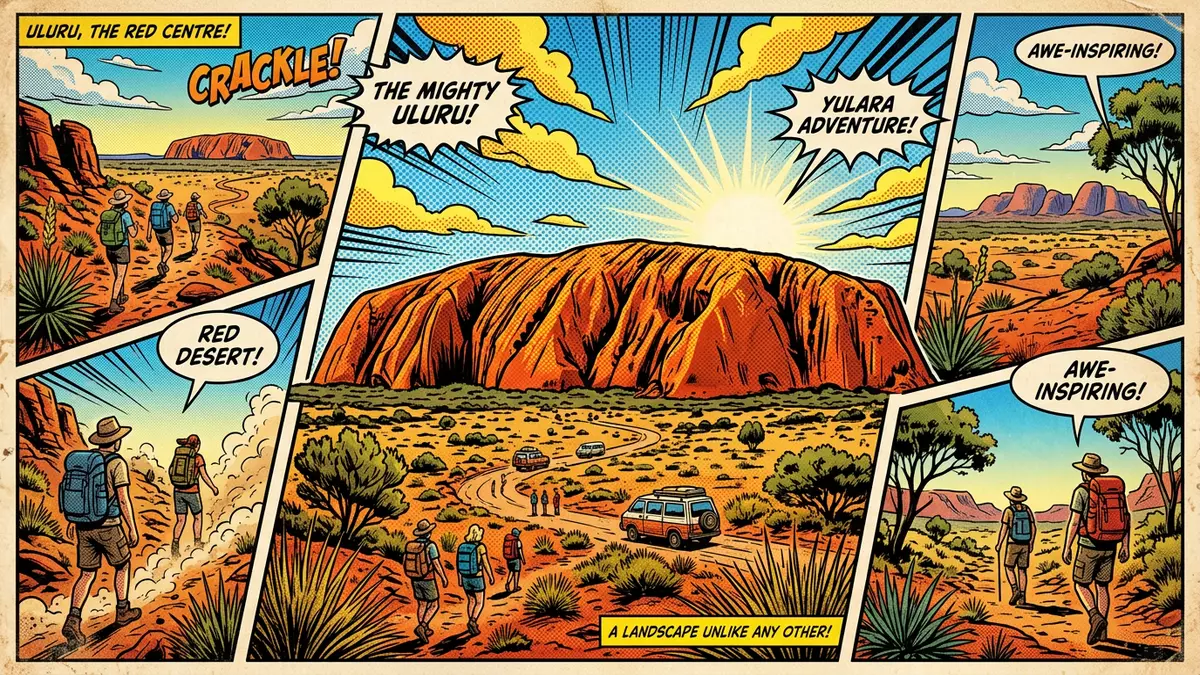
Uluru, also known as Ayers Rock, rises from the desert plains near Yulara in Australia’s Northern Territory as a single sandstone monolith with a commanding presence over the surrounding country. This immense rock stands about 348 m (1,142 ft) above the plain and measures roughly 9.4 km (5.8 mi) around its base, forming one of the most recognisable landforms in Australia’s Red Centre.
A sandstone giant shaped over geological time
Uluru stands within Uluru-Kata Tjuta National Park in the southern part of the Northern Territory, on arid plains south-west of Alice Springs.Uluru-Kata Tjuta National Park The exposed rock rises about 348 m (1,142 ft) above the surrounding desert surface, while its summit reaches around 863 m (2,831 ft) above sea level, indicating a substantial body of sandstone anchored below ground.height above ground and sea level
Geologically, Uluru is composed of arkose, a coarse-grained sandstone rich in feldspar, formed from sandy sediments eroded off ancient granite uplands and deposited in an inland basin hundreds of millions of years ago.arkose sandstone rich in feldspar Over long geological periods, these sediments hardened, were uplifted and tilted, and the softer surrounding rocks eroded away, leaving Uluru as an isolated monolith rising from the plain.giant monolith in central Australia
Ancient country and Anangu cultural landscape
Beyond its geological scale, Uluru is a central feature of Anangu country, linked to the Pitjantjatjara and Yankunytjatjara peoples and their wider Western Desert cultural world.Anangu, Pitjantjatjara and Yankunytjatjara peoples For Anangu, the rock and its surrounding landscape embody Tjukurpa, the ancestral law and creation stories guiding social life, ceremonies and relationships with land and water.Tjukurpa as ancestral law and creation stories
Every major feature of Uluru’s surface carries significance in these stories, from weathered faces and gullies to rock shelters and waterholes at its base.features, caves and waterholes linked to ancestral beings The wider park preserves both a desert ecosystem and a long-maintained hunter-gatherer culture, with traditional methods of land management grounded in Tjukurpa shaping how fire, plant use and access to sensitive areas are handled.traditional hunter-gatherer culture and landscape management
World Heritage status and the wider Red Centre
Uluru-Kata Tjuta National Park holds dual UNESCO World Heritage listing, recognised for both its exceptional natural geological features and its cultural landscape significance.World Heritage inscription under natural and cultural criteria The park first entered the World Heritage List in 1987 under natural criteria and was later, in 1994, inscribed under cultural criteria as a recognised cultural landscape, acknowledging Anangu connections and responsibilities for the area.1987 and 1994 World Heritage listings
Uluru lies south-west of Alice Springs and near Kata Tjuta, a group of domed rock formations to the west that share geological and cultural ties with the main monolith.location relative to Alice Springs and Kata Tjuta The service town of Yulara was developed beyond the park’s northern boundary as a dedicated settlement and resort area supporting travel to the park, with the park itself remaining free of overnight accommodation buildings.Yulara reservation and resort development
Visiting Uluru: what travellers from Western Europe should know
- Uluru stands in the southern Northern Territory, south-west of Alice Springs; travellers generally reach the area via connections to Alice Springs or the airport close to Yulara on the park’s northern side.
- The rock rises steeply from the surrounding desert plain, and walking routes around its base follow unshaded ground with long stretches on firm but exposed terrain.
- The wider landscape forms part of central Australia’s desert interior, with sparse vegetation and open views to Kata Tjuta and the surrounding plains.
- The official language is English and the currency is the Australian dollar.
- Entry requirements depend on your nationality; UK travellers can check the FCDO travel advice at gov.uk/foreign-travel-advice, Irish travellers the Department of Foreign Affairs at ireland.ie.
Searching for Uluru on social platforms
These links open searches for Uluru on each platform.
Frequently asked questions about Uluru
Where is Uluru located?
Uluru is in the southern part of Australia’s Northern Territory, within Uluru-Kata Tjuta National Park, south-west of Alice Springs and near the service town of Yulara.
What should travellers expect on a visit?
Travellers encounter a high sandstone monolith rising from an open desert plain, with long walking routes around its base, sparse vegetation and broad views across central Australia’s Red Centre.
What makes Uluru distinctive?
Uluru combines its scale as a single arkose sandstone monolith with deep Anangu cultural significance and recognised dual World Heritage status, linking geological prominence with a long-lived cultural landscape.


