
Uluru near Yulara: Australia’s sandstone monolith of land and law
Published on 09/12/2026 at 18:28 | Editorial responsibility: Rafael Müller, Editor-in-Chief AD HOC NEWS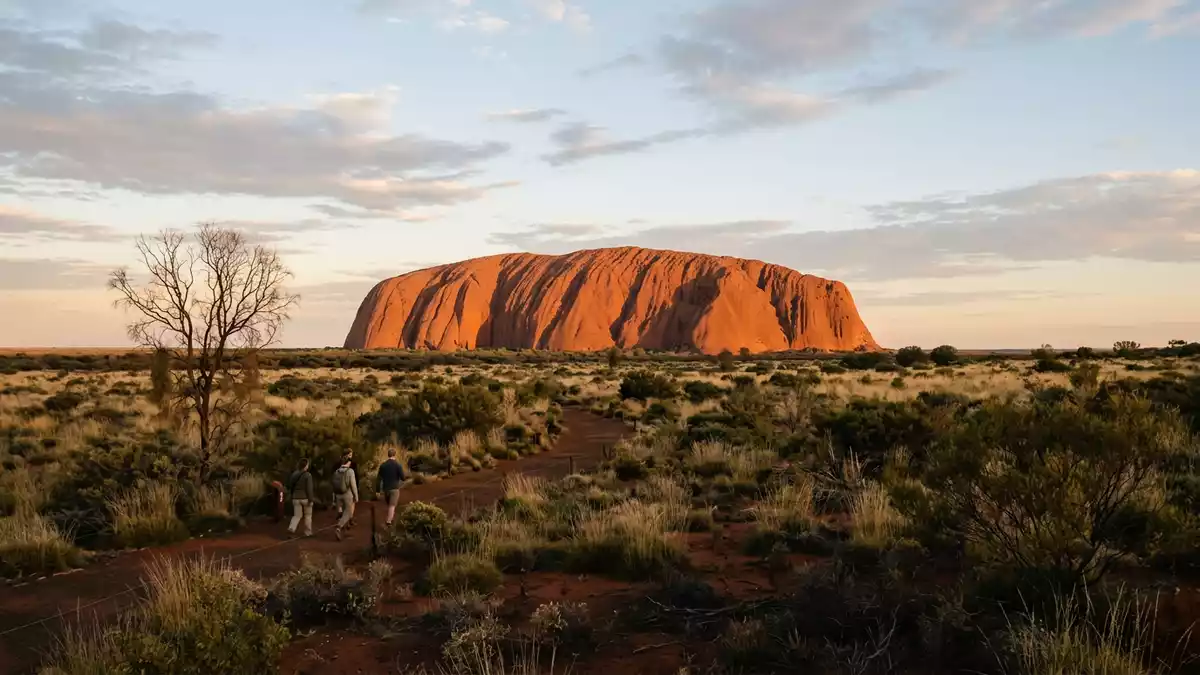
Uluru is a vast sandstone monolith rising from the desert near Yulara in Australia’s Northern Territory, its steep flanks and long profile dominating the surrounding plain. The rock sits within Uluru-Kata Tjuta National Park, a protected landscape recognised on the UNESCO World Heritage List for both natural and cultural values.
A single body of sandstone in the desert
Uluru is composed mainly of arkose, a coarse sandstone rich in feldspar that forms a single, massive body of rock rather than a stack of separate cliffs. The visible faces rise several hundred metres above the surrounding desert plain, with the summit reaching an elevation of about 863 m (2,831 ft) above sea level and much of the formation continuing below ground as a tilted slab.Elevation and sandstone formation The rock’s circumference is about 9.4 km (5.8 mi), so a walk around its base follows a long arc of sheer walls, sloping terraces and weathered surfaces.Rounded red sandstone monolith
Geologists describe Uluru as an inselberg, an isolated hill rising abruptly from comparatively flat erosion lowlands in an arid region. The arkose making up the rock was laid down as thick sedimentary layers hundreds of millions of years ago, then buried, compressed and cemented before being uplifted and tilted close to vertical as the surrounding crust moved.Arkosic sandstone and inselberg form Weathering of iron-bearing minerals in the sandstone gives Uluru its characteristic red-brown colour, which contrasts with the paler sands and scrub vegetation of the plain around it.
Uluru-Kata Tjuta National Park and World Heritage recognition
Uluru stands at the heart of Uluru-Kata Tjuta National Park, a protected area that also includes the domed rock formations of Kata Tjuta to the west. The park covers a broad stretch of central Australian desert with sandplains, low woodland and dramatic rock outcrops that rise well over 300 m above the surrounding terrain.Sandstone monoliths and domes It lies in Australia’s Northern Territory and is managed through arrangements that recognise both traditional ownership and national conservation responsibilities.
Uluru-Kata Tjuta National Park was inscribed on the UNESCO World Heritage List in 1987 for its natural values, including exceptional landforms and arid desert ecosystems, and in 1994 for its cultural landscape, reflecting the longstanding relationship between people and place.Dual World Heritage listing This dual recognition makes the park one of a small number of properties worldwide recognised for both outstanding natural features and cultural significance, highlighting Uluru’s role in geological history and in continuing Indigenous land management.World Heritage datasheet for the park
Anangu law, Tjukurpa and the living rock
For the Pitjantjatjara and other Anangu groups whose ancestral lands include Uluru, the rock is a sacred place bound into Tjukurpa, a body of law, knowledge and creation stories that connects people, land and ancestral beings. Specific features on and around Uluru, including caves, ridges and markings on the rock surface, are associated with particular ancestral figures and stories, and many areas are treated with care under cultural protocols set by traditional owners.Anangu cultural landscape and Tjukurpa The wider park is described as a landscape shaped by thousands of years of management under these traditions, with hunting, gathering and ceremony woven into the desert environment.
Uluru’s status as a cultural landscape is reflected in formal descriptions of the park that link physical features of the rock and surrounding sandplains to the actions, artefacts and bodies of ancestral heroes moving across the land in creation times.Periodic report on Uluru-Kata Tjuta National Park The rock has become a symbol of national identity within Australia, yet it remains first and foremost part of Anangu country, where law, language and land form a single continuum.
Visiting Uluru: what travellers from Western Europe should know
- Uluru lies in Australia’s Northern Territory near the service town of Yulara, reached by road connections and by air services using the local airport.
- The base of Uluru rises from relatively flat desert terrain, but paths at the foot of the rock include uneven surfaces, gentle gradients and stretches exposed to sun and wind.
- The official language is English and the currency is the Australian dollar.
- Entry requirements depend on your nationality; UK travellers can check the FCDO travel advice at gov.uk/foreign-travel-advice, Irish travellers the Department of Foreign Affairs at ireland.ie.
Searching for Uluru on social platforms
These links open searches for Uluru on each platform.
Frequently asked questions about Uluru
Where is Uluru?
Uluru is in Australia’s Northern Territory, rising from the desert near the service town of Yulara within Uluru-Kata Tjuta National Park.
What should travellers expect on a visit to Uluru?
Travellers encounter a single, massive sandstone rock with steep flanks, desert surroundings and paths at its base that pass close to weathered cliffs and terraces.
What makes Uluru distinctive among desert landmarks?
Uluru is a large arkose sandstone inselberg whose physical scale, World Heritage-listed setting and deep role in Anangu law and Tjukurpa give it a distinctive character.


