

Uluru and the red monolith beside Yulara
Published on 08/27/2026 at 16:12 | Editorial responsibility: Rafael Müller, Editor-in-Chief AD HOC NEWS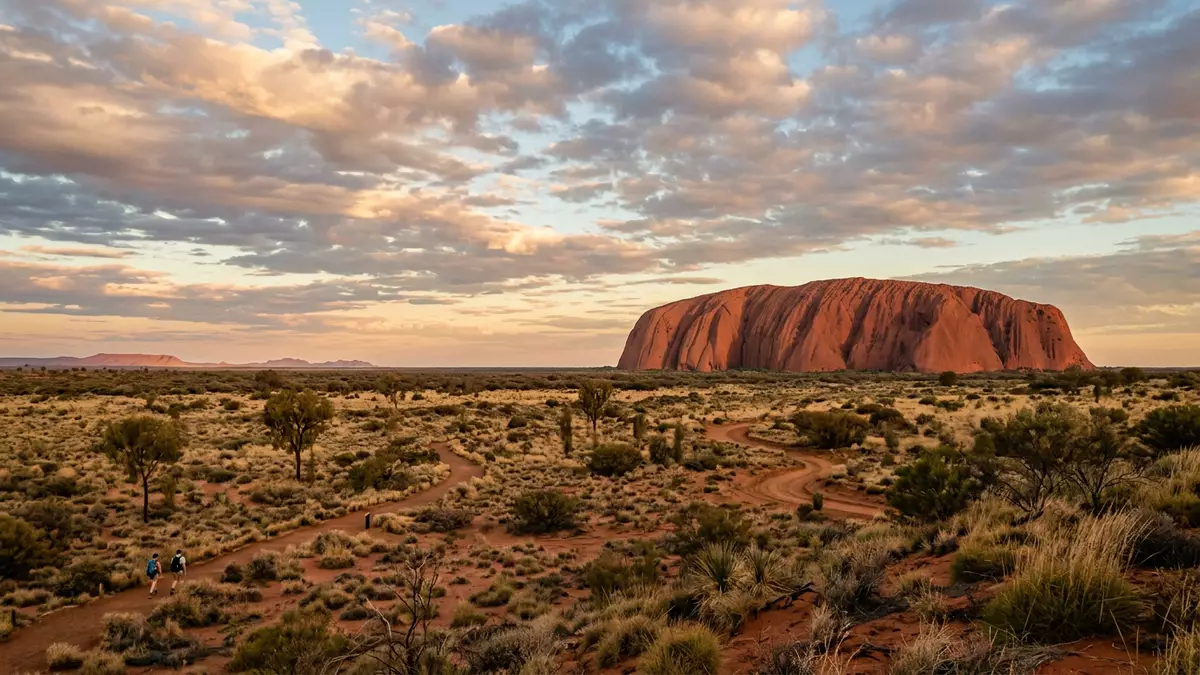
Uluru rises from the red plains near Yulara as a vast sandstone monolith and a central landmark of Australia’s interior. It belongs to Uluru-Kata Tjuta National Park, a World Heritage property inscribed for both natural and cultural value.
Uluru as a single mass of rock
The rock is arkose, a coarse sandstone rich in feldspar, and its steep sides lift it well above the surrounding sand plain. The shape reads as one mass, yet the surface carries fissures, caves and weathered bands.
Its colours shift through red, violet and orange as light and shadow move across the surface. That changing face belongs to the rock itself, along with the broad, bare base and the darker recesses near ground level.
An Anangu cultural landscape
Uluru sits within Anangu country and forms part of a living cultural landscape shaped by Tjukurpa, the law and stories of the traditional owners. The same national park also includes Kata Tjuta, west of Uluru, and both places carry deep cultural meaning.
The park was inscribed on the World Heritage List in 1987 and extended in 1994 for cultural values. Geology | Parks Australia describes Uluru’s red surface as arkose and places its formation at about 550 million years ago.
From ancient formation to park landscape
The rock began forming in the Precambrian, and later earth movements turned the beds upright. Erosion then exposed the monolith above the flat country around it.
That geology is visible in the slope, the vertical faces and the caves at the base. The park also links the rock to a wider desert setting of sand plains and isolated domes.
Visiting Uluru: what travellers from Western Europe should know
- Uluru lies near Yulara in the Northern Territory, and access is by road from the settlement and through Uluru-Kata Tjuta National Park.
- The base walk follows the foot of the rock through open desert terrain. The surface includes exposed stone, uneven ground and shaded recesses at the base.
- The official language is English and the currency is the Australian dollar.
- Entry requirements depend on your nationality; UK travellers can check the FCDO travel advice at gov.uk/foreign-travel-advice, Irish travellers the Department of Foreign Affairs at ireland.ie.
Searching for Uluru on social platforms
These links open searches for Uluru on each platform.
Frequently asked questions about Uluru
Where is Uluru?
Uluru stands in the Northern Territory of Australia, near Yulara, inside Uluru-Kata Tjuta National Park.
What does a visit involve?
The place is a desert landscape centred on a large rock face, its base, and the surrounding sand plain. Paths and viewpoints let visitors read the scale of the monolith from close range.
What makes Uluru distinctive?
Its combination of size, red arkose, steep sides and strong Anangu cultural significance gives the place its character. The rock is part of a World Heritage landscape rather than a stand-alone monument.


