
Ueno Koen, Tokyo’s classic park of culture and greenery
Published on 08/14/2026 at 14:08 | Editorial responsibility: Rafael Müller, Editor-in-Chief AD HOC NEWS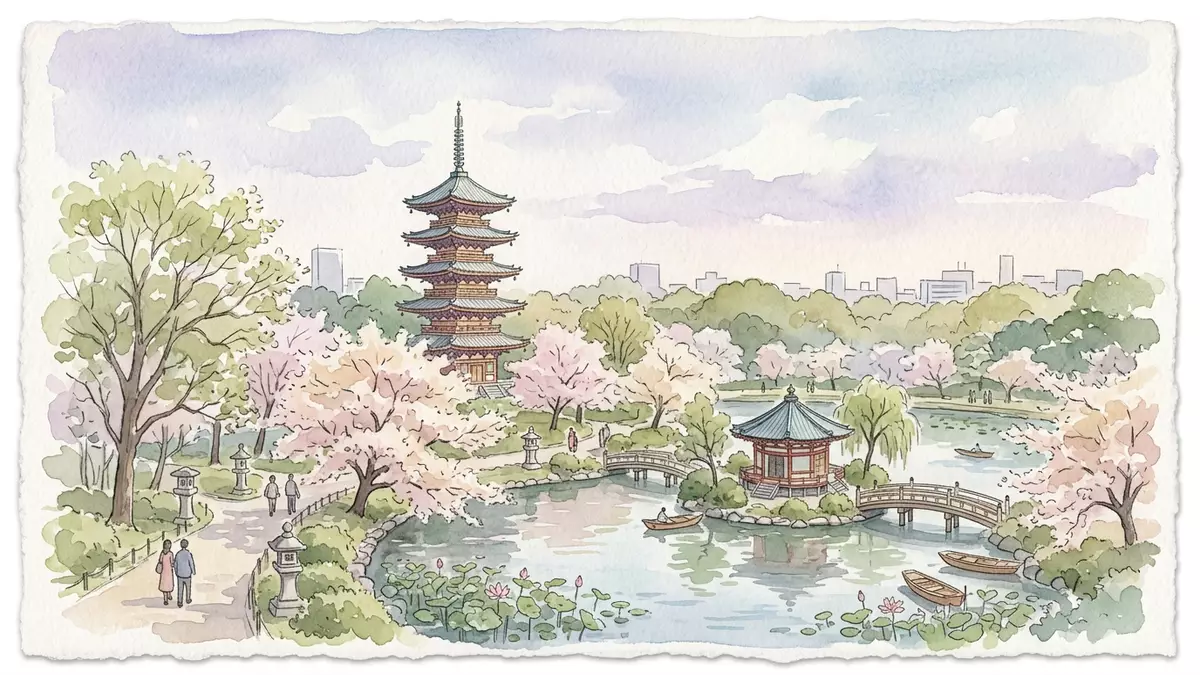
Ueno Koen in Tokio is a broad sweep of parkland where lakes, temples and major museums share the same historic plateau above Ueno Station. Laid out as a public park in 1873 on the former grounds of Kan’ei-ji, it has become a central green space within the Tait? ward and a compact introduction to Japan’s mix of nature, faith and art.
A nineteenth-century park on temple grounds
The land now known as Ueno Koen once formed the precinct of Kan’ei-ji, a Tendai Buddhist temple established during the Edo period when the Tokugawa shogunate governed Japan from Edo, the city that later became Tokyo. In 1873 the area was designated as one of the country’s first Western-style public parks, and its official name, Ueno Onshi Koen, refers to its status as an imperial gift to the city.Ueno Onshi Koen imperial gift The park occupies a large plateau in the Ueno district of Tait?, and figures published for Tokyo list its area at just over 538,000 square metres.area of 538,506.96 square metres
Walking across Ueno Koen reveals how the nineteenth-century decision to convert temple land into public space shaped a varied landscape. Stone lanterns and surviving temple buildings stand beside broad promenades, with shrines such as Toshogu approached along axial paths and framed by mature trees.established in 1873 on Kaneiji grounds The result is a park that reads as both historical site and everyday open space, where religious architecture, memorials and recreational lawns share the same terrace above the surrounding streets.
Museums, zoo and cultural institutions in one precinct
One of the defining features of Ueno Koen is the concentration of major museums within its boundaries. Close to the central pathways stands the Tokyo National Museum, which holds extensive collections of Japanese art and archaeology, ranging from Buddhist sculpture to samurai armour and painted scrolls.Tokyo National Museum within Ueno Park Nearby the National Museum of Western Art occupies a modernist building designed by Le Corbusier, adding European painting and sculpture to the park’s cultural line-up.National Museum of Western Art in Ueno
Alongside these flagship institutions sit the Tokyo Metropolitan Art Museum and the National Museum of Nature and Science, creating a cluster where galleries and exhibition halls line the main routes. Within the same precinct, Ueno Zoo operates as Japan’s first zoological garden, with animal enclosures and internal paths set into the park’s eastern side.Japan’s first zoological garden The combination means a day in Ueno Koen can move from viewing prehistoric fossils to watching animals, then on to sculpture gardens or special art exhibitions, without leaving the park’s boundaries.
Water, planting and seasonal walks
Ueno Koen is not only about buildings; water and planting structure much of the experience of moving through it. On the park’s western side lies Shinobazu Pond, a broad stretch of water divided into sections, with boating areas, reed beds and an island carrying Bentendo, a hall dedicated to Benzaiten.Shinobazu Pond and Bentendo Paths run along the pond’s perimeter, offering views across lotus-covered water in the warmer months and towards the city skyline beyond.
Tree-lined avenues cross the central terrace, and in spring the park’s cherry trees turn the main promenades into tunnel-like walks of blossom that draw residents and visitors alike.spectacular cherry blossoms in spring Elsewhere, smaller groves and lawns provide pockets of shade, while shrines and memorials sit within planting that reflects different periods of Tokyo’s urban history. This mix of water, trees and built structures gives Ueno Koen a layered character: shrine precincts emerge beside museum forecourts, and quiet corners appear a short walk away from busy concourses near the station.
Visiting Ueno Koen: what travellers from Western Europe should know
- Ueno Koen lies in the Ueno district of Tait? in north-eastern Tokyo, directly adjacent to JR Ueno Station on the Yamanote Line and other rail routes, with park entrances near the station’s Park Exit.
- Much of the park sits on a level terrace, but approaches to shrines and viewpoints include flights of stone steps, and walks around Shinobazu Pond cover a noticeable distance on foot.
- Ueno Koen is in Japan, where the official language is Japanese and the currency is the yen.
- Entry requirements depend on your nationality; UK travellers can check the FCDO travel advice at gov.uk/foreign-travel-advice, Irish travellers the Department of Foreign Affairs at ireland.ie.
Searching for Ueno Koen on social platforms
These links open searches for Ueno Koen on each platform.
Frequently asked questions about Ueno Koen
Where is Ueno Koen located in Tokyo?
Ueno Koen is in the Ueno district of Tait? ward in Tokyo, on a plateau directly beside JR Ueno Station and close to Shinobazu Pond.
What should visitors expect during a visit to Ueno Koen?
A visit brings a mix of temples, shrines, major museums, Ueno Zoo and lakeside walks, all linked by broad paths and smaller routes through trees and planting.
What makes Ueno Koen distinctive among Tokyo’s parks?
The park is distinctive for combining a nineteenth-century public park layout with historic religious sites, Japan’s first zoo and a dense cluster of national museums in one contiguous area.


