
Tsodilo Hills and the desert gallery of ancient rock art
Published on 09/15/2026 at 22:37 | Editorial responsibility: Rafael Müller, Editor-in-Chief AD HOC NEWS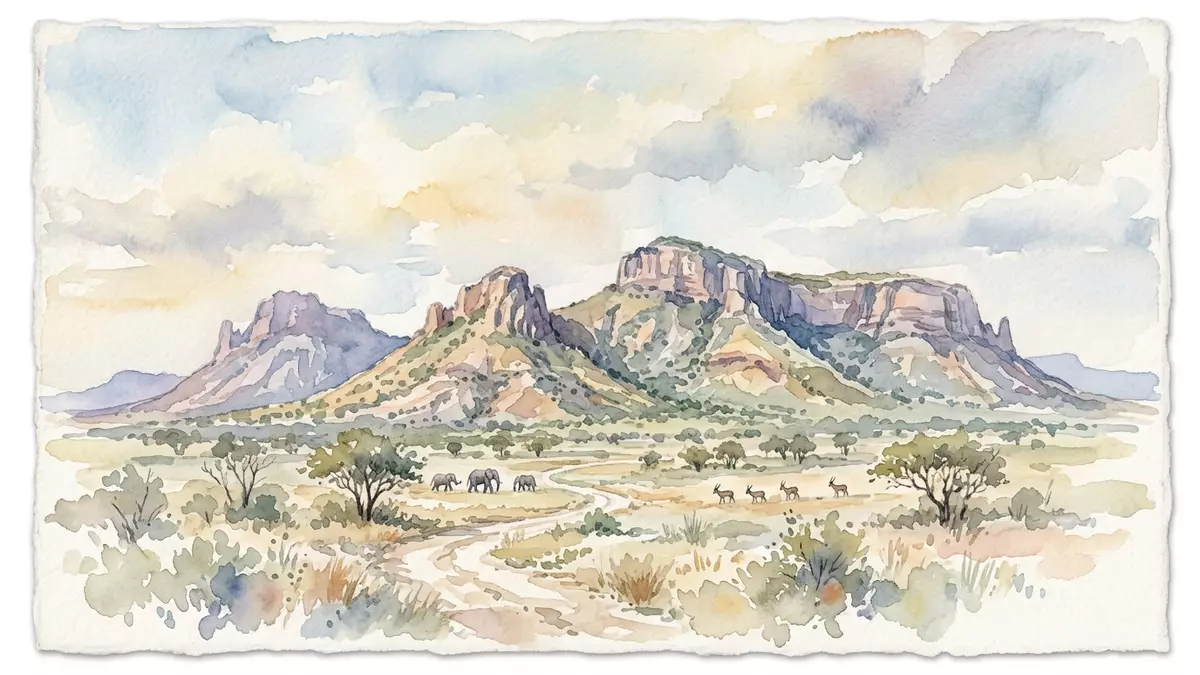
In northwest Botswana near Shakawe, Tsodilo Hills lifts a compact group of quartzite hills out of the flat Kalahari landscape, creating a striking landmark where stone, desert sand and human history meet. Inscribed as a UNESCO World Heritage Site in 2001, the hills hold thousands of rock paintings and archaeological traces that chart human presence over many millennia.
Quartzite hills above the Kalahari sand
Tsodilo Hills stands in the Ngamiland District of northwest Botswana, close to the Namibian border and south of the Okavango River panhandle, where the Kalahari Desert gives way to a dry fossil lake bed and long sweeps of sand.Ngamiland District location The site is formed by massive quartzite outcrops that rise sharply from the surrounding sandveld, breaking what would otherwise be an almost level desert plain.quartzite inselbergs in the Kalahari
The hills are often described as an inselberg landscape, where isolated rock masses tower above wind-shaped dunes and low scrub. Four main hills shape the site: Male Hill, Female Hill, Child Hill and a smaller northern height, each with its own cliffs, gullies and rock shelters.four named hills Approaches from the surrounding desert bring travellers gradually closer to steep rock faces streaked with mineral colours, before paths climb into hollows and terraces among the boulders.
Layers of ancient rock art and settlement
Across an area of about 10 km² (3.86 sq mi), Tsodilo Hills holds an exceptionally dense concentration of rock paintings that has led to the nickname “Louvre of the Desert”.“Louvre of the Desert” description Surveys have recorded more than 4,500 individual paintings on cliff faces, rock overhangs and sheltered panels, making Tsodilo one of the richest rock-art areas in Botswana.over 4,500 rock paintings
The paintings include images of wild animals, cattle, human figures and abstract patterns in mineral pigment, their reds and browns standing out against pale quartzite. Archaeological investigations have uncovered pottery, iron objects, glass and shell beads, carved bone and stone tools that point to long-term settlement and repeated visits to the hills.archaeological finds and habitation Excavated sites such as Divuyu, an Early Iron Age settlement at Tsodilo dating to between 700 and 900 AD, add further depth to the record of occupation and movement around the hills.Divuyu Early Iron Age dating
Sacred landscape and living heritage
UNESCO recognises Tsodilo Hills as a cultural landscape because the archaeology, rock art and topography together document at least 100,000 years of human presence in this part of Botswana.World Heritage cultural landscape Layers of artefacts and paintings show how different communities, including San hunter-gatherers and later pastoral groups, have used and revisited the hills across changing periods.San and Khoe painting traditions
The hills also carry continuing spiritual significance for nearby communities, with specific sites, rock shelters and even individual panels associated with rituals and stories. Paths lead past areas where painted animals and human forms gather on the rock, and where archaeological deposits lie within hollows and caves. In the wider national context, Tsodilo is one of two World Heritage Sites in Botswana, the other being the Okavango Delta, reinforcing its place in the country’s cultural and environmental map.one of two World Heritage Sites in Botswana
Visiting Tsodilo Hills: what travellers from Western Europe should know
- Tsodilo Hills lies in northwest Botswana’s Ngamiland District, south of the Okavango River panhandle and west of the town of Maun; access routes from Shakawe run towards the hills on desert tracks.
- The terrain is shaped by quartzite rock faces, boulder fields and sandy approaches, and paths between the hills include stretches on uneven ground and sections where short climbs reach rock shelters.
- The site sits within the Kalahari Desert, where temperatures, shade and exposure vary between open sandveld and the foot of the cliffs, so time on the hills combines walking on sand with periods among rocky slopes.
- English is widely used in Botswana and the national currency is the Botswana pula.
- Entry requirements depend on your nationality; UK travellers can check the FCDO travel advice at gov.uk/foreign-travel-advice, Irish travellers the Department of Foreign Affairs at ireland.ie.
Searching for Tsodilo Hills on social platforms
These links open searches for Tsodilo Hills on each platform.
Frequently asked questions about Tsodilo Hills
Where is Tsodilo Hills located in Botswana?
Tsodilo Hills is in the Ngamiland District of northwest Botswana, near the Namibian border and south of the Okavango River panhandle, within the Kalahari Desert.
What can visitors expect when exploring the hills?
Visitors encounter steep quartzite slopes, sandy approaches and rock shelters, along with a high concentration of ancient rock paintings spread across the Male, Female, Child and northern hills.
What makes Tsodilo Hills distinctive among African heritage sites?
Tsodilo Hills is recognised as a UNESCO World Heritage cultural landscape for its dense rock art and archaeological record of human settlement extending back many tens of thousands of years.


