
Tsodilo Hills and the desert gallery of ancient rock art
Published on 09/03/2026 at 08:44 | Editorial responsibility: Rafael Müller, Editor-in-Chief AD HOC NEWS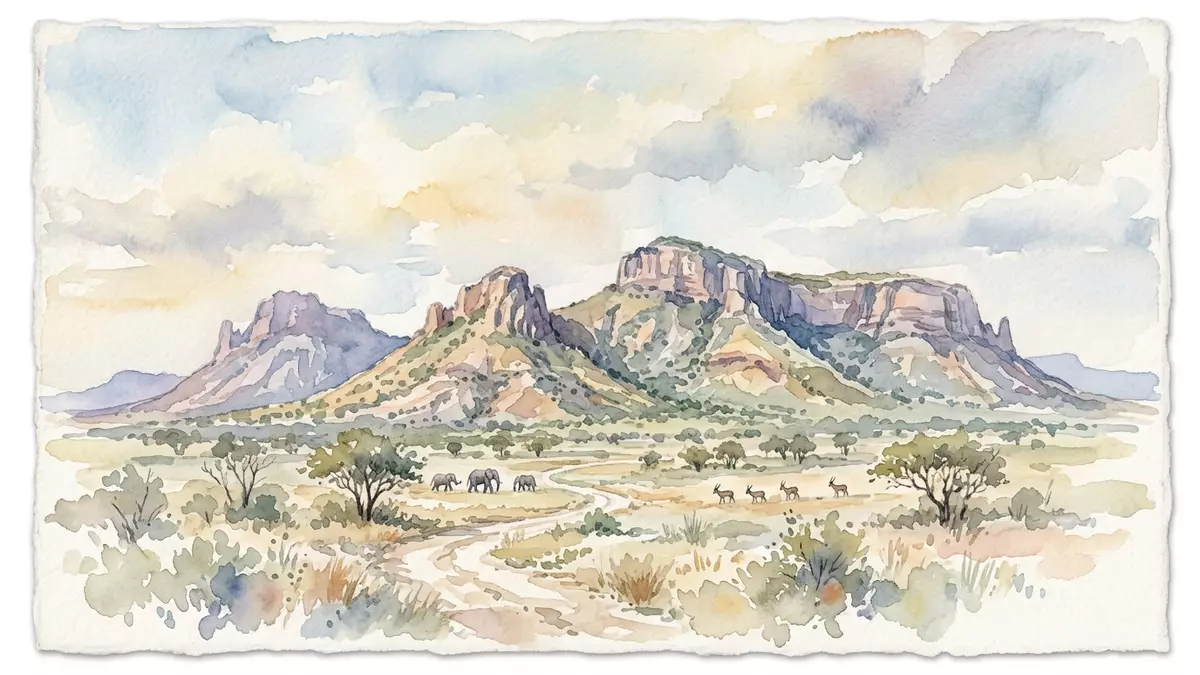
West of Shakawe, Tsodilo Hills lifts abruptly from the Kalahari sands, its cliffs carrying layer upon layer of ancient rock paintings that turn bare rock into an open-air gallery. Recognised as a UNESCO World Heritage Site in 2001, the quartzite outcrops preserve evidence of human presence over at least 100,000 years in this corner of Botswana.
Quartzite hills above the Kalahari sands
Tsodilo Hills stands in north-west Botswana, close to the Namibian border and not far from the Okavango Delta, where a group of steep-sided hills rises from otherwise low-lying desert terrain.Located in north-west Botswana The hills are composed mainly of quartzite, their rock faces catching the light and providing the canvas for paintings scattered across a compact area of roughly 10 km² (3.9 sq mi) within the Kalahari Desert.an area of only 10 km2
The site is usually described as four main hills, identified by names that reflect a human family: Male, Female, Child and a smaller companion also known locally as a spouse or additional relative.four main hill: Male Hill, Female Hill, Child Hill and North Hill Their steep slopes create sheltered ledges and overhangs, where wind and sand have shaped hollows that protect the painted surfaces. From many vantage points among the rocks, the surrounding Kalahari plain stretches away in muted tones of sand and scrub.
UNESCO World Heritage Site and desert “Louvre”
Tsodilo Hills was inscribed on the UNESCO World Heritage List in 2001 as a cultural site, recognised both for its spiritual importance to local communities and for its dense concentration of rock art.UNESCO World Heritage Site in 2001 The protected area records human activities and environmental change over at least 100,000 years, with archaeological deposits, rock shelters and caves sitting alongside the painted panels on exposed cliffs.chronological account of human activities
The density of imagery has led to frequent comparisons with a major museum, and Tsodilo is sometimes called the “Louvre of the Desert” for the sheer number of paintings within a relatively small landscape.termed the “The Louvre of the Desert” Many panels sit just a short walk apart along worn paths at the base of the hills, while others appear higher up, reached by steeper scrambles between boulders and ledges.
Ancient rock art and living spiritual landscape
UNESCO estimates that more than 4,500 individual rock paintings have been recorded at Tsodilo Hills, spread across hundreds of separate sites on the four main hills.over 4500 rock paintings Many are located beneath overhangs or on sheltered cliff faces, where the mineral pigments adhere to the rock. The paintings include images of wild animals, cattle, human figures and abstract or geometric patterns, some of which can be traced back many thousands of years.over 4,500 rock paintings
Archaeological work in the area has identified human occupation stretching back around 100,000 years, making Tsodilo Hills one of the longest-used cultural landscapes in southern Africa.human occupation going back 100,000 years The hills remain a place of spiritual significance for San and Hambukushu communities, who associate particular caves, wells and hilltops with ancestral beings and continue to conduct rituals in the landscape.place of spiritual significance to the San For visitors walking the marked paths beneath the cliffs, the layering of ancient art, archaeology and present-day ritual use gives Tsodilo Hills an unusually continuous sense of human presence.
Visiting Tsodilo Hills: what travellers from Western Europe should know
- Tsodilo Hills lies west of Shakawe in north-western Botswana, near the Namibian border, and is reached by road turn-offs from the main route that links Maun with the Shakawe area.
- The hills rise abruptly from the surrounding Kalahari sands, and many paths involve walking on uneven rock, loose stones and short, steep sections between boulders.
- The surrounding region forms part of the broader Kalahari environment, so daytime heat and exposure on open sections of trail are significant factors for anyone exploring the site on foot.
- The official language is English and the currency is the Botswana pula.
- Entry requirements depend on your nationality; UK travellers can check the FCDO travel advice at gov.uk/foreign-travel-advice, Irish travellers the Department of Foreign Affairs at ireland.ie.
Searching for Tsodilo Hills on social platforms
These links open searches for Tsodilo Hills on each platform.
Frequently asked questions about Tsodilo Hills
Where are Tsodilo Hills?
Tsodilo Hills are in the Ngamiland region of north-west Botswana, west of Shakawe and close to the border with Namibia in the Kalahari Desert.
What can visitors expect to see at Tsodilo Hills?
Visitors encounter quartzite hills rising from desert sands, with marked paths leading past rock shelters, caves and cliff faces covered in ancient paintings of animals and people.
What makes Tsodilo Hills distinctive?
Tsodilo Hills combines over 4,500 recorded rock paintings, evidence of human occupation over roughly 100,000 years and an ongoing spiritual role for local communities in one compact landscape.


