

Trinidad's colonial streets and sugar-era centre
Published on 08/28/2026 at 11:36 | Editorial responsibility: Rafael Müller, Editor-in-Chief AD HOC NEWS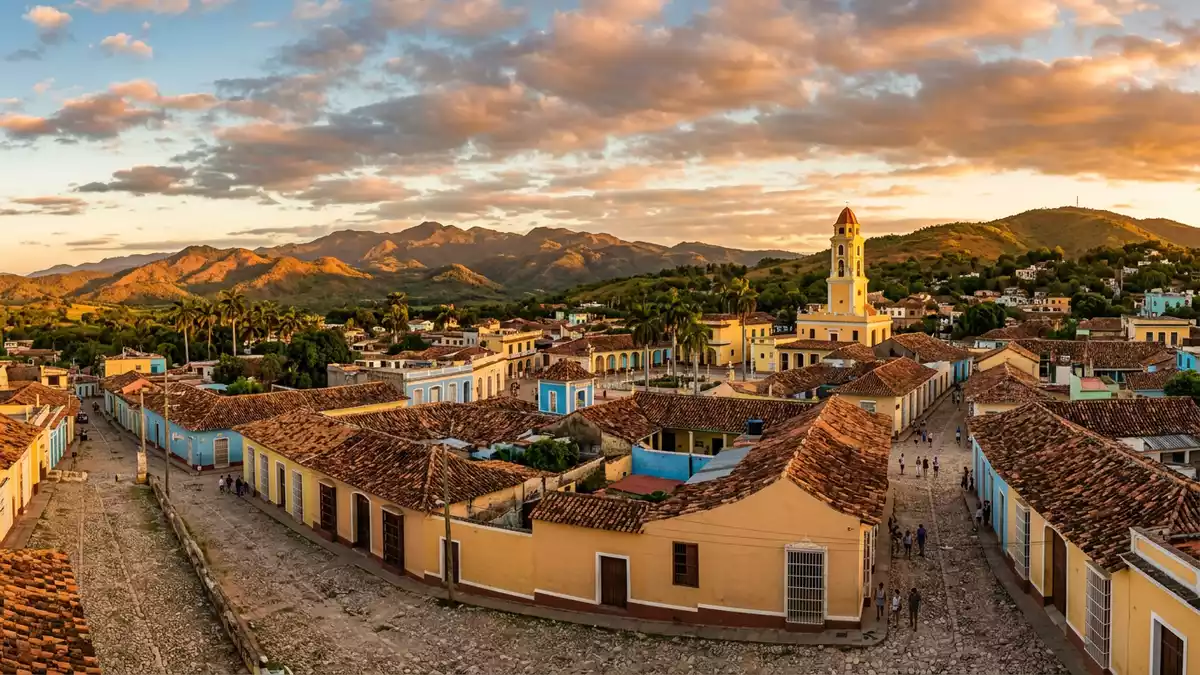
Trinidad in Cuba is a colonial town whose historic centre still reads as a compact urban ensemble. Its core around Plaza Mayor and the sugar-era buildings of the nineteenth century make the place memorable at street level.
Plaza Mayor and the town’s colonial frame
The town lies in Sancti Spíritus Province in south-central Cuba and is linked with the nearby Valle de los Ingenios. UNESCO inscribed Trinidad and the Valley de los Ingenios in 1988, and the designation fixes the town’s place in Cuba’s colonial heritage.UNESCO inscribed Trinidad
The historic centre has a clear focus at Plaza Mayor, where the Palacio Brunet and Palacio Cantero stand among other civic and religious buildings. The square is part of a fabric of cobbled streets, low houses and irregular blocks that preserve the scale of the old town.Plaza Mayor
Houses, churches and sugar wealth
Trinidad was founded in the early sixteenth century by Diego Velázquez de Cuéllar. The town grew with sugar trade and plantation wealth, and that prosperity left behind neoclassical and more vernacular houses in the same streetscape.founded in the early 16th century
The architecture combines single-storey dwellings, decorative facades, tiled roofs and broad eaves. In the town centre, the Palacio Cantero and Palacio Brunet show the more elaborate side of that built environment, while the surrounding streets remain low and tightly knit.tiled roofs
The Valley de los Ingenios beyond the town
The nearby Valley de los Ingenios extends Trinidad’s story beyond the streets of the old centre. Its former sugar mills, plantation houses and barracks belong to the same historical landscape that shaped the town’s prosperity.Valley de los Ingenios
The urban plan of Trinidad developed from the summit area around Plaza Mayor and spreads through narrow, rectilinear streets. That plan, together with the preserved masonry, lime plaster and cobbled surfaces, gives the old town a strongly coherent appearance.urban plan
Visiting Trinidad: what travellers from Western Europe should know
- Trinidad is in south-central Cuba, in Sancti Spíritus Province. The town is reached through Cuba’s inland and southern routes, with the historic centre clustered around Plaza Mayor.
- The old streets include cobblestones and irregular gradients. Many buildings are low, and the town’s colonial core keeps a compact street pattern.
- The official language is Spanish and the currency is the Cuban peso.
- The historic centre and the nearby valley form a single cultural landscape. Sugar-era architecture and former industrial sites belong to the same heritage setting.
Searching for Trinidad on social platforms
These links open searches for Trinidad on each platform.
Frequently asked questions about Trinidad
Where is Trinidad?
Trinidad is a town in south-central Cuba, in Sancti Spíritus Province. Its historic core sits near Plaza Mayor and is linked to the Valley de los Ingenios.
What can be expected on a visit?
The old centre is built on cobbled streets, low houses and civic buildings from the colonial era. The setting is compact, with a strong emphasis on preserved urban form rather than large monuments.
What makes Trinidad distinctive?
Its distinction lies in the combination of a well-preserved colonial town and the sugar landscape beyond it. Plaza Mayor, the old houses and the Valley de los Ingenios form one connected historical setting.


