

Trinidad Kuba Altstadt, Cuba’s colonial city of cobbles and pastel walls
Published on 08/24/2026 at 11:04 | Editorial responsibility: Rafael Müller, Editor-in-Chief AD HOC NEWS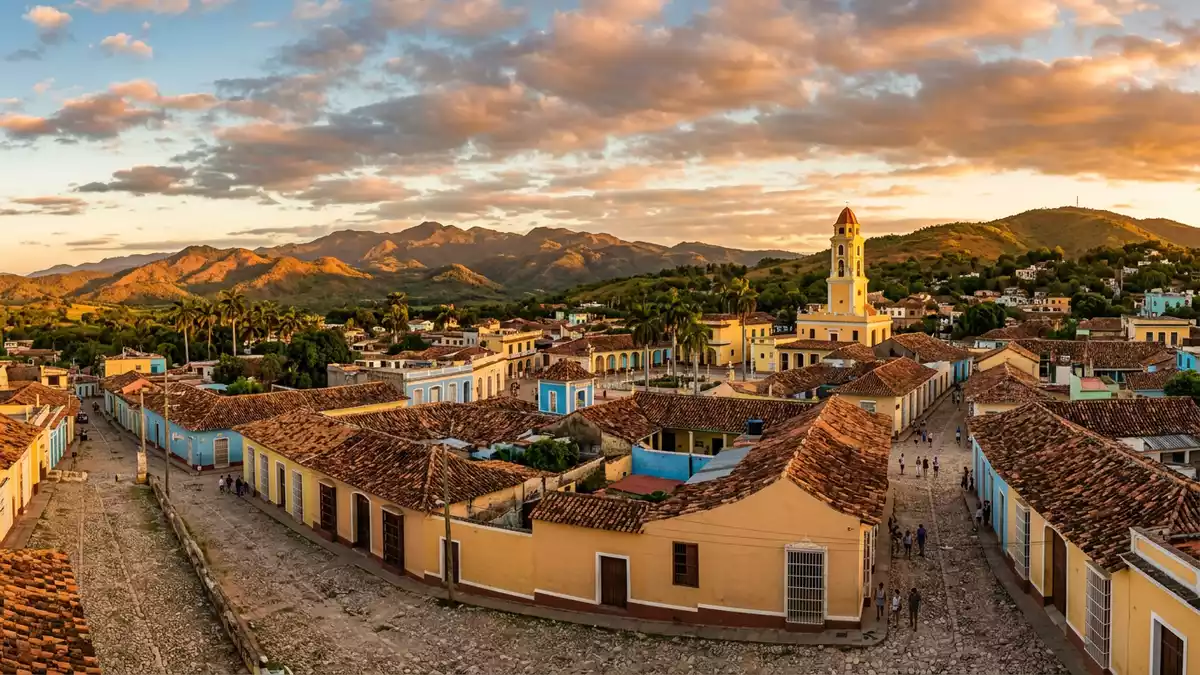
Trinidad Kuba Altstadt is the historic heart of Trinidad, a colonial city on Cuba’s southern coast where cobbled streets, pastel houses and sugar-era mansions form a remarkably intact urban ensemble. Founded in 1514 by the Spanish conquistador Diego Velázquez de Cuéllar during the early phase of Cuba’s colonisation, Trinidad later became closely tied to sugar production in the surrounding Valle de los Ingenios, a relationship that shaped the architecture and wealth of its old town.
A Spanish colonial town shaped by sugar
Trinidad stands in central Cuba, in Sancti Spíritus Province, with the old town rising gently above the coastal plain between the Caribbean Sea and the foothills of the Escambray Mountains. The settlement was established as Villa de la Santísima Trinidad in honour of the Holy Trinity in the first decades of Spanish rule, part of a chain of early towns created as bases for conquest and administration across the island.Founded in 1514 by Diego Velázquez de Cuéllar
From the eighteenth century, Trinidad’s fortunes became closely linked to sugar cane planted in the fertile valley to the north of the city, known as the Valle de los Ingenios. Wealthy plantation owners channelled profits from sugar exports into grand urban residences, building mansions with generous rooms, internal courtyards and decorative details that reflected their status. The combined cultural landscape of the colonial city and the sugar valley has been recognised as a cultural World Heritage Site, inscribed on the UNESCO list in 1988 for its outstanding testimony to this era.Trinidad and the Valley de los Ingenios were inscribed in 1988
Plaza Mayor and the museum-like historic centre
At the core of Trinidad Kuba Altstadt lies Plaza Mayor, a compact formal square that serves as the focal point of the historic centre. Around it stand some of the town’s most notable buildings, giving the area the character of an open-air museum of Spanish colonial urbanism.Plaza Mayor is recognised as the historic centre of Trinidad Among the most prominent structures are the neoclassical Palacio Cantero, which houses the municipal history museum, and the Palacio Brunet, whose preserved interiors offer a sense of the domestic life of Trinidad’s sugar elites.
One side of Plaza Mayor is overlooked by the campanile of the former Convento de San Francisco, its tower rising above the low roofs of the old town.The convent’s campanile is a prominent landmark above Plaza Mayor Close by stands the Iglesia de la Santísima Trinidad, the city’s main church, rebuilt in the nineteenth century and facing the plaza. The streets radiating from the square are paved in cobblestones, flanked by single- and two-storey houses painted in soft shades of blue, green, yellow and pink, with wooden doors and wrought-iron grilles enclosing windows and ground-floor openings. Together, these elements create a dense, low-rise urban fabric whose scale and materials reflect the town’s eighteenth- and nineteenth-century development.
Trinidad’s architectural character and surrounding landscape
The architecture of Trinidad Kuba Altstadt blends Spanish colonial forms with adaptations to the Caribbean climate and local building traditions. Many houses open onto inner patios, providing light and air to rooms set around them. Roofs are commonly covered with clay tiles, and the combination of thick walls and shaded arcades helps interiors cope with the tropical sun. Public buildings such as town houses, churches and former convents share similar materials and proportions, giving the historic centre a coherent appearance.
Beyond the streets and plazas, the wider landscape contributes to the character of the town. To one side of Trinidad Kuba Altstadt, the land rises towards the Escambray range, while on the other it drops towards the coast and nearby beaches on the Caribbean Sea.Trinidad and the Valley de los Ingenios form a combined cultural landscape in central Cuba Inland, the Valle de los Ingenios still contains remains of former sugar mills, including towers and plantation houses, which echo the story told by the mansions and museums within the city itself. The relationship between the compact urban core and the surrounding agricultural landscape is part of what UNESCO sought to preserve when recognising the area.
Visiting Trinidad: what travellers from Western Europe should know
- Trinidad Kuba Altstadt lies in Trinidad, a city in Sancti Spíritus Province on Cuba’s southern coast. It is reached by road connections from other Cuban cities, with long-distance buses and private vehicles arriving near the historic centre.
- The historic streets around Plaza Mayor are paved with cobblestones, and many routes involve short, steep stretches. Walking around the old town means dealing with uneven surfaces and occasional stairways between levels.
- Nearby, the terrain rises towards the Escambray Mountains and descends to coastal plains and beaches along the Caribbean Sea, so excursions from the old town can involve both hillside paths and flat seaside promenades.
- The official language is Spanish and the currency is the Cuban peso.
- Entry requirements depend on your nationality; UK travellers can check the FCDO travel advice at gov.uk/foreign-travel-advice, Irish travellers the Department of Foreign Affairs at ireland.ie.
Searching for Trinidad on social platforms
These links open searches for Trinidad on each platform.
Frequently asked questions about Trinidad
Where is Trinidad Kuba Altstadt located?
Trinidad Kuba Altstadt is the historic centre of Trinidad, a city in Sancti Spíritus Province on the southern coast of Cuba, in the central part of the island.
What should visitors expect in the old town?
Visitors encounter cobbled streets, pastel-coloured houses, churches, former convents and sugar-era mansions around Plaza Mayor, forming a compact colonial core that can be explored on foot.
What makes Trinidad Kuba Altstadt distinctive?
The pairing of a well-preserved Spanish colonial town with the surrounding Valle de los Ingenios sugar landscape, recognised together as a UNESCO World Heritage Site, gives Trinidad Kuba Altstadt a distinctive historical and architectural character.


