
Traku salos pilis and the red-brick island castle
Published on 09/12/2026 at 09:24 | Editorial responsibility: Rafael Müller, Editor-in-Chief AD HOC NEWS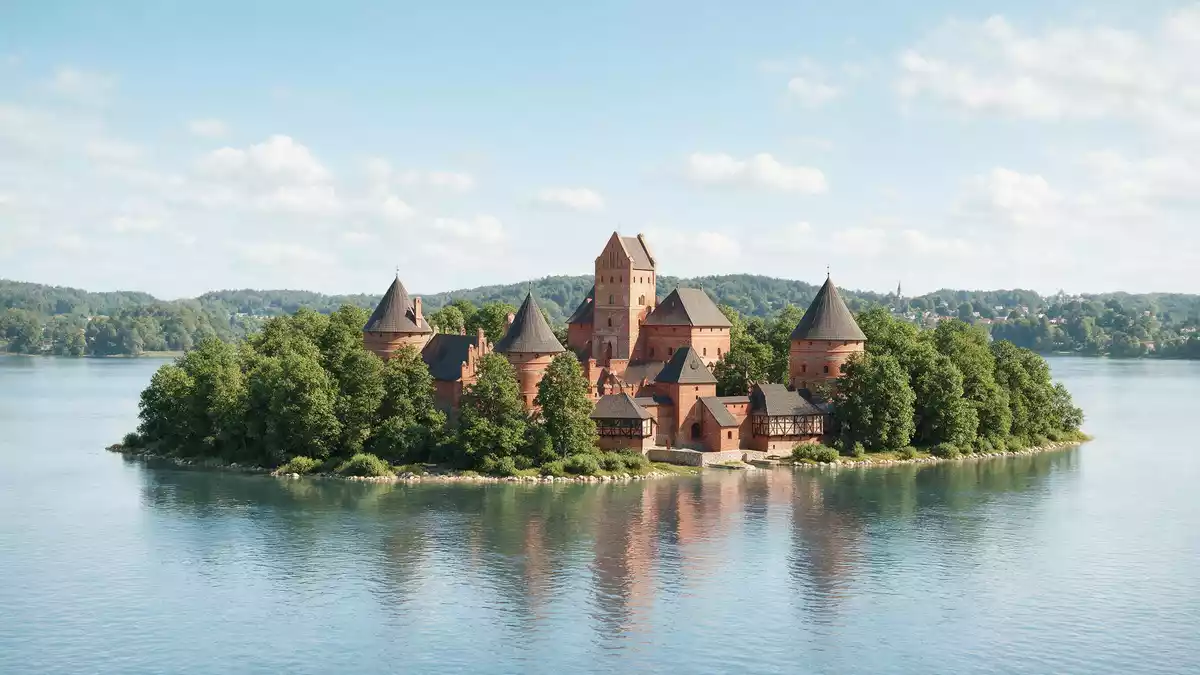
Traku salos pilis stands on an island in Lake Galv? in Trakai, with red brick, Gothic forms and water on every side. It is known in English as Trakai Island Castle, and its profile belongs to the historical centre of the Grand Duchy of Lithuania.
Red brick and water at Traku salos pilis
The castle’s setting is its strongest visual feature: a stone-and-brick complex separated from the town by water and approached by bridges. Its walls, towers and courtyard give it the look of a fortified residence rather than a plain palace. The ensemble is tied to a Gothic structure that was begun in the fourteenth century.
The castle is associated with K?stutis and Vytautas, two central figures in the history of Lithuania. The site’s later role as a royal seat and museum gives the island a layered appearance, with military mass and domestic rooms sharing the same complex. The castle also belongs to the broader story of the Grand Dukes of Lithuania.
K?stutis, Vytautas and the medieval court
Construction began in the second half of the fourteenth century and was completed in the first half of the fifteenth century. K?stutis started the work, and his son Vytautas carried it forward, linking the castle to the late medieval court of Lithuania. The castle’s history is also tied to Vytautas the Great, whose reign shaped Trakai’s importance.
Inside the complex, the palace, forecourt, casemates and towers form a sequence of enclosed spaces rather than a single hall. Gothic brickwork, vaulted rooms and defensive walls give the place a strict, ordered character. The island position, paired with the masonry, keeps the castle legible as both residence and stronghold.
From royal stronghold to museum
After the medieval period, the castle lost its original role and later became linked to preservation and museum display. The restored complex entered a new phase in the twentieth century, when it was transferred to the Trakai History Museum in 1962. That date matters because the building’s present identity as a museum site is part of its public character.
The present interior combines exhibition rooms with the castle’s older architecture. Visitors encounter a fortified shell filled with museum displays, rather than a reconstructed palace that hides its structure. The castle’s survival also links it to the long preservation work that shaped it during the twentieth century.
Visiting Traku salos pilis: what travellers from Western Europe should know
- The castle stands in Trakai, south-west of Vilnius, on an island in Lake Galv?. It is reached by road into Trakai and then across the bridge to the island.
- The approach is flat, but the site sits on water and stone surfaces. The castle complex includes towers, walls and enclosed courtyards rather than open lawns.
- The official language is Lithuanian and the currency is the euro.
- The island setting places the castle within the lake landscape of Trakai, close to the town and the wider castle ensemble.
Searching for Traku salos pilis on social platforms
These links open searches for Traku salos pilis on each platform.
Frequently asked questions about Traku salos pilis
Where is Traku salos pilis?
It is in Trakai, Lithuania, on an island in Lake Galv?. The castle lies within the town’s historic lake landscape.
What does a visit involve?
The place combines bridges, courtyards, towers and museum interiors. It reads as a castle complex first, and as an exhibition space second.
What makes it distinctive?
Its island setting and red-brick Gothic fabric define it. The association with K?stutis, Vytautas and the Trakai History Museum gives the site its historical depth.


