
Traku salos pilis, a red-brick island fortress on Lake Galv?
Published on 09/18/2026 at 14:24 | Editorial responsibility: Rafael Müller, Editor-in-Chief AD HOC NEWS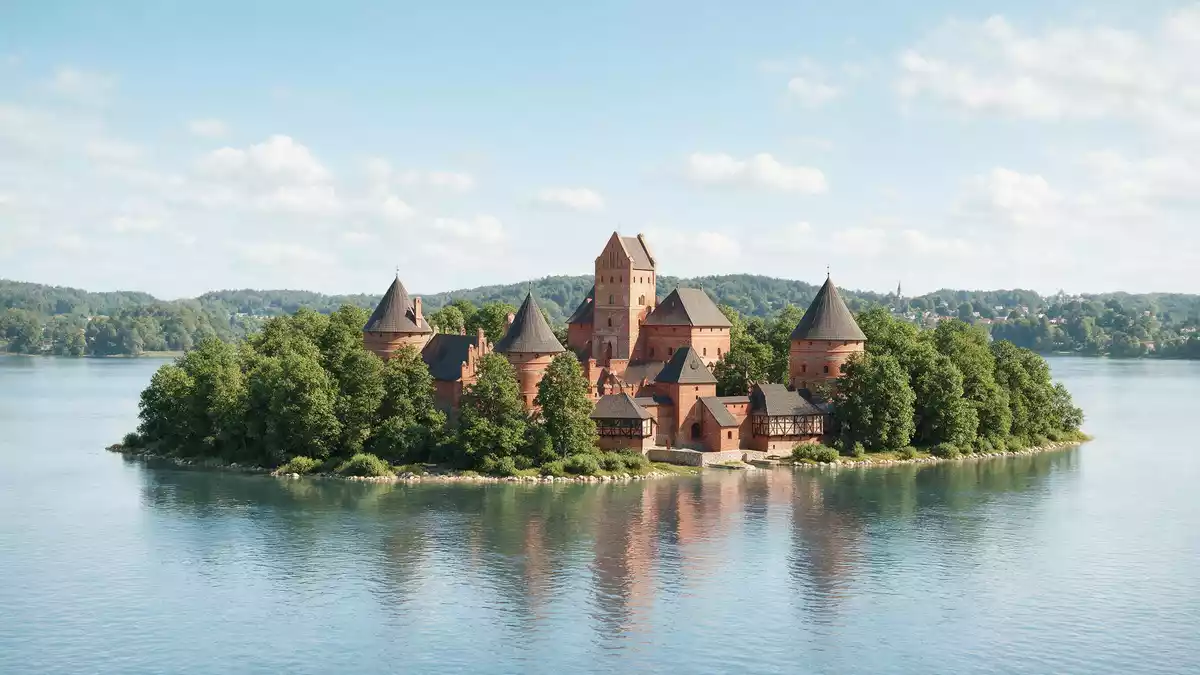
Traku salos pilis is the red-brick island castle that anchors the historic town of Trakai in Lithuania, set on Castle Island in Lake Galv? and reached by footbridges from the shore. Built as a Gothic fortress and residence in the fourteenth and fifteenth centuries under Grand Duke K?stutis and his son Vytautas the Great, it later fell into ruin before twentieth-century restorations returned its towers and courtyards to a medieval outline. Today the castle houses the Trakai History Museum inside walls that once guarded the heartland of the Grand Duchy of Lithuania.
Red brick, Gothic lines and an island plan
Traku salos pilis belongs to the group of brick Gothic castles that marked the power centres of the Grand Duchy of Lithuania, yet its complete separation from the mainland on Castle Island gives it a distinct spatial character among them.Trakai Island Castle The main palace and curtain walls rise from the island’s edge in red brick, structured around an irregular plan that covers about 1.8 hectares and leaves almost no flat ground outside the defended precinct.occupies the whole island Inside the perimeter, the ensemble combines tall towers, enclosed courtyards and ranges of residential and service buildings, all arranged to make the most of the limited space.
The castle developed in several building phases between the late fourteenth century and the first years of the fifteenth century, with the earliest structures focused on the northern part of the island and later works expanding the defensive outer ward.XIV a. II pus?je Its walls and towers are predominantly Gothic in style, expressed through pointed arches, narrow openings and the vertical emphasis of the brickwork, while some details retain echoes of earlier Romanesque forms in their heavier proportions.Pilies architekt?ra gotikos stiliaus Standing on the inner walkways, the visitor looks down into enclosed yards and up to battlements that combine military purpose with the representational needs of a ducal residence.
From ducal seat to ruin and museum
Traku salos pilis was created at a time when Trakai held a central place in the Grand Duchy of Lithuania, and the castle became one of the main residences of its rulers in the fifteenth century.LDK valdov? rezidencij? After the Teutonic Order suffered defeat at the Battle of Grunwald in 1410, Vytautas the Great used the island castle as a residence, giving its halls and chambers a ceremonial role in the political life of the duchy.Vytauto rezidencija Over the following centuries the military importance of Trakai declined, and wars in the seventeenth century left the castle damaged.
For a long period Traku salos pilis lay in partial ruin, its brickwork exposed and its roofs gone, while the town of Trakai continued on the shores of Lake Galv? nearby.abandoned and in ruins In the twentieth century extensive restoration campaigns reconstructed the palace and outer ward in a form that reflects the fifteenth-century state of the complex, based on historical and archaeological research.restoration was completed Since the 1960s Traku salos pilis has housed the Trakai History Museum, with exhibition rooms arranged through the rebuilt interiors to tell the story of the castle, the town and the wider region.Type Gothic water castle and history museum
Water, bridges and the wider Trakai landscape
The presence of Traku salos pilis on a separate island shapes the wider landscape of Trakai as strongly as its brick walls shape the castle interior. Castle Island lies just off the lakeside street Karaim? gatv?, with wooden footbridges crossing narrow stretches of water to link the town and the fortress.cross the two wooden footbridges Lake Galv? wraps around the island, so views from the castle terraces and windows carry across open water to other islands and to the wooded shorelines beyond.many islands of Lake Galv?
Within the town, streets lead directly towards the water and the sightline to the castle, making Traku salos pilis a constant presence in everyday life as well as in visitor itineraries. The main approach passes traditional wooden houses and Karaim eateries before reaching the lakefront and the bridges to Castle Island, threading together the living town and the museum precinct. On the island itself, stone paving, enclosed courts and staircases connect the different levels of the rebuilt complex, while the red brick rises above the water in sharp contrast to the broad surface of Lake Galv?.
Visiting Traku salos pilis: what travellers from Western Europe should know
- Traku salos pilis stands on Castle Island in Lake Galv? on the northern side of Trakai; trains and buses connect Vilnius with Trakai, and the castle is reached on foot from the town’s stations.
- The approach from Trakai runs along Karaim? street to the lakeshore, followed by wooden footbridges and paved paths across Castle Island, with staircases inside the castle leading between the courtyards and upper levels.
- The official language in Lithuania is Lithuanian and the currency is the euro (EUR).
- Entry requirements depend on your nationality; UK travellers can check the FCDO travel advice at gov.uk/foreign-travel-advice, Irish travellers the Department of Foreign Affairs at ireland.ie.
Searching for Traku salos pilis on social platforms
These links open searches for Traku salos pilis on each platform.
Frequently asked questions about Traku salos pilis
Where is Traku salos pilis located?
Traku salos pilis stands on Castle Island in Lake Galv? beside the town of Trakai in Lithuania, west of Vilnius in the Trakai District Municipality.
What can visitors expect on a visit to Traku salos pilis?
Visitors cross wooden footbridges to reach the island castle, then explore courtyards, towers and exhibition rooms of the Trakai History Museum inside the restored red-brick Gothic complex.
What makes Traku salos pilis distinctive among Lithuanian castles?
Its complete location on an island in Lake Galv?, its red-brick Gothic architecture and its role as a rebuilt ducal residence and museum give Traku salos pilis a distinctive character within Lithuania’s castle landscape.


