
Tower of London as fortress, palace and prison
Published on 09/22/2026 at 01:46 | Editorial responsibility: Rafael Müller, Editor-in-Chief AD HOC NEWS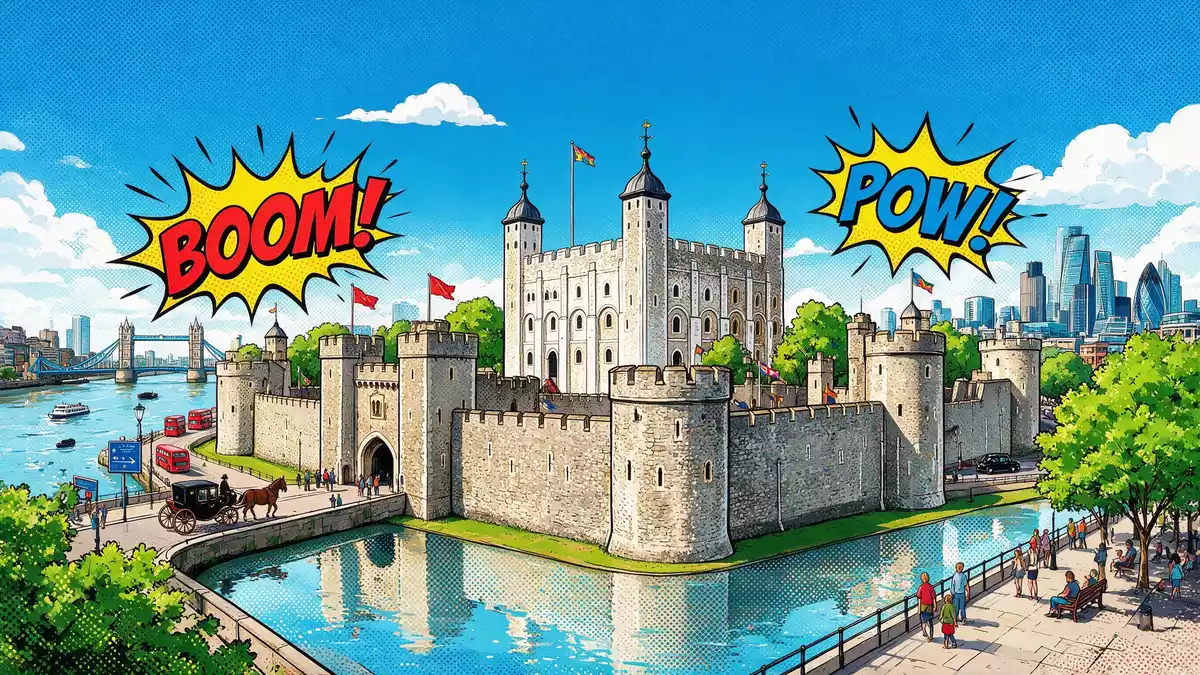
On the north bank of the River Thames, near the eastern edge of London’s historic city, the Tower of London gathers centuries of English history behind dense stone walls. Founded in the aftermath of the Norman Conquest under William the Conqueror in the 1070s, it developed from a single keep into a complex of wards, towers and courts that has served as fortress, royal palace, armoury and prison in turn.William the Conqueror’s fortress palace
The White Tower and the Norman core
The heart of the complex is the White Tower, a massive keep begun under William I around 1078 and constructed of pale limestone brought from Caen in Normandy.Caen stone keep begun about 1078 Rising above the inner ward, this blocky structure defined the early castle and gave the site its name as the Tower. Built close to the line of the old Roman city wall, it asserted Norman authority over the defeated Anglo-Saxon city and guarded access to the upper reaches of the Thames.
Inside, the White Tower contained vaulted rooms, a great hall and chapels arranged over several storeys, reflecting its double role as fortress and royal residence.The story of the Tower of London Later monarchs adapted these interiors, inserting fireplaces, panelling and decorative details as the keep shifted from stark military stronghold to part of a broader palace complex. Standing today within the inner ward, surrounded by later curtain walls, it remains a rare surviving example of an eleventh-century fortress palace.
Medieval expansion and royal power
From the twelfth century onwards, successive kings expanded the Tower beyond the Norman core. Under Richard I, Henry III and Edward I, new curtain walls, mural towers and gatehouses pushed the defences outwards, creating inner and outer wards in a concentric arrangement.Phases of expansion under medieval kings By the thirteenth century, the complex had grown into one of England’s largest and most formidable castles, with rings of fortification enclosing royal lodgings and service buildings.
These medieval works included the construction and enlargement of a moat around the outer walls, a wharf along the riverside and new towers on both river and landward approaches.Medieval defences and moat Within the protected space, monarchs added residential ranges and a great hall, allowing the Tower to function as a primary royal residence for long stretches of the Middle Ages. Its architecture from this period expressed power through height, thick masonry and controlled access, with layered gateways and portcullises guarding entry from both river and city.
Palace, arsenal, mint and menagerie
As the political centre of England evolved, the Tower’s functions multiplied. For centuries it housed the Crown Jewels and served as a treasury, keeping royal valuables within heavily guarded chambers near the White Tower.Crown Jewels and royal institutions The Royal Mint operated within the fortress from the reign of Edward I around 1279 until the early nineteenth century, coining money under royal authority behind its walls.Royal Mint at the Tower
Other institutions used the site as needs changed. A royal armoury stored weapons and armour within its buildings, supporting campaigns and the defence of London. The Royal Menagerie, established in the thirteenth century, kept exotic animals in towers near the western side of the fortress for centuries, making the place a mixture of palace, military base and zoological display.Royal armoury and menagerie In later periods, parts of the complex also held public records and state offices, turning this single enclosure into a physical map of royal administration.
Prison, executions and national memory
Alongside its ceremonial and administrative roles, the Tower gained lasting notoriety as a state prison. From the Middle Ages into the seventeenth century, political and religious prisoners were confined in towers and lodgings within the walls, ranging from high nobles to future monarchs such as Elizabeth before she became queen.Imprisonment of nobles and royals Cells, storerooms and chambers were adapted as holding spaces, leaving behind scratched graffiti and carved coats of arms that still mark the stone.
Executions linked to the Tower’s judicial role took place both inside and just outside the complex. While many condemned prisoners were beheaded on Tower Hill, beyond the outer walls, a smaller number met their deaths on Tower Green itself, within view of royal lodgings.Executions on Tower Hill and Tower Green The deaths of figures such as queens Anne Boleyn, Catherine Howard and Lady Jane Grey embedded the Tower in England’s collective memory as a place where power struggles reached their most dramatic end.
A World Heritage fortress on the Thames
The strategic siting of the Tower beside the Thames gave it control over river traffic and the eastern approach to the historic City of London. From the Norman period onwards it guarded the gateway to the capital, its riverfront wharf connecting directly to the water for movement of goods, troops and prisoners.Gateway fortress on the Thames Rising above surrounding streets and docks, its layered walls and towers remain prominent in views along the river.
In 1988 the Tower of London was inscribed as a UNESCO World Heritage Site, recognised as one of the best-preserved examples of an eleventh-century fortress palace and a major reference for medieval military architecture.World Heritage inscription in 1988 Conservation work during the nineteenth and twentieth centuries, including post-Blitz repairs, stabilised its masonry and opened more areas to visitors, turning a once-feared stronghold into a heritage site where layers of royal, military and urban history can be read in stone and brick.
Visiting Tower of London: what travellers from Western Europe should know
- The fortress stands on the north bank of the River Thames beside Tower Bridge, on the eastern edge of London’s historic city, and is reached by Underground and mainline rail stations in the surrounding streets.
- Within the complex, movement passes through gateways, cobbled lanes and staircases between towers; some paths involve uneven surfaces and climbs within turrets.
- Nearby, the River Thames, Tower Bridge and the former Port of London docks frame the setting, with the City of London’s financial district rising to the west and the modern redeveloped Docklands further east along the river.
- The official language is English and the currency is the pound sterling.
Searching for Tower of London on social platforms
These links open searches for Tower of London on each platform.
Frequently asked questions about Tower of London
Where is the Tower of London located?
It stands on the north bank of the River Thames beside Tower Bridge, at the eastern edge of central London’s historic core.
What can visitors expect to see inside the Tower of London?
Visitors encounter the Norman White Tower, later medieval curtain walls and towers, historic prison spaces, royal apartments and the secure area housing the Crown Jewels.
What makes the Tower of London distinctive among European castles?
It combines an eleventh-century fortress palace, later concentric defences and long use as a royal mint, armoury, prison and residence, all preserved together on a single riverside site.


