
Tower Bridge and the drama of a moving Thames crossing
Published on 09/10/2026 at 22:06 | Editorial responsibility: Rafael Müller, Editor-in-Chief AD HOC NEWS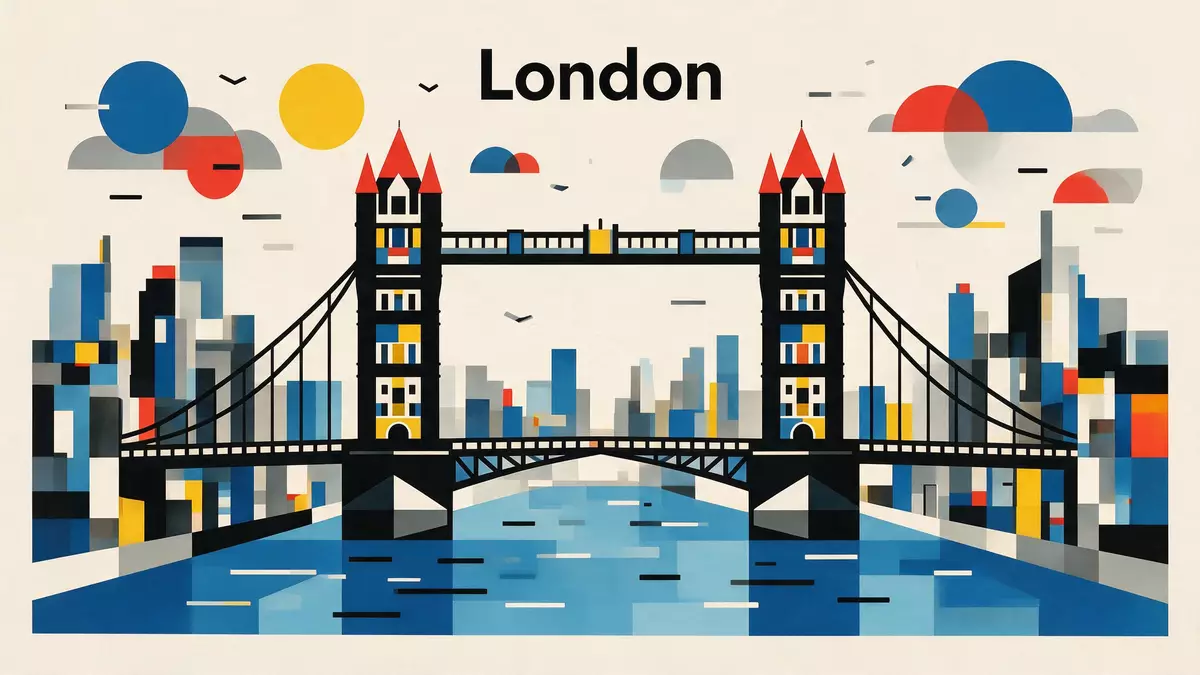
Tower Bridge in London is a combined bascule and suspension bridge whose steel framework is wrapped in Gothic-style stone, turning an essential Thames crossing into a daily piece of urban theatre. Built between 1886 and 1894 to designs by architect Sir Horace Jones with engineering by Sir John Wolfe Barry, it rises beside the Tower of London and has become a defining landmark of the city’s eastern riverfront.
Steel, stone and a moving roadway
The structure of Tower Bridge brings together several distinct elements that visitors can see at a glance: a central opening span formed by two bascules, flanked by suspension sections that carry the road from each bank, all tied visually by the pair of towers and the overhead walkways.combined bascule and suspension bridge The bascules are immense steel leaves paved for road traffic; when river vessels pass, each leaf pivots upwards from the riverbank, creating an unmistakable silhouette against the sky.
What gives Tower Bridge its character is the decision to clad this machinery in stonework that echoes the nearby medieval fortress. The towers rise from massive river piers and are faced in granite and Portland stone, with turrets, pointed arches and traceried openings that recall nineteenth-century Gothic Revival architecture.neo-Gothic style that complemented its next-door neighbour Above the roadway, high-level walkways span between the towers, originally built as cantilever structures and later converted to suspension form, giving pedestrians a route across even when the bascules are raised.high level walkways converted to suspension in 1960
A Victorian solution beside the Tower of London
Tower Bridge belongs firmly to the late Victorian period, both in its engineering and its politics. In the nineteenth century, London’s growth placed heavy pressure on crossings downstream of London Bridge, and the City authorities sought a new river crossing that could carry road traffic while maintaining access to the Pool of London, the stretch of water between London Bridge and the Tower that served shipping. The Corporation of London promoted legislation for the project, and the Tower Bridge Act received Royal Assent in 1885, clearing the way for construction.Tower Bridge Act received Royal Assent in 1885
Work began in April 1886 under resident engineer Edward Cruttwell, using deep iron caissons sunk into the Thames bed to carry the foundations.construction began on 22 April 1886 Over the following years, around 11,000 tons of steel formed the internal skeleton of the towers and walkways, later encased in stone to match the historic setting.11,000 tons of steel beneath its Gothic stone exterior The bridge was opened on 30 June 1894 by Edward, Prince of Wales, and Alexandra, Princess of Wales, in a ceremony that underlined its importance to the capital.opened on 30 June 1894 From the outset, the combination of heavy engineering and historicist architecture marked Tower Bridge as a showpiece of Victorian ingenuity beside one of England’s most significant royal fortresses.
Crossing the Thames and looking down on it
Tower Bridge crosses the River Thames between the boroughs of Tower Hamlets and Southwark, linking the northern approach near the Tower of London to the southern riverside at Bermondsey.bridge crosses the River Thames close to the Tower of London Its total length is about 286.5 m (940 ft), with side spans supported by suspension chains and a central opening span of around 79 m (259 ft) formed by the bascules.total length 286.50 m and centre span length 79 m High-level walkways sit roughly 43 m (141 ft) above the river, giving expansive views up and down the Thames when open to visitors.height of foot bridges 43 m
The bridge also has an internal life that is less visible from the roadway. Beneath the road deck, machinery originally powered by coal-fired steam hydraulics moved the bascules; in the 1970s the system was converted to electro-hydraulic operation with electric pumps and oil, while key components of the Victorian installation were preserved in the engine rooms.steam hydraulic system replaced by electric motors in 1976 Inside the towers, stairways and lifts connect the roadway level with the walkways above, where sections of floor now include glass panels giving direct views to the traffic and the river below.walkways reopened with transparent glass floors The result is a crossing that functions as infrastructure, viewing platform and piece of historic engineering in one.
Visiting Tower Bridge: what travellers from Western Europe should know
- Tower Bridge stands on the Thames just downstream from London Bridge, between the Tower of London on the north bank and the riverside districts of Bermondsey and Southwark on the south bank. It is reached by local buses and by London Underground services to nearby stations including Tower Hill and London Bridge.
- Approaching the bridge on foot involves urban pavements and short ramps on both banks; inside the towers, the high-level walkways are accessed by lifts and stairs, and the historic engine rooms lie below roadway level.
- The official language is English and the currency is the pound sterling.
Searching for Tower Bridge on social platforms
These links open searches for Tower Bridge on each platform.Frequently asked questions about Tower Bridge
Where is Tower Bridge in London?
Tower Bridge spans the River Thames beside the Tower of London, linking the north bank in Tower Hamlets to the south bank in Southwark.
What should visitors expect when crossing Tower Bridge?
Visitors encounter a mixed traffic bridge with stone-clad towers, views along the Thames from the walkways, and, on some occasions, the spectacle of the bascules lifting for river vessels.
What makes Tower Bridge distinctive among London’s bridges?
The bridge’s combination of moving bascule span, suspension side sections and Gothic Revival stone towers, all built in the late nineteenth century, gives it a form that is immediately recognisable.


