
Tower Bridge and its twin towers over the Thames
Published on 09/14/2026 at 15:35 | Editorial responsibility: Rafael Müller, Editor-in-Chief AD HOC NEWS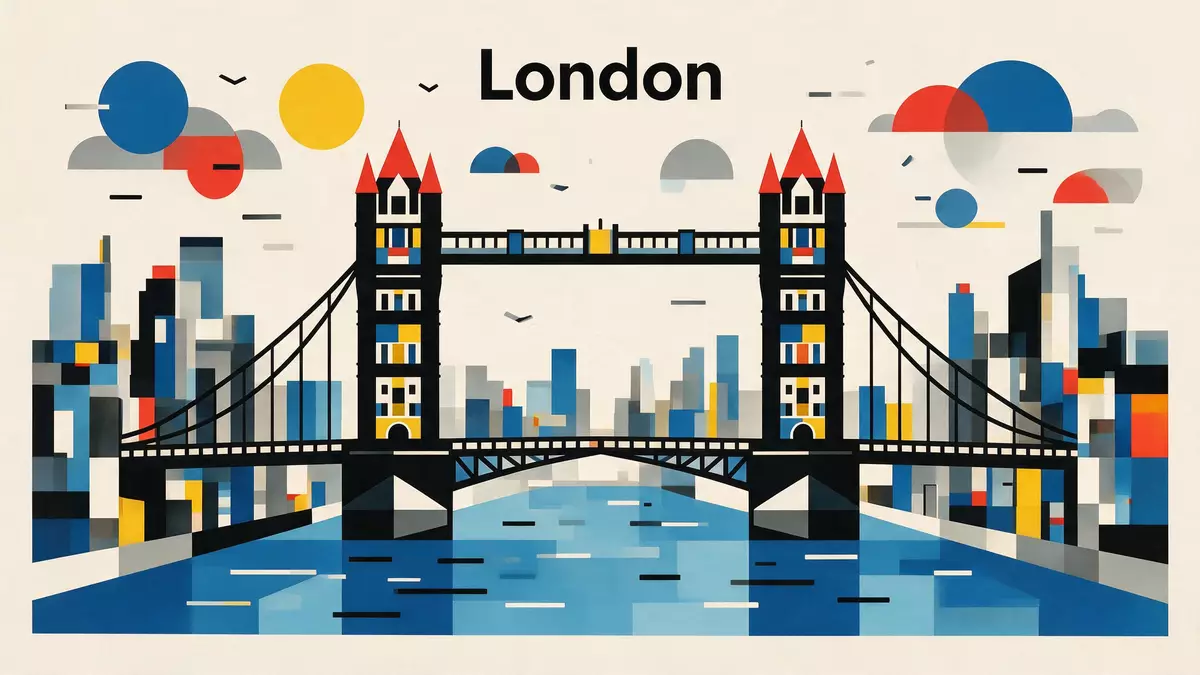
Few structures convey London’s relationship with the River Thames as clearly as Tower Bridge, the paired stone towers and moving roadway beside the Tower of London that took shape in the late nineteenth century. Built between 1886 and 1894 as a combined bascule and suspension bridge and opened by the Prince and Princess of Wales in 1894, it still carries traffic while its roadway lifts to let ships pass.
Victorian engineering beside the Tower of London
Tower Bridge stands on the Thames just downstream of London Bridge, anchored to the riverbanks next to the historic fortress of the Tower of London. The bridge was commissioned by the City of London in the nineteenth century as a response to growing traffic east of London Bridge, where docks and warehouses lined the river.
The design brings together a movable central span with suspension sections that extend towards the banks, forming a combined bascule and suspension bridge expressed in stone and steel.combined bascule and suspension bridge The overall scheme was developed by the City Architect, Horace Jones, whose Victorian work also included Smithfield Market, with the civil engineer Sir John Wolfe Barry responsible for the structural design.Horace Jones and John Wolfe Barry
Construction, materials and structure
Work began in 1886 and took eight years, finishing in time for the formal opening on 30 June 1894.it took eight years to build Beneath the stonework that most visitors see, the bridge is framed by a large steel skeleton assembled from thousands of tonnes of metal. Concrete foundations support the towers in the riverbed, with steel sections rising to carry the walkways and the machinery for the lifting roadway.
The main roadway is formed of two bascules, large sections that pivot upward from the towers so that vessels on the Thames can pass between them. Historic steam-powered hydraulic machinery once drove these bascules; this has since been replaced by an electro-hydraulic system, while the original Victorian engine rooms survive below as preserved industrial spaces.steam-powered hydraulic machinery Above, high-level walkways span between the towers, giving a separate route across the river when the roadway is raised.
Gothic silhouette and later changes
Although its working parts are iron and steel, Tower Bridge presents itself as a Gothic neighbour to the medieval Tower of London, with stone cladding, turrets and pointed details chosen to echo the older fortress along the riverbank.Neo-Gothic design beside the Tower of London The towers rise above the river with a series of recesses, balconies and projecting elements, while the suspension chains and lattice girders stretch away to the landward sides.
In the twentieth century the operation of the bridge shifted from steam to electric power, with an electro-hydraulic system introduced in the 1970s to raise the bascules.electro-hydraulic system introduced The structure received Grade I listed status in the 1970s, recognising its historical and engineering significance, and the high-level walkways later reopened with added viewing features that look down onto the traffic and water below.Grade I listed status and walkway changes
Visiting Tower Bridge: what travellers from Western Europe should know
- Tower Bridge crosses the River Thames just east of London Bridge, connecting the northern bank near the Tower of London with the southern bank in the district of Southwark.
- Approaching the bridge on foot involves stairways and sloping pavements on both banks, and the internal routes in the towers include additional flights of stairs.
- The official language is English and the currency is the pound sterling.
Searching for Tower Bridge on social platforms
These links open searches for Tower Bridge on each platform.Frequently asked questions about Tower Bridge
Where is Tower Bridge located in London?
Tower Bridge crosses the Thames close to the Tower of London, linking the City of London on the north bank with Southwark on the south bank.
What should visitors expect when crossing Tower Bridge?
Visitors see stone-clad towers, steel suspension elements and views along the Thames, with traffic using the roadway and the possibility of the bascules lifting for river vessels.
What makes Tower Bridge distinctive among London’s bridges?
The combination of moving bascules, high-level walkways and a Neo-Gothic stone exterior over a steel frame gives Tower Bridge a character unlike the city’s other river crossings.


