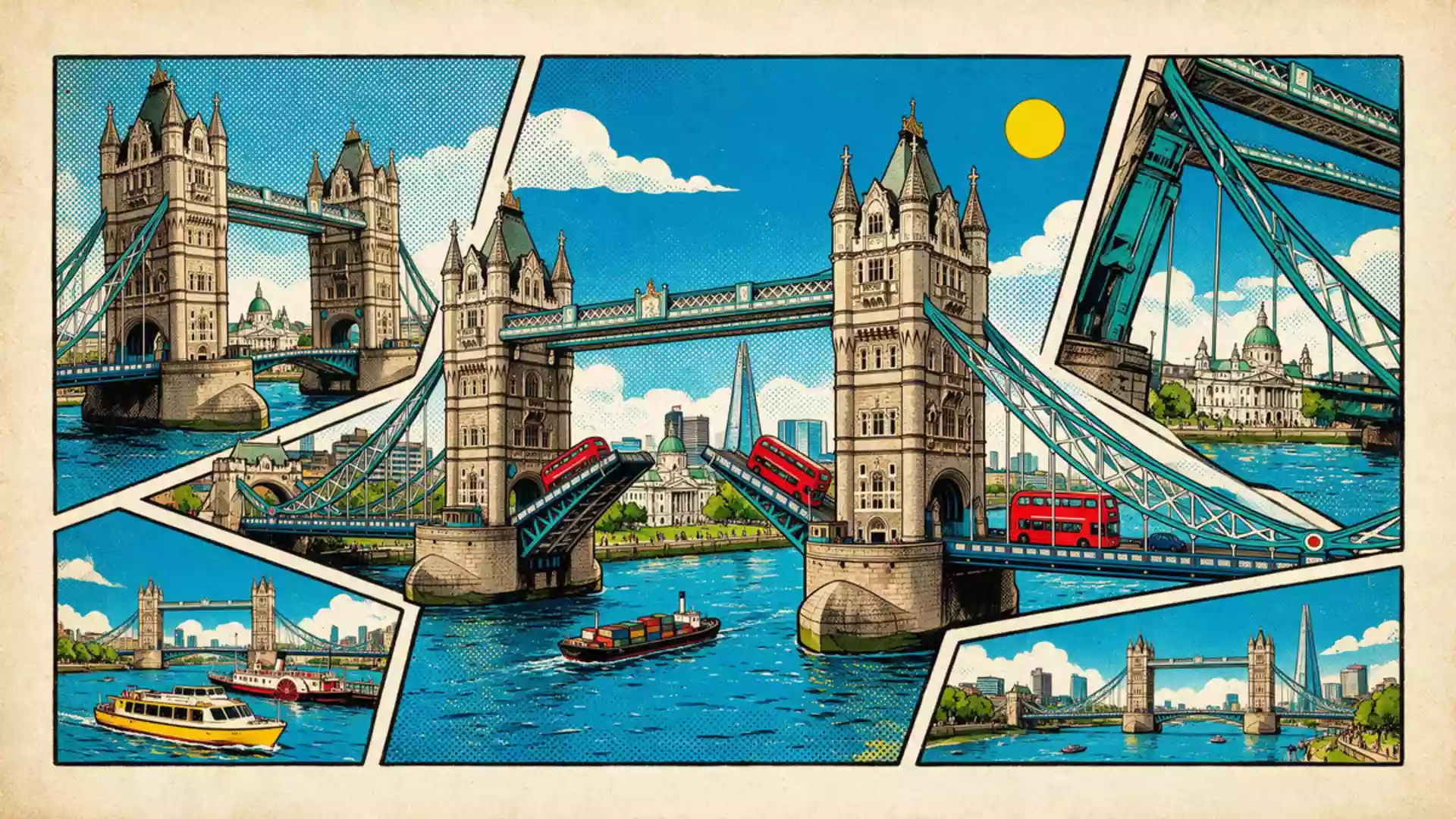
Tower Bridge and its steel-framed Gothic silhouette over the Thames
Published on 08/29/2026 at 20:46 | Editorial responsibility: Rafael Müller, Editor-in-Chief AD HOC NEWS
Tower Bridge spans the River Thames beside the Tower of London, combining a steel-framed roadway with Gothic revival stone towers that frame one of London’s most distinctive river crossings. Built between 1886 and 1894 to designs by architect Horace Jones and engineer John Wolfe Barry, it presents a bridge that is as much vertical architecture as horizontal span.
A Victorian hybrid of bascule and suspension
Tower Bridge carries a roadway across the Thames using more than one structural system, a direct response to the need for a crossing that could keep river channels open to tall ships while taking road traffic across the water. From each bank to the main piers the approaches are formed as suspension spans, with steel chains and links carrying the deck towards the central towers.bascule structure with two towers Between the towers, the central roadway divides into paired bascules that can pivot upwards, creating a gap through which river vessels can pass while the towers remain fixed on their masonry piers.suspension roadways and lifting bascules
The bridge’s steel frame is sheathed in stonework shaped into turrets, arches and detailing that echo the medieval fortress next door, tying an industrial-age structure visually to the older riverfront. Under that cladding lies a skeleton of riveted steel trusses, chains and cross-bracing carrying the loads of road traffic and the forces generated when the bascules move. The bascules themselves are balanced around hidden pivots inside the towers and piers, with substantial counterweights helping them move in a controlled arc when raised for shipping.
Designers, dates and the Victorian context
The idea of a river crossing at this point emerged in the nineteenth century as London’s eastern districts grew and existing upstream bridges struggled with road traffic, while the port on the Thames needed unobstructed access for masted ships. The design finally adopted in the 1880s combined the practicality of an opening span with the architectural ambition of tall stone towers and high-level walkways. Horace Jones, serving as City Architect, produced the original architectural scheme, later developed with John Wolfe Barry as chief engineer.built between 1886 and 1894 to designs by Horace Jones and John Wolfe Barry
Construction began in 1886 after enabling legislation and design approvals, with work continuing for eight years before the bridge opened to traffic in 1894.built between 1886 and 1894 and opened on 30 June 1894 The opening ceremony on 30 June 1894 was conducted by the Prince of Wales, later King Edward VII, representing Queen Victoria.opened to traffic by the Prince of Wales on 30 June 1894 Behind the stone façades, the project used thousands of tonnes of steel to form the main spans and towers, reflecting late nineteenth-century bridge engineering while presenting a historicist exterior to match the nearby Palace of Westminster and other Gothic revival landmarks.
The towers, walkways and river setting
The most striking elements of Tower Bridge are the pair of towers rising from masonry piers in the Thames, each carrying the machinery for the bascules and supporting the suspension chains that reach back towards the banks. Above roadway level, high-level walkways link the towers, giving an additional crossing route and contributing to the bridge’s layered silhouette against the river skyline.twin towers with suspension links and high-level walkway spanning the Thames The whole structure runs between substantial abutments on the north and south banks, with the north bank anchored beside the Tower of London and the south bank reaching into the riverside streets of what is now a mixed commercial and residential district.
From the roadway, travellers see the stone detailing at close quarters: sculpted cornices, traceried openings and turreted corners that frame views along the Thames. From a distance, particularly from upstream and downstream promenades, the combined form of suspension spans, towers and walkways stands as a layered composition of horizontal and vertical lines. River traffic passes beneath the side spans when the clearance is sufficient; when taller vessels approach, the central bascules can be lifted to create an open channel between the towers.
Visiting Tower Bridge: what travellers from Western Europe should know
- Tower Bridge stands over the River Thames immediately downstream of the Tower of London, linking the northern bank near the City of London to the district of Southwark on the southern side.
- The bridge carries a roadway with pedestrian footways, and its towers contain interior spaces reached by lifts and staircases; approaches on both banks involve standard urban pavements rather than long rural paths.
- London is reached by air and rail from Western Europe through several major airports and termini; from central districts, Underground and bus routes converge near the Tower of London for access to the bridge area.
- The bridge sits at river level, so there is no sustained hillside ascent, but within the structure the vertical circulation between roadway and high-level walkways uses enclosed stairs and lifts.
- The official language is English and the currency is the pound sterling (GBP).
Searching for Tower Bridge on social platforms
These links open searches for Tower Bridge on each platform.
Frequently asked questions about Tower Bridge
Where is Tower Bridge in relation to central London?
Tower Bridge crosses the Thames just east of the historic core of the City of London, beside the Tower of London and facing Southwark on the opposite bank.
What should travellers expect when visiting Tower Bridge?
Travellers encounter a working road bridge with pedestrian footways, tall Gothic revival towers, and the layered structure of suspension spans, bascules and high-level walkways above the river.
What makes Tower Bridge distinctive among London bridges?
Tower Bridge combines a bascule opening span with suspension approaches and steel-framed Gothic stone towers, creating a multi-level structure that connects Victorian engineering directly to the Thames beside a medieval fortress.